
From Three-Hour Sleep Shifts to a Startling Discovery
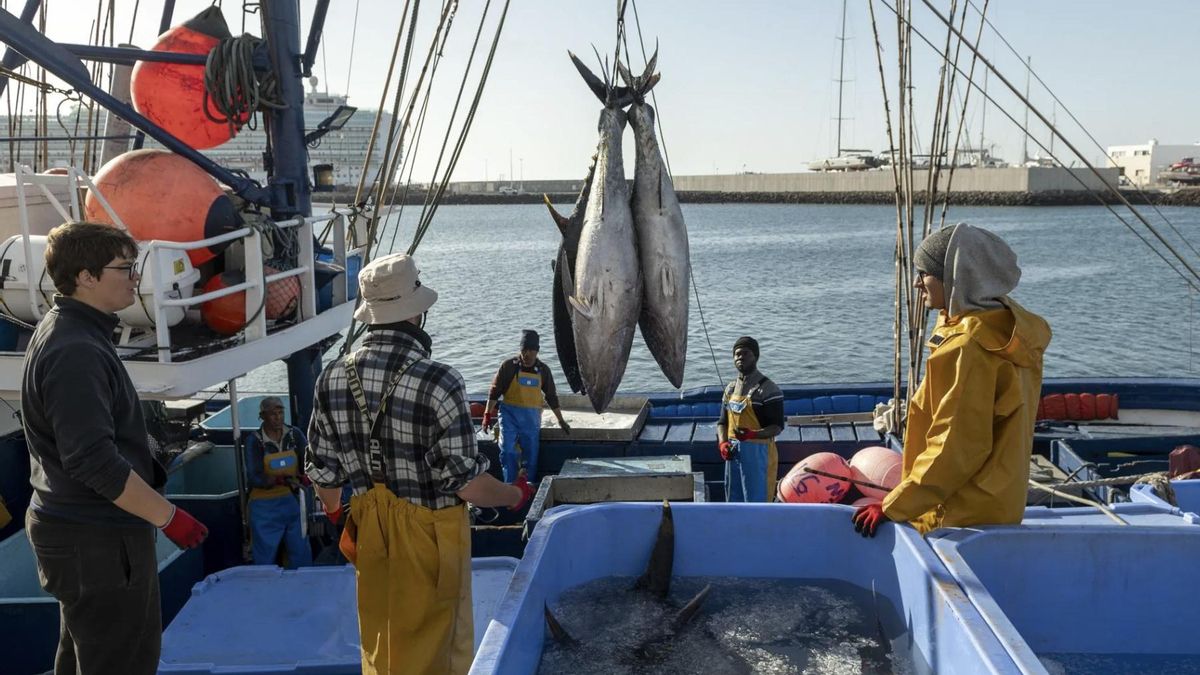
Santiago González, 49, answers the phone during one of his first days off since the red tuna season began in late January. He is an artisanal fisherman in the north of Lanzarote, home to Spain’s largest marine reserve covering 70,700 hectares. He says he is finally relieved, having endured many days with just three hours of sleep to catch the prized fish, unload, and continue working. It is his vocation. For twelve years, he has dedicated himself solely to this. Catching red tuna is not his main work—he has a small quota of five or six specimens—but he loves it. Despite the infernal pace, he lives it “like a holiday.”
The Mysterious 48% Catch Collapse
A few years ago, González and other workers in the artisanal fishing sector of northern Lanzarote went to the Canary Islands Government’s Directorate-General for Fisheries to report a very noticeable decline in their catches. They went from recording peaks of over 400 tonnes between 2018 and 2020 to just 210 tonnes in 2023, a 48% drop affecting species like hake, alfonsino, wreckfish, and blackspot seabream. He and his colleagues were convinced sharks were to blame.
Sharks in the Crosshairs
They practice what is known as ‘deep-sea fishing’, an artisanal method in waters between 200 and 800 metres deep, conducted over complex seabed areas like slopes or seamounts. The technique involves setting a hook and using traditional hand lines or electric reels to bring the fish to the surface. It is during this ascent that the sharks intercept the hooked fish, the fishermen alleged. “As soon as you hooked a fish, it [the shark] was on it immediately,” laments González about the mako shark, a “super bad and opportunistic” shark in his opinion that “gets everywhere and bites without being hungry.” “Since I cast two or three lines and catch several fish, they position themselves underneath and don’t let me do anything,” he adds. Some workers estimated these shark encounters had caused catch reductions of up to 80%. For them, the conclusion was clear.
Scientists Board the Boats
The regional government’s Directorate-General for Fisheries relayed the concern to the University of Las Palmas de Gran Canaria (ULPGC) to investigate if this was indeed true. Researchers from the University Institute ECOAQUA boarded vessels of the artisanal fleet based in the ports of Caleta de Sebo (La Graciosa) and Órzola (north Lanzarote) between July 2022 and June 2023 to evaluate 317 fishing operations. The result of these shark encounters was anecdotal: they only recorded two clear cases of predation by them. The catch collapse was not due to sharks, but to something else.
The Climate Connection Unveiled
The scientists compiled historical landing data from 2006 to 2023 and climate data for the same period associated with an atmospheric pattern, the North Atlantic Oscillation (NAO). This measures the difference in atmospheric pressure between the Azores High and the Icelandic Low. One ECOAQUA member, biologist Jos Juan Castro, had already spent many years investigating the correlation between this climate phenomenon and its impact on marine species, notes David Jiménez-Alvarado, also a ULPGC researcher, so the hypothesis was present from the start. They analysed other variables like El Niño, ocean temperature, and acidification. But with the NAO, they found a correlation that perfectly matched the historical catch series.
How the NAO ‘Switch’ Controls the Ocean
“The NAO functions as a natural switch that modulates wind strength in the Atlantic. It is a key pattern regulating winter weather in Europe, the Mediterranean, and eastern North America,” explains María Dolores Pérez, a researcher at the ULPGC’s IOCAG institute. In its positive phase, it intensifies the trade winds, increases Saharan upwelling, and cools surface waters. In its negative phase, the trade winds weaken and water temperature tends to rise, creating a warmer environment.
A Perfect Match With an Eighteen-Month Lag
Statistical analyses by ECOAQUA researchers revealed a strong correlation between NAO variations and catches in the northern Lanzarote artisanal fishing sector, with a small lag of 8 to 18 months—the time it takes for fish larvae to grow (or not). The negative NAO between 2014 and 2017 favoured an exceptional boom of multiple species. But the shift to a positive phase immediately afterwards coincided with marked drops in landings from 2021, returning records to levels seen before the fishing bonanza (just under 250 tonnes per year).
Why Fishermen Pointed the Finger at Sharks
The findings were recently published in the journal ‘Marine Environmental Research’. The publication also includes results from a survey of 26 artisanal fishermen, revealing that 30% of them directly blamed shark predation for their catch reduction, while only 7.7% attributed the drop to overfishing. “Imagine you have a trend of 100 tonnes of annual catches, but a period arrives where you jump to 500 and, after two or three years, you return to 100. For them [the artisanal fishermen], that drop has been a drama,” points out Jiménez-Alvarado, the study’s lead author. “In those years when they were catching so much, they didn’t care if sharks took some catch. Now that they have started catching less, that interaction annoys them even more.”
Warm Water Winners and Losers
In this case, the effect on the ecosystem is particular. A positive NAO is usually good news for the fishing sector: increased wind favours the upwelling of nutrient- and oxygen-rich deep water, boosting fish presence. However, this process cools the ocean’s most superficial layer, especially off the coasts of Fuerteventura and Lanzarote. The deep-sea species fished in the north of Lanzarote, like hake, alfonsino, or wreckfish, were favoured by the warmer waters during the years of negative NAO. The heat benefited them. But when the NAO changed to its positive phase and the water cooled, their larvae began to find it much harder to survive.
Temperature Dictates Survival
“Water temperature conditions the life of fish, from larval survival to reproduction, growth, and longevity. Depending on the species, it can produce greater (or lesser) larval survival and, therefore, condition the number of adult fish there will be years later. But the system works differently for each of them. Tropical species, like the parrotfish, are favoured by warm water. But more boreal species, like mackerel, suffer higher mortality,” explains Castro.
A Future of More Positive NAO Phases
Climate projections from the Intergovernmental Panel on Climate Change (IPCC) suggest the NAO will tend to become increasingly positive if humans continue emitting greenhouse gases. “This implies that positive winter NAO extremes will be up to 35% more common in the future and that in summers there will also be more extremes, both positive and negative,” indicates Dolores Pérez. How this will affect the fish, however, is another question.
The Complicated Reality of Overfished Stocks
“It is very difficult to know. Not only does temperature influence it, but also the starting situation. Overfishing in Lanzarote is very intense and that already sets the bar very low. If populations are very depleted, even a favourable environmental situation cannot recover them. We have seen this with octopus, a species that responds quickly to changes and which, theoretically, has great resilience. With fish, the situation is more complex,” responds Castro.
A Call for Climate-Informed Fishing Management
The academic work he signed with other scientific colleagues concludes that traditional fisheries management tools are no longer sufficient in the face of climate variability. It recommends integrating indices like the NAO to “create early warning systems based on climate forecasts. That would help fishermen anticipate periods of low productivity and adjust their fishing strategies.” Facing a changing ocean, “if something happens suddenly… we must be prepared to know why,” stresses Jiménez-Alvarado.

Iberdrola plans Tenerife’s biggest battery storage plant

The wild canary that gave its name to the Canary Islands

Canary Islands sea hits second-hottest year on record

Legal bid to halt tree felling in Santa Cruz’s La Salud

Fiesta del Charco: A journey through La Aldea’s past

Corralejo dunes power line set for removal

ULPGC launches 14 research projects at Las Canteras

TMT will never be built, says Canary Islands astrophysics chief

Pedro Duque: Canarias is the “ultimate dream” for rockets
