
Nature as identity: the Canary Islands’ biocultural bond
Life in the Canary Islands cannot be understood without nature. Not just the external view that describes the islands as a paradise, but the perspective of the islanders themselves, who identify with their landscape. A concept born in indigenous territories describes this feeling of attachment to the environment felt by inhabitants of places that harbour a large number of species found nowhere else on Earth, such as the Canary Islands. The term ‘biocultural diversity’ puts a name to the feeling of children who grow up near the sea, of women who recognise themselves in the cardón cacti of Tenerife after years of walking past them on the way to the greenhouses, or of those who are moved by the sight of a guirre bird soaring over the Famara cliff. The destruction, disappearance or transformation of this natural wealth therefore impacts the wellbeing and identity of the community.
As botanist Atteneri Rivero explains: ‘The landscape is a mirror, and we Canary Islanders recognise ourselves in our plants. Many of the places that make us unique because of our endemic species have been destroyed and turned into something completely different. We stop going to these places because we no longer feel comfortable there.’ This phenomenon is clearly visible in the south of the islands, where the tourism model has taken precedence over diversity, replicating the same scene along much of the archipelago’s coastline: large hotel complexes, foreign food outlets, souvenir shops and intense human pressure on the ocean.
A coastline under siege: tourism’s relentless march
The report ‘SOS Canary Coastline’, produced by the Canarina Foundation and the Sustainability Observatory, reveals that the Canary Islands loses a kilometre of coastline every three months, and points to touristification as the main driver of coastal devastation. Yet the archipelago remains home to dozens of endemic species of flora and fauna.
In the case of plants, ‘our original source is the neighbouring continents,’ explains Rivero. ‘Different species arrive from the mainland to the islands, either through the digestive tracts of birds, on the wind, or floating in the water. Some plants establish themselves here and, having to adapt to such a different, volcanic island environment, they create entirely new species that do not exist anywhere else in the world,’ says the biologist, who is from Tenerife. Examples include the Tajinaste del Teide, which grows only on the summit of Tenerife; the sea daffodil, found in some parts of Lanzarote and Fuerteventura; and the cardón, a plant exclusive to the Canary Islands.
From near-extinction to recovery: restoring what was lost
Just as the islands host a vast catalogue of unique species, they also shelter many endangered ones. Some have been rescued thanks to restoration projects. Such is the case of the La Palma broom (Genista benehoavensis). ‘Of this plant from La Palma, fewer than ten individuals remained,’ says Rivero. ‘Today there are about 14,000 specimens that can be seen all across the island’s summit.’ The same has happened with the Guanche rose (Bencomia exstipulata), which has gone from 20 to 4,000 individuals.
On the other side of the balance are species and habitats in a critical state. For the Canarian biologist, a clear example is the cardonal-tabaibal community. ‘We are at the point where we can still manage to preserve it before it is too late,’ she insists. ‘It is not just the cardón and tabaiba plants, but a host of associated species. The monoculture of tourism, based on coastal exploitation, is completely destroying it and building something entirely artificial on top. If we lose the tabaiba, we do not just lose a botanical species of incredible interest, but a Guanche name and an identity,’ the expert stresses.
The ocean: a hidden world of wonder and threat
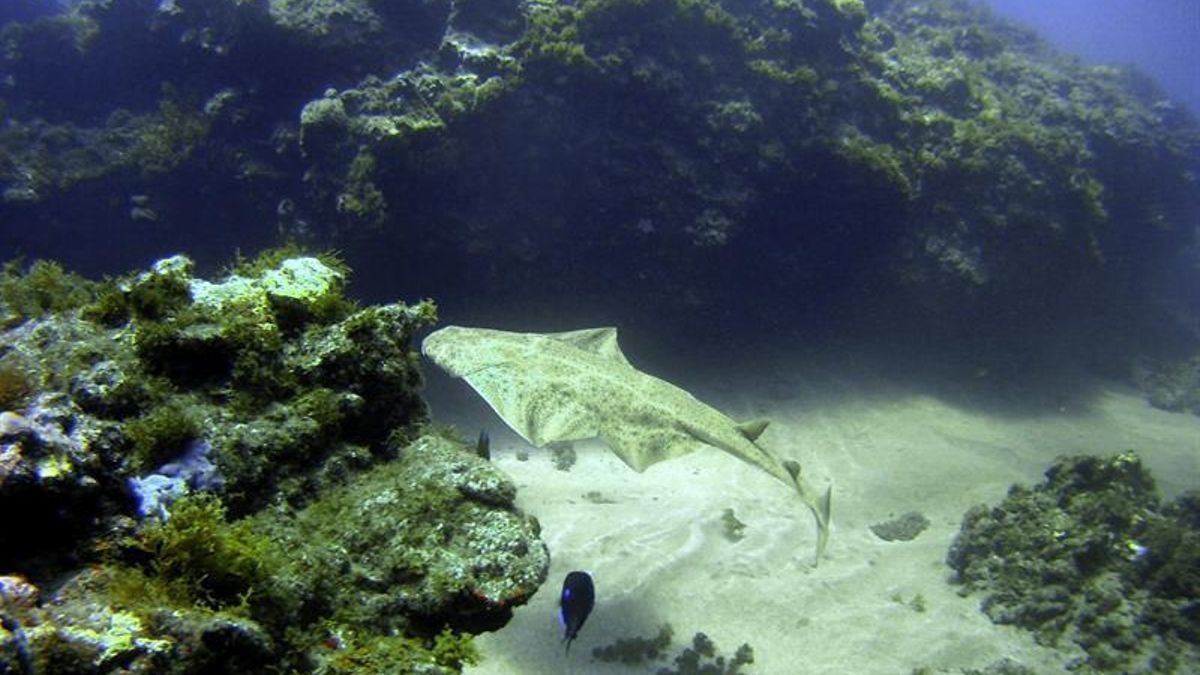
The natural wealth of the Canary Islands extends from the land to the sea via its sky. The archipelago’s ocean is home to hundreds of species, such as tropical pilot whales, the critically endangered angel shark, rays, sharks including the common eagle ray, and the largest aggregations of mobula rays in the world. ‘At certain times, more than 200 mobula rays have been counted on a single beach between summer and early autumn,’ explains Felipe Ravina, a documentary filmmaker and science communicator. Like terrestrial biodiversity, the sea is a key element of Canarian identity.
Through his work, Ravina seeks to bring the public closer to all the values hidden beneath the surface, as well as the pressures and threats they face. ‘I try to make sure that part of that identity we think about includes the fact we have angel sharks, pilot whales, mobula rays, and that people look after them and defend them because they are ours,’ he stresses.
The sperm whale, according to the documentary filmmaker, is one of the most critically endangered species at present. ‘It is estimated that in recent years, half the population in the Canary Islands has been lost due to collisions with high-speed vessels, and no effective measures have been taken,’ he states. In June 2025, two specimens were found dead off the coast of Tenerife. The necropsy concluded that a clean cut more than two metres long on the head killed one of them ‘in a matter of seconds or minutes.’ The results of the report attributed the death to ‘a severe sharp-force cranial trauma, compatible with near-immediate death from collision.’
Overfishing and pollution: a sea under pressure
Overfishing is also decimating the seabed. ‘Although professional fishing has declined in recent years, the number of licences for recreational fishing is increasing exponentially, and on top of that there is poaching,’ details Ravina. ‘The seabeds have neither the time nor the space to breathe or recover from the 60 years of overfishing we have subjected them to,’ he warns.
Add to this the uncontrolled use of illegal vessels and jet skis in protected areas, the discharge of untreated wastewater into the sea (with 403 discharge points in the Canary Islands, 216 of which are illegal) and a lack of resources for surveillance.
Nevertheless, strategies do exist to protect and preserve this wealth. For the scientist, the best example is the marine reserves, such as La Graciosa and the Northern Islets, or the Mar de Las Calmas. ‘You can see how simply regulating fishing can achieve great changes,’ he insists. He also references the Angels Shark Project research initiative, which has made it possible to collect scientific data on the species across the archipelago and thus protect it. ‘It is a major victory achieved thanks to science,’ he concludes.
The guirre: a bird slowly escaping extinction
In the air, the guirre — a subspecies of Egyptian vulture endemic to the islands — is slowly trying to escape extinction. It has suffered a significant decline over the last 50 years, with the loss of between 70% and 90% of its individuals in the Canary Islands, and is therefore classified as critically endangered. It now only nests on Fuerteventura, Lanzarote and Alegranza. The main threats to the guirre are accidents with power lines, disturbances during nesting, habitat modification, and poisons.
However, although the species was expected to disappear within a few decades, a glimmer of hope has emerged in recent years. In 2025, 519 specimens were detected across the islands. This year, two new breeding territories have been recorded on Lanzarote, and in 2021, just after the coronavirus pandemic, the guirre returned to nest in Timanfaya National Park for the first time in decades. The Government of the Canary Islands has announced that this confirms the species’ incipient recovery on the island.
In a statement, Walo Moreno, a field technician who has been studying the guirre on the ground for fourteen years, explained that in the early part of the year, the birds spend almost the entire day choosing the cave they will use for breeding, bringing material to the nest, and strengthening their bond through joint flights and frequent mating. ‘The guirre’s productivity rate is around 40%: out of every ten monitored pairs that start breeding, only four successfully raise a chick,’ he added. Incubation lasts 42 days and is the most delicate stage. The noise of motor vehicles, loose dogs and other human activities cause disturbances that have fatal consequences: the birds abandon their nest.
Surveillance and protection are enabling the guirre population on the island to recover by 30 to 40 new individuals each year, but public cooperation is key. ‘Let us respect the signs, stay on the marked trails, and enjoy nature in silence,’ the experts urge. According to them, if people respect the spaces where the guirre nests, seventy days after hatching, the chicks can be seen flying across the skies of Lanzarote with their parents.
What’s happening in the Canaries – straight to your phone
News, weather alerts and practical updates – direct from the islands, in English. We live here and know what’s going on – before the international media catch up. Everything lands on our WhatsApp channel – no middlemen, no algorithm. Curated for families, expats and travelers.

Canary Islands sea hits second-hottest year on record

Legal bid to halt tree felling in Santa Cruz’s La Salud

Fiesta del Charco: A journey through La Aldea’s past

Corralejo dunes power line set for removal

ULPGC launches 14 research projects at Las Canteras

TMT will never be built, says Canary Islands astrophysics chief

Pedro Duque: Canarias is the “ultimate dream” for rockets

Court blow to Tenerife motor circuit project
La Palma faces new volcanic risk planning deadline
