
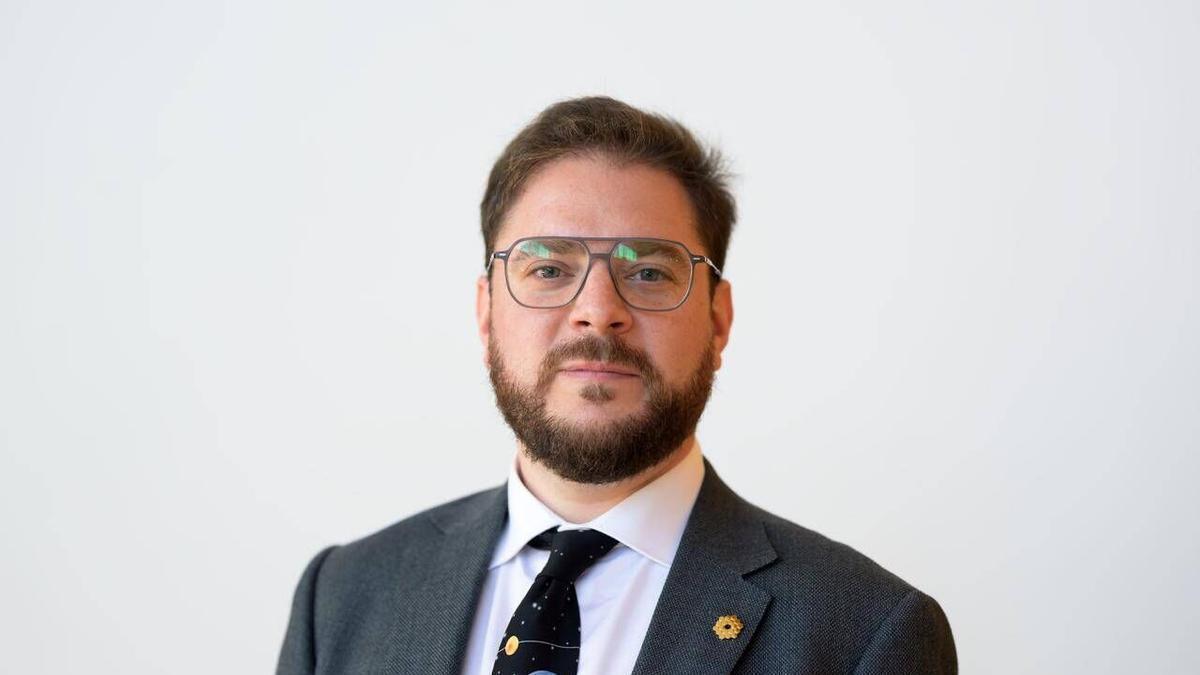
A lover of the cosmos and a devotee of the Canary Islands. That is how one might describe Rafael Luque (born in Córdoba, 1993), who has become one of Spain’s most promising young scientists — a status confirmed by his recent award of the Princesa de Girona Research Award. The prize, he admits, came as a surprise, but it arrives at a sweet spot in his career.
A childhood dream, realised in the islands
Luque, who now works at the Institute of Astrophysics of Andalusia (IAA) in his native region, was one of the exoplanet hunters trained in the Canary Islands. Although he left the archipelago almost five years ago, he cannot forget the five years he spent there completing his PhD. His time in the islands allowed him to fulfil a “childhood dream”, achieved through perseverance, determination, and a natural talent for science.
“It happened in my hometown, Priego de Córdoba. They ran an introductory astronomy course there when I was about 11 or 12, and I saw Saturn for the first time through a little yellow telescope the teacher had. That image stayed with me for a long time. When I turned 15, I got to know that teacher and shared observations with his telescope. I spent my teenage nights out in the Andalusian countryside observing and learning with him.
“I also really loved physics and maths, and when I first encountered astrophysics, it was a dream come true.”
First contact with research
Luque’s first hands-on research was actually in galaxies. “I got a summer scholarship that took me to Mexico in 2013. There I worked with researcher Fabián Rosales, studying star-forming regions in galaxies. That work continued through my undergraduate thesis.”
As for exoplanets, it was a stellar physics professor in Germany — at the University of Heidelberg, where Luque did his master’s — who recruited him to analyse data from the Carmenes project, based at Calar Alto in Almería. “Being from the area, I knew the project; it was cutting-edge and extremely powerful.”
The pull of the Canary Islands
“My dream was always to do my PhD at the Institute of Astrophysics of the Canary Islands (IAC). My admiration for the Canarian observatories goes back a long way, and I always tried to end up there. I took a year off my degree to study at the University of La Laguna, taking optional modules only available there. Then I tried to spend several summers in the islands, some with scholarships, and I did external placements at the IAC. I always tried to be in the Canary Islands as much as possible, and thanks to a La Caixa Foundation scholarship, I succeeded.”
“They gave me the freedom to do my own research, and because I wanted to continue what I had started in my master’s, I chose my supervisor, Enric Pallé, to work on exoplanets at the IAC. They were five wonderful years. The Canary Islands are part of my life, and it always feels like home.”
Life in Tenerife and rugby with the ULL
“I know the island quite well, and above all I remember watching my daughter grow up there in Tenerife — she’s a ‘lagunera’. And that wonderful time, with the chance to go to the mountains or the sea, and to climb Mount Teide… So many friends still live there, and I can’t fail to mention my teammates from the ULL rugby club. I played with them for years; we trained and travelled together for the Canarian league. They were unforgettable years, without a doubt.”
Luque left the Canary Islands in mid-2021. “Since then, apart from a short period in the United States, I joined the Institute of Astrophysics of Andalusia (IAA) in Granada last summer.”
The best observatories in the northern hemisphere
“For me, the best — and most accessible — observatories in the northern hemisphere are undoubtedly in Tenerife and La Palma. I’ve spent countless nights observing at both, and I know them well. I have enormous affection for them, even from my university days when we went up to Teide for practical sessions with smaller educational telescopes.”
“I love observing, going to the observatory and working there in person, although it’s true that since Covid there are fewer and fewer opportunities to do so. We no longer take our own data as often; it’s taken for us.”
A dream for La Palma: attracting the TMT
“Without doubt, one of the country’s greatest scientific achievements would be to attract the TMT to La Palma and to make the Roque de los Muchachos Observatory the most important in the northern hemisphere.”
Astronomical tourism and the Colorados complex
“Very early in my career, together with my colleague Miguel Gil, we founded a non-profit association, Turismo Astronómico, dedicated to astronomy outreach. At first, it was a travelling initiative. We went wherever we were asked, with our telescopes, which often meant doing observations, courses and talks in the squares of small villages in rural Andalusia.”
“But our dream was to stop being itinerant. For us, the best skies in the province of Granada are in Gorafe, which is also where we started our outreach activities. So Miguel Gil, Miguel Ángel Pugnaire and I managed to found this observatory in 2022. It is an observatory dedicated solely to teaching astronomy and to amateur-professional collaborations. It’s called the Complejo Astronómico de los Colorados, because it is located in the Desierto de los Colorados, in the heart of the Granada UNESCO Global Geopark.”
“We are running at full capacity, doing lots of projects, both outreach and amateur-professional scientific collaborations. We contribute with our small telescopes and with the enthusiasm of a beginner.”
The search for water worlds and life beyond Earth
Luque’s research focuses on sub-Neptune exoplanets. “This type of planet doesn’t exist in the Solar System, but they are the most common type in the galaxy. We believe that these sub-Neptunes, at least for other types of stars different from the Sun, are actually water worlds, with up to half their weight being water. But we still don’t know whether these sub-Neptune-type planets around stars like the Sun could be water worlds.”
“With the project we are developing, thanks to a Starting Grant from the European Research Council, we want to prove that sub-Neptunes, under the right conditions, contain liquid water and could be candidates for harbouring life. With the instruments available today, we could study in a different way whether we are alone in the Universe.”
“The precursor instrument, the small-ELF, will be available shortly. I think I recently saw a photo showing that the mirror structure was almost ready. It’s a very interesting project and is precisely one of the reasons I study sub-Neptunes.”
Observing with the James Webb Space Telescope
“We can already observe sub-Neptunes. If they have large amounts of water, and if they are candidates for harbouring life, with the James Webb Space Telescope, which is already operational, we can study their atmospheric composition. For a planet like Earth, orbiting a star like the Sun, we cannot do this yet. We need new technologies, like ExoLife Finder, or projects like the Habitable Worlds Observatory or LIFE from the European Space Agency. We need new telescopes. They have to be built, developed, and technology pushed to levels not yet reached.”
An unexpected but deeply cherished award
“I didn’t expect the Princesa de Girona Award, but I did dream of it. It was the dream of that kid who carried a telescope everywhere and wanted to do his PhD in the Canary Islands to become an astrophysicist and then research from his homeland, Andalusia. I didn’t expect it, but if you know the rules of the game, more or less, you can prepare and train yourself, trying to educate yourself in the best possible way, so that when these opportunities and calls come, you are ready.”
“I really encourage anyone who wants to pursue a scientific career to do so. It’s not a question of talent, but of perseverance and passion. Although you might call it meteoric, I would define it better as a marathon. I can’t deny that I’ve been lucky with some discoveries that we didn’t expect. You need a pinch of luck, but it has to find you working.”
World-class research in Spain
“In Spain, we do first-rate research. If we were given a little more support, and above all better conditions to stabilise our positions, it would be even better.”
What’s happening in the Canaries – straight to your phone
News, weather alerts and practical updates – direct from the islands, in English. We live here and know what’s going on – before the international media catch up. Everything lands on our WhatsApp channel – no middlemen, no algorithm. Curated for families, expats and travelers.

Canary Islands sea hits second-hottest year on record

Legal bid to halt tree felling in Santa Cruz’s La Salud

Fiesta del Charco: A journey through La Aldea’s past

Corralejo dunes power line set for removal

ULPGC launches 14 research projects at Las Canteras

TMT will never be built, says Canary Islands astrophysics chief

Pedro Duque: Canarias is the “ultimate dream” for rockets

Court blow to Tenerife motor circuit project
La Palma faces new volcanic risk planning deadline
