
Formal Negotiations on Airport Management Begin
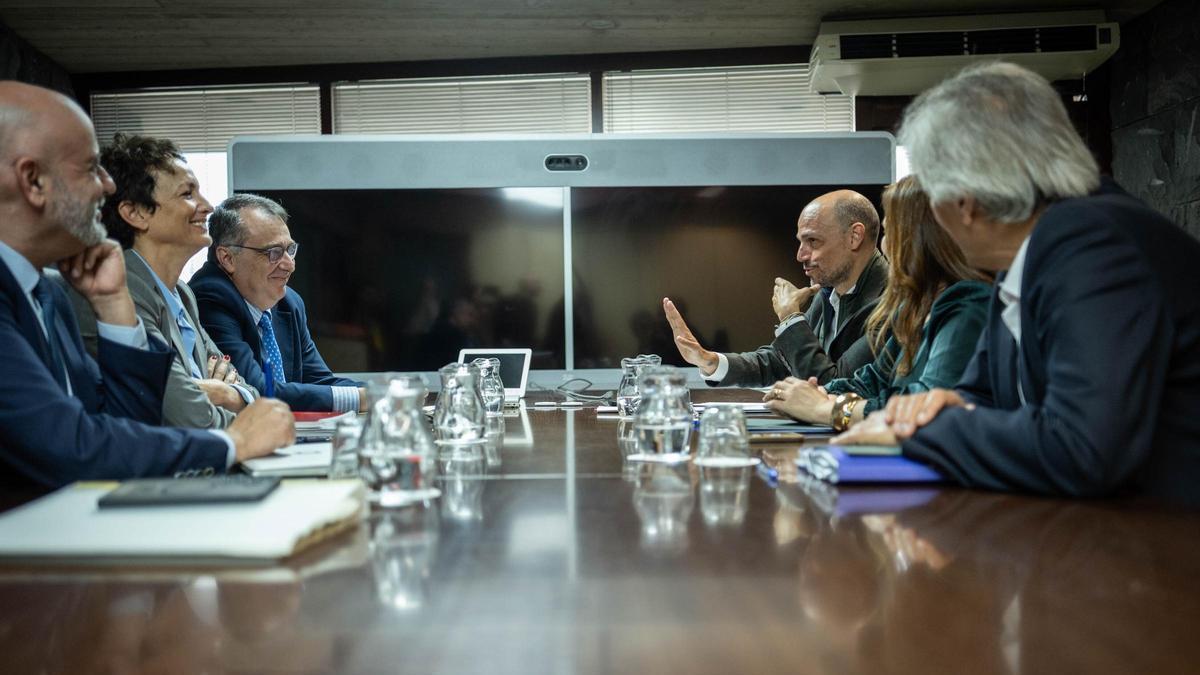
There was no slamming of doors, no veto, and no red lines. The Spanish state and the Canary Islands opened a formal channel of negotiation this Friday in Tenerife regarding participation in the management of the archipelago’s airports. This is a long-standing political demand that the government of Fernando Clavijo had raised to the highest level in recent weeks and which, for the first time, is now firmly on the bilateral agenda between the two administrations. This is the principal political outcome of the meeting held at the Presidency headquarters in Santa Cruz de Tenerife, where the Spanish and Canarian governments signalled a change in tone after days of open friction over the role of airport operator Aena in the Islands.
A New Optimism After Weeks of Friction
“There is a willingness to reach an agreement,” stated the Secretary General for Territorial Coordination, Miryam Álvarez, at the end of the meeting. “We are sure that at the end of the negotiations we will be better off than we are now,” emphasised the Minister of the Presidency, Nieves Lady Barreto. To dispel any doubt, the Deputy Minister of the Presidency, Alfonso Cabello, assured that after the meeting “we are optimistic,” especially because in the coming weeks the Ministry of Transport, led by Óscar Puente, will send a document to the ministry led by Pablo Rodríguez, which Barreto described as “the basis for starting negotiations.”
This optimism was also echoed by the Minister of Territorial Policy, Ángel Víctor Torres, who hours after the meeting expressed his certainty that “an agreement satisfying both parties can be reached, always within the Constitution and the Statute of Autonomy of the Canary Islands.” He stated, “Today that commission has been established, representatives of the Government of Spain have sat down with those of the Government of the Canary Islands and now the exchange of documents and positions will begin.”
Opening the Debate on Shared Control
The meeting did not settle on a model, nor did it specify how far the Canary Islands might go in their aspiration to have an effective presence in decisions concerning their eight airports. However, it did leave something politically relevant: the central government accepts opening the debate, exchanging documentation, and beginning a technical and legal negotiation to explore formulas for the archipelago’s participation in airport management. “Today we have opened a path, and from now on the co-management of airports is on the agenda of both governments, with the goal of starting to work and make progress,” assured the Minister of the Presidency.
“The Government of the Canary Islands is obliged, and it is necessary for it to do so, to express its maximum aspirations to have a voice and a vote, but the Government of Spain is also obliged to comply with the legal framework. However, there is confidence that we will reach agreements,” stated the Secretary for Territorial Coordination.
Contrast With Recent Institutional Clash
This optimism contrasts with the climate of institutional clash that had dominated recent weeks. The conflict intensified after the agreement sealed at the Moncloa Palace with the Basque Lehendakari, Imanol Pradales, allowing the Basque Country to participate in the management of its three airports. The Canary Islands reacted by invoking Article 161 of its Statute of Autonomy and also demanding a “voice and vote” in strategic decisions affecting its airport infrastructure. On this point, Torres reiterated that with the Basque Country, “a bilateral body where the Basque Government participates was agreed, but there is no co-management of the airports.”
Underlying the process is an idea that both parties avoided verbalising excessively but which now looms over it: if there was room to design a unique formula for the Basque Country, the Canary Islands aspire for there to also be room for a territory where air connectivity is not just strategic, but vital. The most acrimonious moment in recent weeks occurred on 9 April, when President Clavijo called for the dismissal of Aena’s chairman, Maurici Lucena, accusing him of defending shareholders’ interests more than public interests, especially those linked to the Canary Islands.
Faced with that scenario, Friday’s meeting represented a shift. Both sides chose to reduce tension, channel the dispute, and place it on legal and technical ground. Álvarez emphasised that the negotiation starts with a defined framework and with the imminent incorporation of the Ministry of Transport and Pablo Rodríguez’s ministry into specific meetings that must define the scope of the future understanding.
Other Key Issues on the Table
The technical commission also addressed other open issues between the two administrations: the Canary Islands’ claim regarding fiscal control of incentives under the REF (Special Economic and Fiscal Regime) and the request to extend the deadline for executing European funds linked to the energy transition. The claim of the regional government, also supported by the main energy and business organisations in the archipelago, is to extend the current calendar, which ends in July 2026, until 31 December 2028. The goal is to gain leeway to complete key energy transition projects and avoid leaving a portion of these resources unused.
The concern is significant. If this extension does not go ahead, the Canary Islands could see around €200 million from the Recovery and Resilience Mechanism (RRM)—the central instrument of the NextGenerationEU funds with which the European Union drives economic recovery and ecological and digital transformation—put at risk. Minister Barreto stressed that the intention of the Canarian executive is to “execute the funds to the maximum” and admitted that an extension would allow reaching “a much higher level of execution.” However, she recalled that for now no decision has been made, although there is a shared concern about the deadlines, especially given the extension allowed for the Institute for Energy Diversification and Saving (IDAE) for funds linked to the energy transition. This precedent strengthens the position of the Canary Islands, which insists it needs more time to ensure the use of these strategic resources.
The meeting, however, did not serve to make progress on another matter that the regional government has open with the state: the fiscal control of incentives under the REF. The issue was not addressed in the meeting and remains pending a response from the Ministry of Finance to the documentation sent by the Canarian cabinet. The regional government considers this waiting period logical following the departure of María Jesús Montero and the appointment of her replacement, Arcadi España.

Bomb threat on Vueling flight triggers Gran Canaria airport security operation

Cruise to Canaries cancelled after collision in port

Tenerife tram delays worsen amid staff shortages

Titsa adjusts night bus times for clock change on Tenerife

Night roadworks to disrupt TF-1 traffic from Sunday

Public service obligation for Canary inter-island flights announced

Iberia accused of ejecting passengers from paid seats

Tenerife announces six months of TF-5 resurfacing works

Canary Islands close to historic airport management deal
