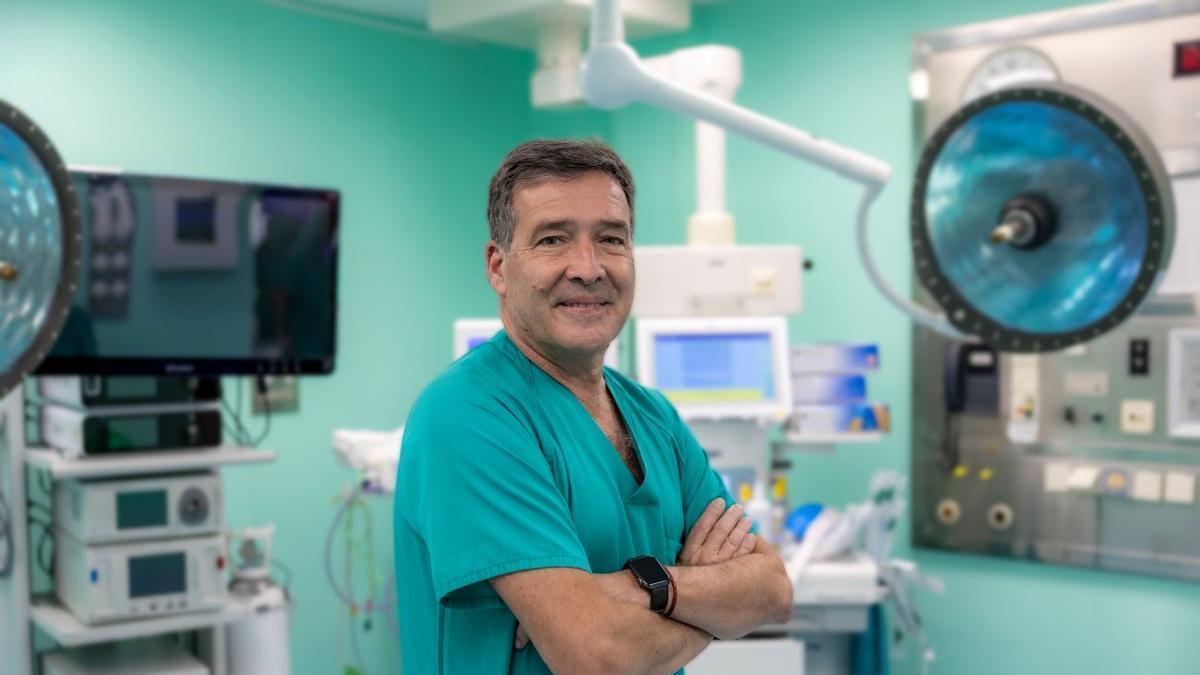
New surgical frontier at Hospiten Rambla
Hospiten is making strides in adopting techniques that enable the treatment of complex tumours, some of which were previously considered inoperable. The Da Vinci Xi robotic platform integrates 3D technology (CELLA) and fluorescence-guided surgery, allowing surgeons not only to view a three-dimensional image but to work directly on it, perform the surgery virtually and establish different resection margins around the tumour, ranging from one to five millimetres.
Virtual planning for real precision
Dr Manuel Barrera Gómez, head of the General and Digestive Surgery Service at Hospiten Rambla University Hospital, explains: “This allows us to determine whether a tumour is affecting major vascular structures and whether prior treatment, such as chemotherapy or radiotherapy, is necessary.” He adds: “We have the image to work on, we can plan the surgery with different types of margins, and even navigate through the vascular structures to see if they are affected from within.”
Fluorescence guidance during surgery
The integration of fluorescence-guided surgery is particularly valuable during the procedure itself. This technique includes a series of programmes and sensors capable of detecting a dye, helping surgeons confirm that the margins have adequate blood supply to proceed with the operation, whether laparoscopic or robotic.
Advantages of the Da Vinci Xi system
“The advantages of using Da Vinci Xi technology mean we know in advance that the oncological surgery will be effective for removing the tumour. It also helps us determine, before the operation, whether prior treatment is needed to shrink the tumour and achieve appropriate margins,” notes Dr Barrera Gómez.
Tackling the toughest tumours
The use of these techniques also makes it possible to approach tumour surgeries that were extremely complex to perform using conventional methods. Dr Barrera Gómez states: “This technology is essential for tumours affecting the pancreas or liver, such as retroperitoneal sarcomas, or very low rectal tumours. In all these cases, precision is vital because the difference between a margin of one or two millimetres is crucial to whether the tumour can be removed.”
From virtual model to patient care
The technology has significant potential for pre-operative planning. It also enables the creation of a physical 3D model, which can be used to explain to patients exactly how the surgery will be carried out. Hospiten continues to reaffirm its commitment to patients and to the implementation of innovative technology for better management of complex surgeries.
About Hospiten
Hospiten is an international healthcare network with over 55 years of experience, dedicated to providing the highest quality service. It operates 20 private hospitals and medical centres in Spain, the Dominican Republic, Mexico, Jamaica and Panama, as well as 175 outpatient clinics under the Clinic Assist brand. Founded by Dr Pedro Luis Cobiella, the network treats more than three million patients from around the world each year and employs over 5,000 people. This care is set to be strengthened in the Madrid region with the construction of a general hospital in Boadilla del Monte, expected to open by the end of 2026.
MD Anderson Cancer Center Madrid – Hospiten
MD Anderson Cancer Center Madrid – Hospiten is an affiliate of the prestigious MD Anderson Cancer Center in Houston, Texas (USA). With more than twenty years of history in Spain, MD Anderson Madrid – Hospiten currently has a Phase I Clinical Trials Unit, over 150 medical specialists trained in oncology, a total of 87 inpatient beds, and state-of-the-art technological equipment for the diagnosis and treatment of different types of cancer.
What’s happening in the Canaries – straight to your phone
News, weather alerts and practical updates – direct from the islands, in English. We live here and know what’s going on – before the international media catch up. Everything lands on our WhatsApp channel – no middlemen, no algorithm. Curated for families, expats and travelers.

Tenerife faces huge tourism expansion despite moratorium calls
El Bejeque in Las Canteras adds sea to its fire

Siam Park Gran Canaria must build its own desalination plant

Fuerteventura’s biggest resort to open on 1 November

Gran Canaria to teach tourism history in schools

Canary Islands see 0.3% rise in foreign tourists in August

Row over 368-bed hotel project in La Gomera
Spanish astronaut trains in Lanzarote for Moon mission

Tivoli La Caleta hosts first red tuna Kaitai in Canarias