
Military advances on the Canary Islands’ doorstep
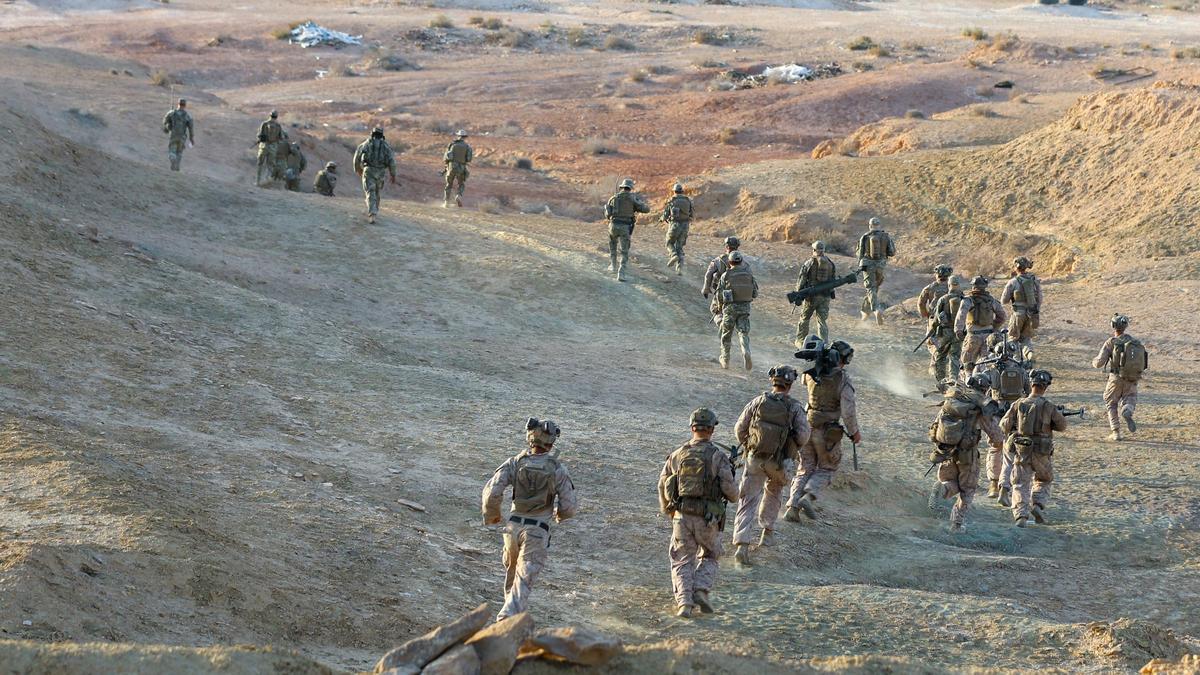
The United States has pushed ahead with a major African military training and drone centre just 300 kilometres from the Canary Islands, as part of a defence cooperation memorandum signed with Morocco for the period 2026-2036. Located in Tan-Tan, on the Atlantic coast, the complex aims to become the continent’s primary military training hub and is expected to be operational before 2030.
Implications for migration
For the Canary Islands, the implications go well beyond the purely military sphere. “In terms of migration flows, it could lead to greater control – or, on the contrary, to a lack of control if Morocco, backed by Washington, decides to stop monitoring the departure of small fishing boats and makeshift vessels heading for the Canaries,” explains Frédéric Mertens, an expert in International Relations at the European University.
One scenario gaining ground is the fact that relations between Donald Trump and Pedro Sánchez’s government are not at their best, and “migration has already been used as a pressure tool against Spain,” the expert adds.
A key location for African Lion drills
Tan-Tan – which is also very close to the Sahara – is, moreover, one of the main locations for African Lion, the largest military exercises organised by the United States Africa Command (AFRICOM), which take place off the coast of the Canary Islands. The most recent edition involved more than 10,000 military personnel from 20 different countries.
The growing US military presence in North Africa once again places the Canary Islands in a strategic position, both for Spain’s defence and for NATO’s security framework on its southern flank.
A decade-long defence deal
As for US-Morocco cooperation, it was formalised a few months ago with the signing of a military cooperation agreement that includes, among other provisions, the acquisition of American equipment by Rabat. “Now it’s necessary to help the North African country so it can use those weapons effectively,” stresses Mertens.
Washington continues to bolster its presence in Africa, particularly following the waning influence of historical powers such as France and the United Kingdom, and the growing prominence of China and Russia on the continent. “Trump is trying to take whatever he can from China, because Beijing is enemy number one – more than Iran, more than Russia or any other country. If China moves into certain African nations, obviously Trump will want to do the same.”
All these moves on the international geopolitical chessboard have a particular impact on the Canary Islands, due to their geographical proximity.
What the new centre will include
The major African centre will be made up of three main areas: a military training space, a drone academy, and an innovation and experimentation hub. It is a veritable laboratory in the defence sector, combining military training, instruction in unmanned systems, and the development and testing of new defence technologies.
Morocco’s key role in migration routes
Beyond the strictly military domain, the strengthening of US-Morocco cooperation raises the question of what real impact it may have on the migration route to the Canary Islands. Rabat plays a key role in controlling departures from the Atlantic coast, and any change in its security cooperation strategy could have repercussions for this route. The evolution of these moves will now depend on the decisions Morocco takes in coordination with Washington.
A geopolitical message from the Sahara
Another striking aspect of the project is its location, close to the Sahara. The choice of site also sends a geopolitical signal to the region. “It is a way of curbing threats to stability and strengthening an area stretching from the Sahara to Libya. Many interests converge there, both for Morocco and for the United States, which are seeking to increase their cooperation and reinforce stability across the entire region,” warns Mertens.
What this means for Spain
For Spain, these military advances could represent “a threat” that requires close attention. The proximity between the two countries and the Canary Islands’ position as Spain’s main southern frontier make the archipelago a particularly sensitive territory: “Anything that could happen in the Canaries would affect the whole of Spain.”
What’s happening in the Canaries – straight to your phone
News, weather alerts and practical updates – direct from the islands, in English. We live here and know what’s going on – before the international media catch up. Everything lands on our WhatsApp channel – no middlemen, no algorithm. Curated for families, expats and travelers.

Canary Islands sea hits second-hottest year on record

Legal bid to halt tree felling in Santa Cruz’s La Salud

Fiesta del Charco: A journey through La Aldea’s past

Corralejo dunes power line set for removal

ULPGC launches 14 research projects at Las Canteras

TMT will never be built, says Canary Islands astrophysics chief

Pedro Duque: Canarias is the “ultimate dream” for rockets

Court blow to Tenerife motor circuit project
La Palma faces new volcanic risk planning deadline
