Defiant message on Canary Islands Day
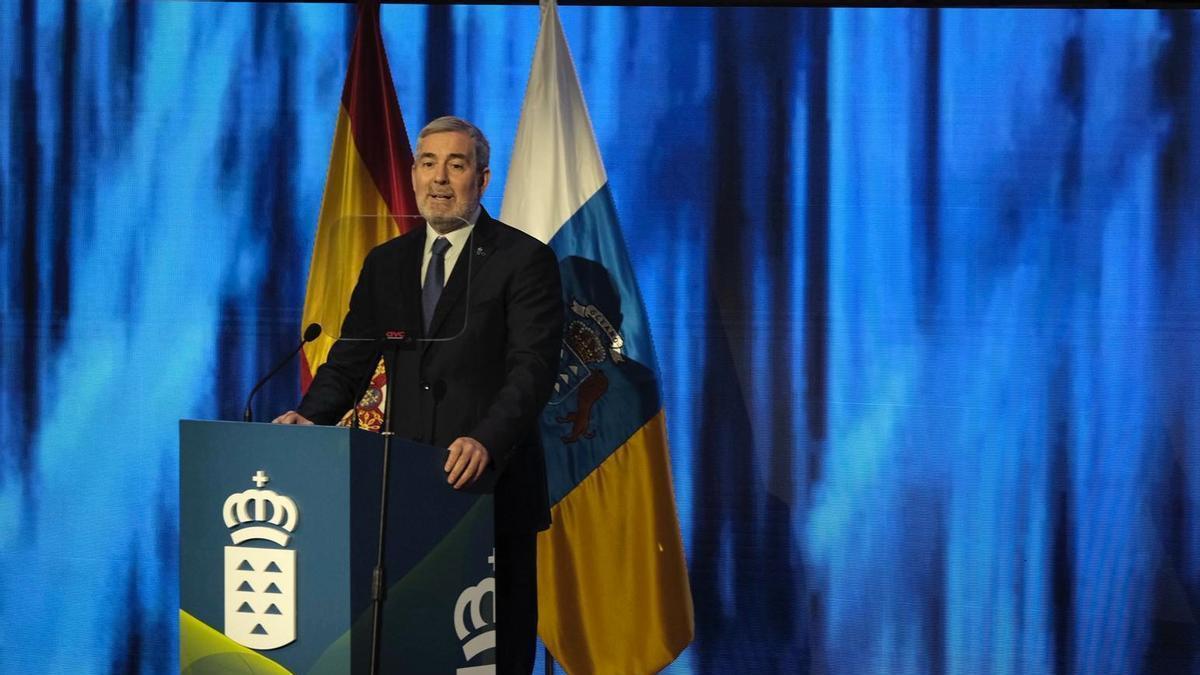
The Canary Islands “are a land of solidarity that will not take lessons from outside, because it decided long ago to speak for itself”. With that underlying message, inspired by the institutional crisis that erupted with the Spanish state over the handling of the MV Hondius cruise ship carrying passengers affected by hantavirus earlier this month, President Fernando Clavijo delivered a speech of political and emotional affirmation at the official Día de Canarias (Canary Islands Day) ceremony this Saturday, 30 May. The archipelago knows what it is, he said, and does not need anyone to tell it otherwise.
An appeal for unity in uncertain times
The president crafted a strongly political address, the most defiant in recent years, built on a sense of nationhood, the defence of identity and the need for unity in a political and economic climate he described as uncertain, difficult and fraught with threats to the islands. “Every international crisis, every war, every tension in the markets, every decision made far from our islands has very concrete consequences for the daily lives of our people,” he said. But he warned that the archipelago “is a land that extends its hand as long as it finds respect in return, but will not tolerate shoves and impositions”.
Along those lines, the president presented unity as an essential condition for confronting challenges coming from Europe, from the Spanish state and from an increasingly unstable international context. “We are sailing through an ocean that is sending us clear signs of a coming storm, and it would be irresponsible not to prepare to weather it,” he added.
Identity as a force for the future
In this context, Clavijo appealed to identity as a tool for the future. “The Canary Islands have made progress when they have been clear about their place, when they have defended their accent, when they have protected their symbols, when they have looked at the world without complexes,” he said, later adding that “our identity is not nostalgia, but strength”. A strength that changes with each generation, he explained, but which maintains a constant affirmation: “Here there is a people who recognise themselves, who care for themselves, and who want to remain masters of their own destiny.”
From that premise, Clavijo gave political depth to the ceremony’s motto, ‘We are the Heritage of the Canary Islands’, by arguing that the true heritage of the islands lies in its people. “The people are the ones who have built the Canary Islands with their work, their talent, their commitment, their daily effort, and also with that very Canarian way of never giving up when things get tough,” he said.
Focus on Europe, Spain and global threats
The regional president linked the current moment to a global scenario marked by wars, economic tensions, paradigm shifts and decisions taken far from the archipelago that ultimately impact the daily lives of its citizens. He first turned his attention to the European Union’s Multiannual Financial Framework and the threat of cuts to EU social cohesion policies and aid for productive sectors. For Clavijo, this is not just another budgetary discussion, but a matter of territorial justice. “What is at stake is ensuring that Europe continues to understand that the Canary Islands are not asking for privileges, but for justice,” he said. The islands’ status as an outermost region (OR), he reminded the audience, is not an administrative label but a daily reality that makes it more expensive to produce, transport, live and compete from islands located in the middle of the Atlantic.
The president also turned his gaze towards Spanish politics. Without naming names, he offered a harsh diagnosis of the state’s institutional climate, noting that “the situation of political crisis in Spain does not exactly contribute to providing stability and certainty for our land”. In his view, “short-sighted tactics, the pursuit of narrative over results, constant bickering and a vacuum in management have become the norm, and it is impossible to make progress like that”.
This context, he warned, forces the Canary Islands to strengthen its own voice, because “it falls to us, once again, to defend ourselves alone and demand the respect that our people deserve”. The phrase connected with the president’s central message: the Canary Islands cannot depend on outside circumstances or become trapped in state-level partisan squabbling when its rights, funding, public services or ability to compete on equal terms are at stake.
Honouring Canarian achievement
For this reason, Clavijo linked the Premios Canarias and Medallas de Oro (Canary Islands Awards and Gold Medals) to a vision of a plural, creative, supportive and critical nation. He highlighted: the solidarity of the Fundación Canaria MAIN; the ironic and critical humour of José Luis Padilla Morilla, known as Padylla; the modernity without forgetting tradition in the work of architect Fernando Martín Menis; the sense of belonging to one’s homeland as expressed by singer Braulio; the social commitment of Fernando Berge Royo; the empathy shown by the Casa de Galicia in Las Palmas de Gran Canaria; the sporting strength of Juan Espino Dieppa; the business roots of Ron Arehucas rum; and the civic, democratic and egalitarian legacy of Pedro Zerolo.
He also praised the humanity of Ámate, the educational and cultural footprint of Antonio López Bonillo, the defence of traditional clothing by María del Carmen Almenara, the spirit of service of the nursing colleges, the values of the ‘In Corpore Sano’ sports club, and the living tradition of the Danza de las Cintas (Ribbon Dance) of Güímar in Tenerife. All these careers, the president said, confirm that the Canary Islands “create, care, compete, innovate, conserve and support”.
A special mention for the young
Clavijo made a special reference to the islands’ youth, crediting them with ensuring that Canarian identity has not been interrupted, even though it now expresses itself through different languages, rhythms and codes. For the president, when young people defend their accent, talk about their island, their neighbourhood or their street, or become indignant because they feel this land is not being respected or cared for as it should be, they are saying that “the Canary Islands are loved, respected and defended”.
Conclusion: a future on its own terms
In closing, Clavijo called for a Canary Islands that “does not resign itself to being anyone’s periphery and that does not accept its difficulties being used as an excuse to limit its rights”. To meet that challenge, he asked for “more unity, more responsibility and more self-confidence”. “The Canary Islands have a future, yes, but only if they continue to be the Canary Islands,” he concluded.
What’s happening in the Canaries – straight to your phone
News, weather alerts and practical updates – direct from the islands, in English. We live here and know what’s going on – before the international media catch up. Everything lands on our WhatsApp channel – no middlemen, no algorithm. Curated for families, expats and travelers.

Two tonnes of illegal tropical fruit seized at Tenerife port

Canary Islands approves new €1.6bn development fund
Mogán mayor says her €65,000 salary is too low

Abandoned cars in Canary Islands: hundreds left to rot
Work resumes on 27 affordable rental homes in Las Palmas
Los Realejos residents fight on against propane gas plant
Canarias among Spain’s poorest regions as 36.2% live on low incomes
Canary Islands bananas lose ground to imported bananas
Canary Islands bottom of Spain’s social housing table