
Key step to end wasted renewable energy
“It’s crucial, it was necessary.” That’s the verdict of Mariano Hernández Zapata, the Canary Islands Government’s Councillor for Ecological Transition and Energy, on the creation of a remuneration framework for renewable energy storage systems. The issue at hand is the significant amount of clean megawatt-hours that are currently being thrown away. Last year, 15% of all renewable energy generated in the archipelago was wasted, rising to as high as 20.3% on Gran Canaria. Every gap left unfilled by renewables had to be plugged with conventional, polluting power generation.
Rapid growth in wind power, but storage lags behind
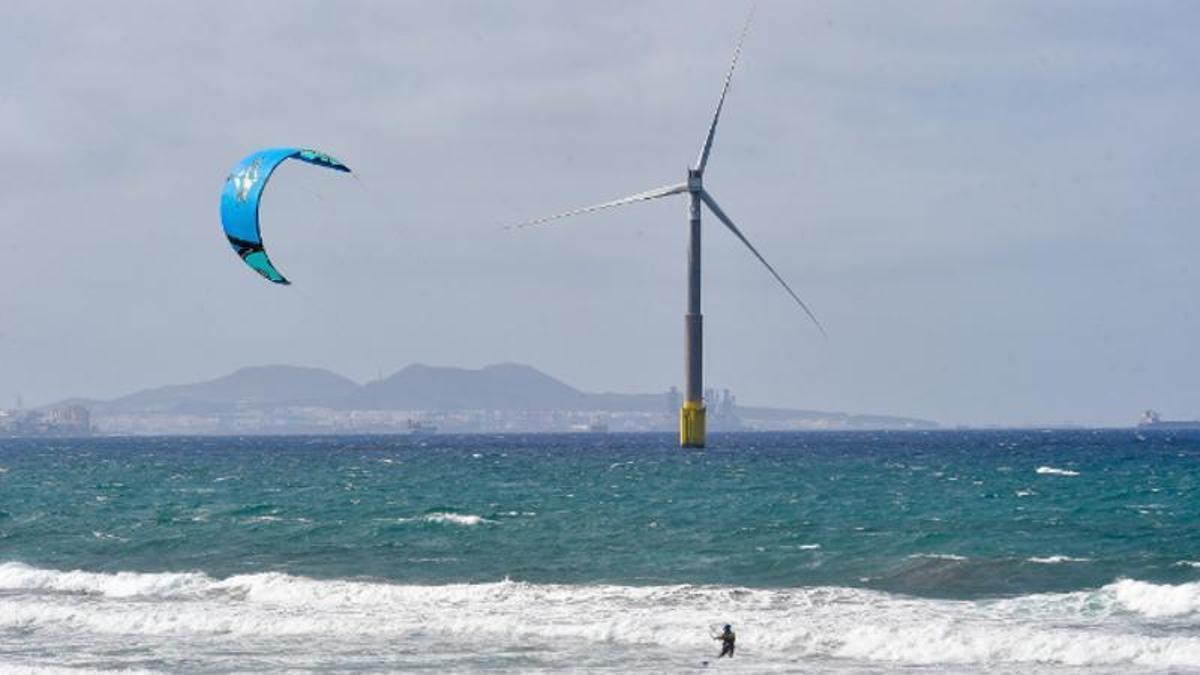
The proliferation of wind farms since 2018 has pushed installed renewable capacity in the islands above 30%. However, when you look at the generation map, barely 22% of actual demand is met by renewables. The problem is that the system can only use the energy that is demanded—no more, no less. At night, when homes and businesses have their lights off and the wind is blowing strongest, the power that turbines could supply is squandered. To prevent this, storage infrastructure is needed that can concentrate those megawatt-hours and release them when required.
Chira-Salto and beyond
On Gran Canaria, the Chira-Salto pumped-storage hydroelectric plant will solve a large part of this problem once it enters service. But even on that island, and certainly on the others—a pumped-storage project for Tenerife has just been announced—batteries are essential. And they haven’t been arriving in sufficient numbers because developers did not know how much they would be paid to install and operate them.
Industry welcomes long-awaited clarity
“We have been calling for this for years,” explains Raúl Macías, president of the Canary Islands Wind Energy Association (Aeolican), referring to the remuneration framework whose creation was announced last Tuesday by the Secretary of State for Energy, Joan Groizard, following a meeting with public and private sector representatives from the archipelago. At both Aeolican and ACER (the Canary Islands Renewable Energy Association), technicians are working flat out to understand exactly what the modification of Royal Decree 738/2015—which regulates electricity production and dispatch procedures in non-mainland Spanish electrical systems—holds for this new storage remuneration. Both ACER president Jesús Matilla and his counterpart at Aeolican are guarded about the outcome of that detailed analysis, but they do not hide their satisfaction that a solution is finally being implemented “after many years of discussing the issue.”
How projects proceeded without knowing the price
How is it possible that some players have invested in batteries without knowing what income they would receive? It would certainly be impossible to secure bank financing without a business plan. That leaves public incentives as the only option. In this case, the Recovery, Transformation and Resilience Plan (PRTR), funded by EU money released after the pandemic, stepped in. In November 2023, the Institute for Energy Diversification and Saving (IDAE) awarded 58.4 million euros across 39 projects in the archipelago: 24 on Gran Canaria, eleven on Fuerteventura and four on Tenerife. The tender attracted several of the islands’ major private energy players.
New rules to expand storage options
Until now, the royal decree being amended only covered thermal and renewable generation. It will now be broadened to include batteries attached to thermal and renewable installations (hybridised with conventional and with renewables) and so-called “stand-alone” storage infrastructure, which receives energy from external plants. Another major change announced by the Secretary of State for Energy concerns the price signal, which affects the revenue renewable infrastructure earns. Until now, that signal was based on the average daily price on the mainland Spanish market. After the modification—again to Royal Decree 738/2015—it will be the average annual price.
Pricing model still imperfect, say industry leaders
This change does not fully satisfy the sector’s business leaders, because it still uses the mainland situation as a reference, which has little resemblance to what happens in the archipelago. While all non-renewable energy in the islands comes from thermal power plants, the mainland has access to cheaper technologies. In numbers, this means that clean energy is either generated at €65.28 per megawatt-hour, or at €200–€202 per megawatt-hour while polluting the environment. “We could be saving money for all Spaniards,” says Raúl Macías, referring to the extra cost incurred by non-mainland electrical systems. Jesús Matilla also weighs in on this point, stressing that “one way or another,” the Canary Islands—along with the Balearic Islands, Ceuta and Melilla—are always tied to mainland Spain in an aspect like electricity, where they have nothing in common. “We are not defined by what we are,” laments the president of ACER.
What’s happening in the Canaries – straight to your phone
News, weather alerts and practical updates – direct from the islands, in English. We live here and know what’s going on – before the international media catch up. Everything lands on our WhatsApp channel – no middlemen, no algorithm. Curated for families, expats and travelers.

Canary Islands sea hits second-hottest year on record

Legal bid to halt tree felling in Santa Cruz’s La Salud

Fiesta del Charco: A journey through La Aldea’s past

Corralejo dunes power line set for removal

ULPGC launches 14 research projects at Las Canteras

TMT will never be built, says Canary Islands astrophysics chief

Pedro Duque: Canarias is the “ultimate dream” for rockets

Court blow to Tenerife motor circuit project
La Palma faces new volcanic risk planning deadline
