‘We have a rule: no public fights’
No. We have a golden rule: we do not engage in public fights. That does not mean we avoid the media. When we have something to say, we present new ships, campaigns, or routes. We have an internal marketing and communications department, as well as an external agency. Moreover, in surveys measuring brand awareness and reputation among companies in the Canary Islands, we consistently rank near the top, alongside firms like Binter, Cepsa, and Disa. People know us and value us, not just for moving passengers on holiday or business, but for being there when we are needed. When we are asked for an interview, we make ourselves available. Personally, I have never turned one down. It is another matter entirely to appear week after week saying the same thing when there is nothing new to report.
A new era begins
I completely agree that a new era is beginning. Baleària is a major player in domestic maritime traffic, operating in the Balearic Islands, on the Spanish mainland, and even on international routes to North Africa. Since 2018, we had a partnership with them on the route between Huelva and the Canary Islands. That changed with Baleària’s takeover of Armas Trasmediterránea. That alliance is dissolved, and from 1 June, Fred. Olsen will operate the Huelva-Canary Islands route alone, while Baleària will use Trasmediterránea to run services between Cádiz and the Canaries. On the inter-island routes, the former Naviera Armas is now also under Baleària’s control, so this is a significant shift. Obviously, they will be our competitor on both the mainland-Canaries route and within the islands. But we always try to focus on ourselves first.
Fred. Olsen has been in the Canary Islands for more than 50 years. Our DNA is service, reliability, punctuality, and customer experience. For the Canary Islands, having two strong companies serving a remote and fragmented territory is a good thing. As a Canarian, I welcome Baleària. From there: respect, but it is time to compete. We have been investing in ships, technology, digitalisation, and sustainability for ten years. This new arrival does not change our criteria, policy, or strategy.
Tripling the fleet and pioneering high speed
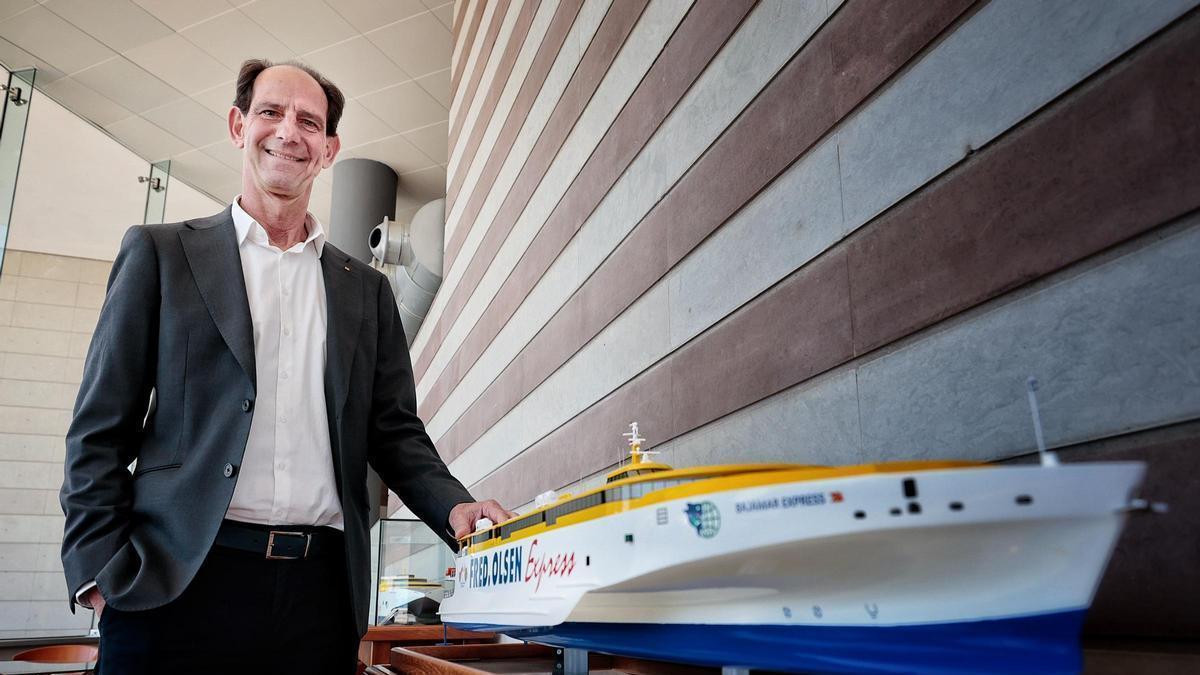
In 2016, Fred. Olsen Express had five ships; in 2026, we have 15. We have tripled our fleet. We were pioneers in Spain from the year 2000 onwards, introducing high-speed vessels capable of carrying passengers, cars, and heavy freight. By 2005, our entire fleet was high-speed. And in 2024 and 2025, we added three ro-ro vessels dedicated exclusively to rolling cargo, introducing purely freight-based inter-island transport in the Canary Islands using specialist ships. Today, we connect Lanzarote, Fuerteventura, Gran Canaria, Tenerife, and La Palma with three cargo-only vessels.
First solo mainland route
Yes. This will be the first time Fred. Olsen connects the mainland with the Canary Islands on its own, using its own ship—the recently refurbished ‘Buenavista Express’. Furthermore, due to the commitments imposed by the National Commission of Markets and Competition (CNMC) on Baleària to authorise the purchase of Armas-Trasmediterránea, they must charter us another ro-pax vessel, the ‘Marie Curi’, until October. Over the summer, we will operate the Huelva-Canaries route with two ships: one of our own and one chartered. From October or November, we will return the Baleària vessel and operate with our own resources. Our intention is to run three or four round trips per week, combining the Buenavista Express with one or two ro-ro vessels—this is still being finalised. In the medium term, we want to acquire a second ro-pax vessel, another passenger and freight ship, to provide that weekly service of three or four rotations with two ships capable of carrying passengers.
A fair hearing from the regulator
I do not know the full file, so I cannot comment on every detail. What I can say is that when a company applies for authorisation for a merger, it must persuade the competition authority that no monopolistic situations or market distortions will arise. The deal was not approved in phase one; it moved to phase two, which means a more in-depth study. If it has ultimately been authorised with conditions, I understand that the CNMC considered them sufficient.
Serving all islands, not cutting back
No. We are a private company and need economic sustainability to survive, but we also know that we provide a public service and that the Canary Islands are a single market. There are routes where we make money and others where we lose it, but that is the nature of the business, and our obligation is to serve all the islands. We will not reduce frequencies because a competitor has arrived. Our customers know us, and they will decide. Our DNA is punctuality, reliability, passenger service, excellence, local Canarian staff, the Spanish flag, and service to the Canary Islands. In 2025, we carried four million passengers, nearly a million vehicles, a million linear metres of freight, and 80,000 pets. People trust us. Why would we cut back? We will continue with our routes, our frequencies, and all our human potential.
Norwegian roots, Canarian heart
Fred. Olsen Express began its maritime activity in the Canary Islands in 1974, but the Olsen family, originally Norwegian, has been in the Canaries since 1904, linked to La Gomera, agriculture, and trade between the islands and northern Europe. The capital is indeed Norwegian and family-owned. There are no external partners, not even non-family foreigners. However, Canarian society considers us Canarian. I am Canarian, 90% of our staff are Canarian, and in the end, people make companies, not capital.
I understand that the Government of the Canary Islands may express concern about such a sensitive sector as transport, because it is vital for us. During the covid lockdown, for example, the islands still had to be supplied. If I had political responsibility, I too would want decisions about strategic companies to be taken here, or at least for those making the decisions to understand the Canarian way of doing things. But the regional government knows that Fred. Olsen has been present in the Canary Islands for more than 120 years, that those of us leading the company locally are from here, and that we have always been at the service of Canarian society. When there has been a fire, we have had a ship ready at 3am. On La Gomera, when there was no airport or heliport, if someone needed to be taken to hospital, one of our ships would set off. We are a private company, but we know we provide a public service.
More than just ferries
There has been interest in Fred. Olsen, and even offers to buy us, but the family remains committed to keeping things as they are. Fred. Olsen S.A. encompasses the maritime division, Fred. Olsen Express, as well as the Hotel Jardín Tecina, Tecina Golf, the Pueblo Don Thomas complex, and several restaurants on La Gomera. The hotel opened in 1987, the inter-island maritime routes began in 1974, and the Olsen family’s international ship agency work in the Canary Islands goes back much further. We are essentially a shipping and hotel company. And we are in the Canary Islands, where tourism and transport are two essential sectors. If tourism represents around 40% of GDP and a good part of employment, adding transport means we are talking about a very significant portion of the economy—around 60% of GDP. We operate in two key sectors for a remote and fragmented archipelago that lives off tourism and services.
‘It would be a mortal blow’
It would be a mortal blow. On this, we are absolutely united: the Government of the Canary Islands, the State Ports Authority, the ports of Las Palmas and Tenerife, and air and sea carriers. The argument is simple, although it must be explained over and over again in Madrid and Brussels: the Canary Islands cannot travel by road or train. The only way we can move between islands or to the mainland is by boat or plane. This is not a privilege; it is a right derived from our remoteness and fragmentation. To move people, we need sustainable prices, and the same goes for freight. The Canary Islands imports a large part of its shopping basket and consumer goods. If transport costs rise, the final price goes up.
The sustainability challenge
The problem is that today there is no real alternative fuel. I can understand penalising those who pollute if they have a clean option available and choose not to use it. But if that alternative does not exist, someone will end up paying the cost of the Emissions Trading System (ETS): the consumer, the passenger, the importing company, or governments through subsidies. The answer is yes, but with many nuances. An electric ship is much slower than a diesel one. Let me give you an example: between La Gomera and Los Cristianos, we have four daily rotations. If we electrify and the ship takes much longer, we might only be able to do two. That halves the available capacity for passengers. Then there is the problem of batteries: how they are charged, with what electricity, and how much space they take up—taking room away from passengers, vehicles, or freight. For very short routes, it could be interesting. In northern Europe, there are electric ferries on trips of just a few miles, with different energy sources. But in the Canaries, given the distances and the need for frequency, it is not a viable solution today. We are in constant contact with engine manufacturers to study alternative fuels such as ammonia or other options, but there is still no real solution for our type of operation.
A world-class transport system
I always say that you have to leave the Canary Islands to appreciate what we have here. The Canaries probably has the best inter-island transport in the world. No other archipelago has Binter, Canaryfly, Fred. Olsen, and now Baleària, with planes and ships departing continuously. Air and sea are complementary. If you need to go and come back very quickly, you take a plane. If you need to take a car or freight, you take a ship. We also have foot passengers, whom we assist with connection services. In terms of passengers, the split is probably around 60-40 or 65-35 in favour of air travel. For freight, obviously, maritime takes practically the entire share. Historically, those percentages have remained fairly stable. The market grows every year, but the proportion tends to stay the same.
Back to pre-pandemic levels and beyond
In 2025, for Fred. Olsen Express as a shipping division, we had a turnover of between 280 and 300 million euros. We have recovered and exceeded the 2019 figures, which were the pre-pandemic benchmark. This growth is not due to a fare increase, but to an increase in market size and activity. In 2024 and 2025, we launched our inter-island freight transport division with dedicated ships, which increased revenue. We also started operating the El Hierro route after Armas’ public service contract between Tenerife and the island ended. Moreover, 2025 was a special year because of the Bajada de la Virgen festival on La Palma and the Bajada de la Virgen on El Hierro, which coincided and generated a lot of movement. But generally speaking, the increase in revenue is linked to more activity, more freight, and new routes—not to making tickets more expensive.
What’s happening in the Canaries – straight to your phone
News, weather alerts and practical updates – direct from the islands, in English. We live here and know what’s going on – before the international media catch up. Everything lands on our WhatsApp channel – no middlemen, no algorithm. Curated for families, expats and travelers.

Canary Islands tourism chief offers dialogue on residentialisation

Canary Islands office helps small councils ditch the peseta

Two tonnes of illegal tropical fruit seized at Tenerife port

Canary Islands approves new €1.6bn development fund

Mogán mayor says her €65,000 salary is too low

Abandoned cars in Canary Islands: hundreds left to rot

Work resumes on 27 affordable rental homes in Las Palmas

Los Realejos residents fight on against propane gas plant

Canarias among Spain’s poorest regions as 36.2% live on low incomes