
Prosecutor calls for immediate halt to coastal works
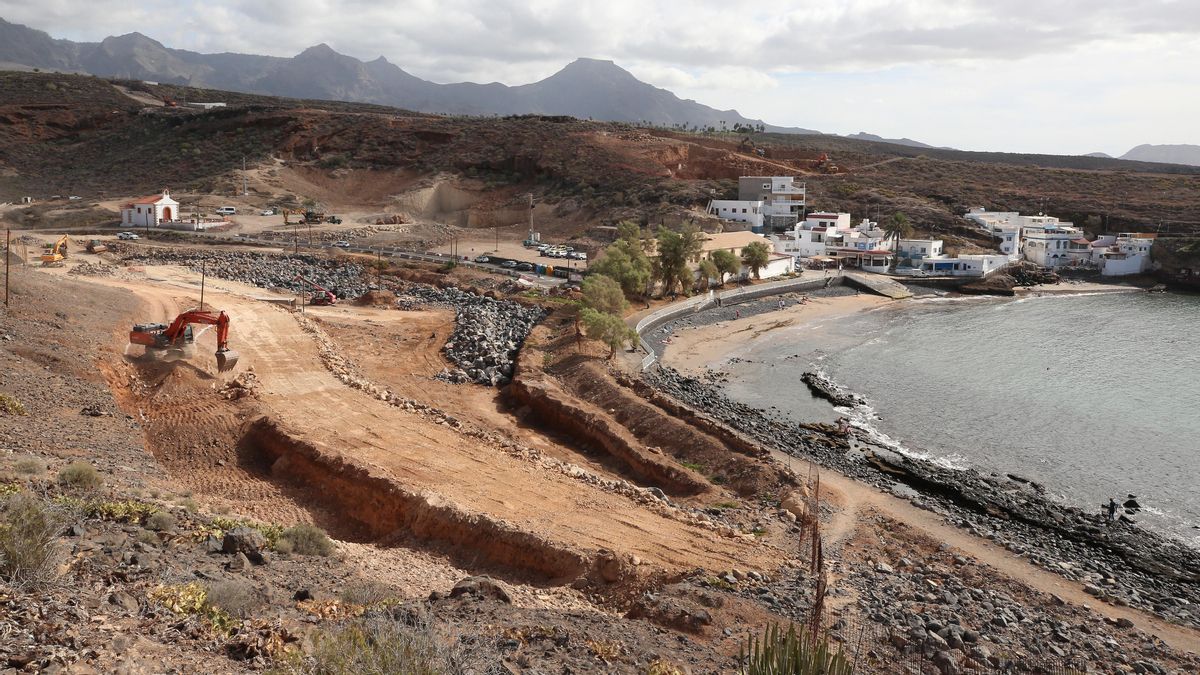
The Public Prosecutor’s Office has requested a halt to construction work that the controversial Cuna del Alma tourism project in El Puertito de Adeje (south Tenerife) is carrying out within the protected coastal easement zone. This is a strip of land extending one hundred metres inland where uses are heavily restricted by the Coasts Law. According to a legal brief from the Prosecutor’s Office seen by Canarias Ahora, prosecutors have asked the judge of the Arona Number One court to provisionally suspend the works the project’s developer is undertaking in that zone to build a swimming pool, a restaurant, and a buggy parking area, among other things. They argue these are uses that could be located elsewhere outside the easement zone and “do not provide a necessary or convenient service for the use of the public maritime-terrestrial domain”.
Judge investigates officials and developers
On 26 March, the judge gave the involved parties five days to present their arguments. The popular prosecution, exercised by the Puertito Libre Cultural Social Ecologist Association, has requested that the suspension be extended to the entire development, according to sources consulted. Furthermore, as requested by the Public Prosecutor, the judge has summoned the head of the Eastern Coastal Planning Service of the Canary Islands Government, Valeriano Díaz, and the legal representative and administrators of the project’s developer, Segunda Casa Adeje SL, to testify as suspects.
The judge has also called, but as witnesses, the head of the Western Coastal Planning Service of the regional government, José David Marín, and the regional technician Francisco Javier Carrancho, from the General Directorate of Coasts and Canary Islands Maritime Space Management.
Legal basis of the complaint
The complaint that initiated the legal proceedings accuses those involved of alleged crimes against spatial planning and the environment, documentary falsification, and misconduct in public office committed during the processing of a project mired in controversy from the outset due to its potential impact on the biodiversity of the archipelago. For several months, however, the only contentious activity under investigation by the judge relates to the works Cuna del Alma is executing within the coastal protection strip, which represent a small part of the total development. Their impact affects 5.25% of plot T2, which is about 45,000 square metres. That is, approximately 2,400 m². The overall plan, however, covers 430,000 m².
Questionable uses in a protected zone
In its aim to build 3,600 tourist beds in one of the last undeveloped areas of southern Tenerife, surrounded by protected natural spaces and sites of geological interest, the developer is constructing a restaurant, an open-air swimming pool, an associated bar, and a buggy park within the easement zone. The Canary Islands Government, led by Coalición Canaria (CC) and the Partido Popular (PP), authorised these uses because it considered the development convenient for the Canary Islands’ tourism-based economic model. An internal report by the government had initially concluded that there was no legal basis for it. But after Segunda Casa Adeje appealed, the administration led by Fernando Clavijo adopted the company’s arguments.
The judge had previously archived the criminal case regarding Cuna del Alma precisely because there was a favourable resolution from the regional government for its occupation of the coast. However, the Prosecutor’s Office filed an appeal requesting the reopening of the case and the handover of the complete file. The judge agreed at the beginning of this year, and now the Public Prosecutor, after studying the documentation in detail, has requested the halt of the works.
The strict rules of the coastal strip
It is important to recall that the protected hundred-metre inland coastal strip is subject to a special regime to preserve the coastline. The law states that only works, installations, or activities that, by their nature, cannot be located elsewhere—such as marine cultivation—or that provide services convenient for the use of the coast are permitted there. When appealing the dismissal of the case, the Prosecutor’s Office already stated it found it difficult to assume that the facilities planned by Cuna del Alma met these requirements. It continues to defend this position now, adding that these are uses that would be located “in the upper part of a stretch of natural beach where there is no urban centre”.
What’s happening in the Canaries – straight to your phone
News, weather alerts and practical updates – direct from the islands, in English. We live here and know what’s going on – before the international media catch up. Everything lands on our WhatsApp channel – no middlemen, no algorithm. Curated for families, expats and travelers.

Vivanta shuts all dental clinics including six in Tenerife

Civil Guard warns of digital skimming threat to online shoppers

Tenerife shifts FDCAN funds from roads to housing

PSOE warns Arrecife plan could ‘bury’ El Cable beach in concrete

Canary Islands faces loss of 20% of self-employed workers

Canary Islands to get 26 new substations by 2030

Canary Islands poverty rates stuck since pandemic

Court backs eviction over verbal room rental in Arona

Canary Islands pushes for 10-year residency rule for foreign buyers
