A never-ending battle to protect a treasure
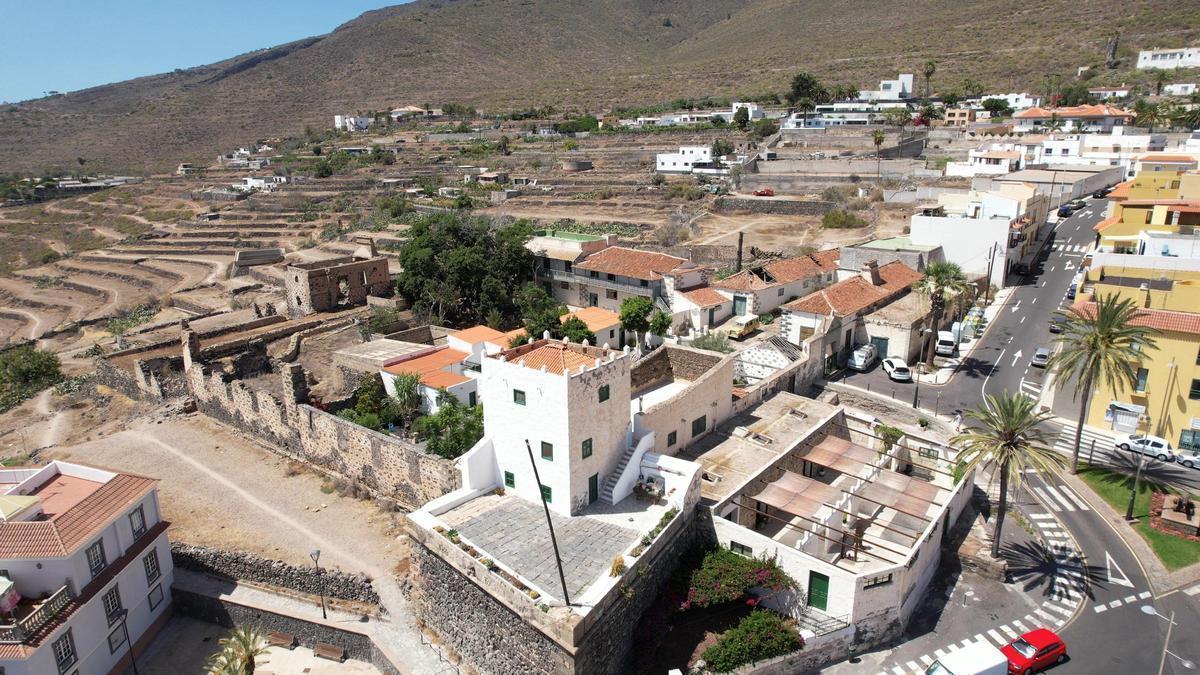
The Casa Fuerte de Adeje, a unique blend of country estate and fortress, is one of Tenerife’s greatest historical treasures. It was the economic engine of the south of the island in the 16th century and one of the most important sugar mills in the Canary Islands – one that relied on slave labour. Yet protecting it has proved anything but easy. More than 30 years after the first steps were taken to guarantee its preservation, Adeje Council has suffered yet another setback in what seems an interminable process.
Back to the drawing board
The southern municipality will have to take the expropriation file for this complex – built shortly after the Castilian conquest of Tenerife – back to a full council meeting. A legal appeal from one of the numerous owners, the sole resident of the Casa Fuerte, over the way she was notified of the expropriation (the courts have ruled in her favour) has forced yet another delay in a process that has proved far more complicated than anyone imagined.
On 27 May 2022, the full council approved the start of the expropriation process for the Casa Fuerte. On 5 August 2023, it took the next step by initiating the expropriation of the surrounding land. But a bureaucratic hurdle has now emerged.
More than a hundred owners
Returning to the full council is not the only obstacle facing the mayor, José Miguel Rodríguez Fraga – who has been determined to add this jewel to Adeje’s public heritage ever since he took office 39 years ago – and his governing team. The main challenge lies in the sheer number of owners. It is estimated that there are more than a hundred, belonging to 11 hereditary lines with rights over this architectural complex.
Fraga’s obsession – to rescue it for future generations by creating an interpretation centre – is justified by a look at the vast and eventful history of this mansion, located in the heart of Adeje’s old town. Its value is so incalculable that in 1986, exactly 40 years ago, it was declared a Site of Cultural Interest (BIC) with the category of monument. Half of the current owners – descendants of families from Gran Canaria’s agricultural bourgeoisie who bought it from the peninsular heirs of the alderman Pedro de Ponte y Vergara at the end of the 19th century – are rejecting the council’s offer to nationalise the estate for €1.6 million.
‘Those plots have no development value’
The head of Urban Planning, Manuel Luis Méndez – one of the councillors most involved in the Casa Fuerte process – respects the decision of that half of the owners who refuse to accept the offer but does not understand it. ‘Those plots have no development value because they are protected by the BIC declaration, meaning it is forbidden to alter any part of the complex.’ Despite this latest blow to the expropriation proceedings, Méndez makes it clear that the council will continue the process, no matter how long it takes.
A castle with a dark past
Covering an area of 7,200 square metres, this castle-like building – surrounded by terraced crops, threatened by pirates, a key player in the first phase of Tenerife’s development after the Castilian victory over the Guanches, and the base from which the early populations of La Gomera and El Hierro were controlled – has seen many important episodes. It was the first large sugar cane plantation in the Islands and housed one of the most valuable archives of the past, which was later moved to Gran Canaria by the descendants of the current owners.
Who built it and why did it become the largest slave centre in the Canary Islands?
The Casa Fuerte was built by one of the most powerful and influential figures in Tenerife during the 16th century. Pedro de Ponte y Vergara was the son of the Genoese merchant Cristóbal de Ponte and Ana de Vergara, one of the families that financed the conquest of the islands, for which he obtained exploitation rights over Tenerife lands. From a young age, he was involved in managing the family’s land and businesses, especially in Daute, Garachico and Adeje. However, Pedro de Ponte stood out for his enormous ambition, expanding agricultural activities into maritime trade and becoming one of the richest men in the Islands.
He controlled the meat supply in Tenerife, trading with El Hierro, and developed an extensive network with America and England. After his father’s death in 1552, he settled permanently in Adeje. There he designed the Casa Fuerte, authorised by the crown in 1555 to defend the area from pirate attacks. He also held important positions, such as perpetual alderman of Tenerife and hereditary warden of the Adeje fortress. Pedro de Ponte also tried to turn Adeje into an independent jurisdictional lordship, although opposition from the Cabildo (island council) prevented him from succeeding. His descendants would eventually obtain that lordship in the 17th century.
He maintained very close relations with English merchants and took part in clandestine trade with America. He had struck up a friendship with the English navigator and privateer John Hawkins, with whom he organised illegal expeditions to the Indies. It was from this relationship that slaves began arriving at the Casa Fuerte, many bought in Cape Verde due to the need for abundant labour for the sugar cane.
Invaluable documentary record
The presence of enslaved workers is recorded in the Casa Fuerte Documentary Collection, one of the most valuable in the Canary Islands. It comprises the documentation generated from the administration and management, from this fortress, of the entailed estate and county of La Gomera, the entailed estate and marquisate of Adeje, and the entailed estate and lordship of El Hierro. This collection has been kept at the Canarian Museum in Las Palmas de Gran Canaria since 1935, following its donation two years earlier by the Curbelo family, one of the owning families of the Casa Fuerte. A digital copy of all the documents is available online after the Canarian Museum and Adeje Council signed a collaboration agreement in 1995 to organise it and make it accessible to anyone who wishes to consult it.
The archive constitutes one of the most valuable testimonies for understanding slavery in the Canary Islands. The documentation reveals that the presence of enslaved people was part of the seigneurial economy of the marquises of Adeje and counts of La Gomera.
Playing both sides
Desiderio Afonso, the councillor who knows the Casa Fuerte best (he is responsible for Municipal Heritage), highlights Pedro de Ponte’s skill in securing royal support for fortifying the estate – under the pretext of protecting it from pirates – while also negotiating with those very pirates to profit from his smuggling activities. ‘He got the backing of King Philip II to shield himself from the threat of pirates and privateers while at the same time trading with them in areas such as the slave trade,’ he recounts.
Everything is recorded in the documentary collection, with references to enslaved workers destined for both domestic service and agricultural labour. Studies carried out on these documents show that slaves were recorded as assets in the accounts, clearly distinguished from free waged workers. Some of the most common surnames in Adeje today, recalls Desiderio Afonso, come from these servants. ‘Cases like Urbano or Lima are examples.’
The property inventories and wills preserved in this archive are particularly revealing about their significant presence at the Casa Fuerte. In these types of documents, slaves are listed alongside land, livestock, tools and other items of economic value. Some deeds reflect the hereditary transfer of slaves within the seigneurial family, while others list dowries, domestic services or manumission processes – formal acts by which a master granted freedom to a vassal.
The mentions also help identify the diversity of the enslaved population in the Canary Islands. Historical records of the time use terms such as ‘negro’, ‘mulatto’, ‘Moor’, ‘bozal’ (a newly arrived, unacculturated slave) or ‘ladino’ (a Hispanicised, Christianised slave), categories used to distinguish origin, cultural condition or degree of Christianisation. Most of these people came from sub-Saharan Africa or North Africa and arrived in the Canary Islands through the Atlantic trade networks connected to Portugal and Seville.
Stubborn determination
This legacy of knowledge, together with the fact that parts of the building are well preserved – others lie in ruins – drives the council to persist in its efforts. ‘This fortress has to belong to all the people of Adeje,’ agree Manuel Luis Méndez and Desiderio Afonso. But it has not been easy. Both are grateful that the woman who lives in some of the Casa Fuerte’s rooms, along with other owners, allow visits organised by the council, such as the annual Ruta del Agua (Water Route), an activity that involves touring Adeje’s historic buildings.
This fact also allowed the Casa Fuerte to be removed from the red list of Spain’s abandoned cultural heritage, drawn up by the Hispania Nostra association, in 2024. However, remaining in private hands is a major handicap for its future. The list of disagreements with the owners is long, including files for works vetoed after its BIC declaration. The idea is to keep it practically as it is, with only some renovations to reinforce its conservation. Experts rule out reconstruction. They avoid historical fakes on grounds of scientific and ethical rigour, as the academic, architectural and archaeological community prioritises authenticity. The priority is to guarantee the survival of a complex where you can travel back to the origins of post-conquest Tenerife.
What’s happening in the Canaries – straight to your phone
News, weather alerts and practical updates – direct from the islands, in English. We live here and know what’s going on – before the international media catch up. Everything lands on our WhatsApp channel – no middlemen, no algorithm. Curated for families, expats and travelers.

Viral meningitis outbreak hits three children on El Hierro

Canary Islands tourism chief offers dialogue on residentialisation

Canary Islands office helps small councils ditch the peseta

Two tonnes of illegal tropical fruit seized at Tenerife port

Canary Islands approves new €1.6bn development fund

Mogán mayor says her €65,000 salary is too low

Abandoned cars in Canary Islands: hundreds left to rot
Work resumes on 27 affordable rental homes in Las Palmas

Los Realejos residents fight on against propane gas plant