Five families, one archipelago, endless stories
Whether they boast eight Canarian surnames or roots that stretch to far corners of the world, the families of the Canary Islands embody the diversity of an archipelago that has forged its identity from more than five centuries of outside influences. Traditions remain very much alive in many homes, yet each family lives them in its own way, enriching what it means to be Canarian.
The Garcias Claverie: a Tenerife family with European roots
The Garcia Claverie family sums up several generations of cultural mixing that ultimately became part of Tenerife’s identity. Their family tree brings together French, Madrid-born, Galician, Basque and Portuguese roots, all of which were fully integrated into the Canary Islands over the years. Mercedes Garcia Claverie recalls that her great-grandfather arrived from a French village on the border with Spain to open a department store in Tenerife. Her father, with roots in Ávila and Madrid and a military career, was posted to the island ‘by chance’ and met his mother when he went to the shop to buy a watch.
The Garcia Claverie family’s life has always been marked by this constant coming and going. Two of Mercedes’ siblings were born in Tenerife, another in Segovia, and she herself was born in Gran Canaria. Marriages further broadened the family mix among Canarians, Portuguese and mainland Spaniards – as did those of her daughters. Although the family is not one for pilgrimage festivities, traditions have always been very much present around the dinner table. Family recipes, inherited mainly from the time they lived in La Palma, remain an essential part of every gathering. Any excuse is good enough to come together and share good huevos mole or home-made Canarian puchero stew.
From Bologna to Tenerife: the Dodi family’s new beginning
Marcello Dodi found in Tenerife a place to build a future without feeling too far from home. He arrived in 2011 from Bologna in northern Italy with his wife Lisa and their daughter Michele, who was barely a year old at the time. The initial idea was to invest, but also to start a new chapter. They no longer wanted to stay in Italy, and a friend told them about the Canary Islands as a safe, close destination with the reassurance of European healthcare. ‘As soon as we arrived, we felt it was our future home,’ he recalls. Within a week they had bought several properties, and what began as an investment project grew over time. Marcello, who describes himself as a ‘restless soul’, ended up developing various businesses linked to real estate and hospitality.
The family also grew in Tenerife. Today Michele is 16, while Sophie (11) and Carlotta (9) were born on the island. The girls have made the archipelago their natural home and feel the Canary Islands are part of their identity. ‘They speak more Spanish than Italian, and among themselves more Canarian dialect than Spanish,’ he says. The family takes part in local festivals and celebrations, often through school, while also preserving some Italian customs. Marcello says they have always felt welcome and believes that respect for the land and its people has been key to their integration.
Casa Efigenia: a La Gomera culinary dynasty born from a village shop
Sergio Mendez Borges’s family has always been deeply rooted in the midlands of La Gomera. His mother was born in Arure and his father in Las Hayas, an enclave where life has always been tied to the land and rural tradition, and where the couple eventually settled to raise their four children. The family home had a small shop that sold everything – from basic provisions to loose tobacco, paraffin and esparto grass sandals. Over time, that space evolved when his mother, after marrying his father (a farmer and livestock keeper), began helping out and introducing home-cooked meals.
This was the origin of what is now Casa Efigenia, an iconic La Gomera restaurant and a pilgrimage destination for anyone seeking authentic traditional island cooking. Behind this legacy is Efigenia, Sergio’s mother and a key figure in preserving traditional Gomeran cuisine, alongside a family story marked by hard work and deep roots. Today, Sergio – the youngest of her four children – runs both the restaurant and Efigenia Natural, continuing a project that began as a tiny village shop and has become one of La Gomera’s culinary landmarks.
The Quintero Casañas: El Hierro’s artisans of tradition
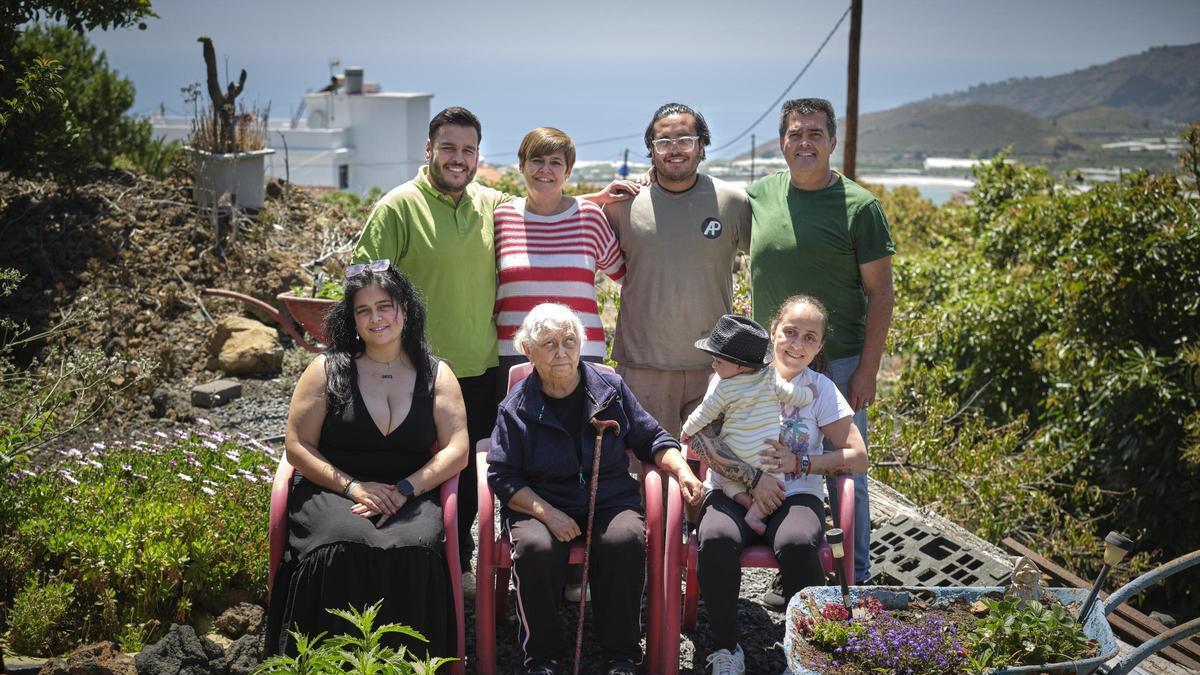
The story of this family from Sabinosa on El Hierro is deeply linked to rural life and traditional craftsmanship. The Quintero Casañas family has maintained a close bond with the land and artisan trades across generations. Blanca’s parents have spent their whole lives dedicated to crafts and farming. Her father worked with wood, making chácaras (traditional castanets) and other traditional items, while her mother is a weaver – a direct inheritance from a family where her grandmother made rag rugs and her grandfather was a basket maker. Blanca has also inherited this artisan spirit and makes macramé. Her life has unfolded between work, caring for her mother and raising her three children as a single mother. ‘We have been a humble family, but an honest one,’ she sums up.
At 18 she left for Tenerife to make her way in the world, married a man from La Gomera, and later returned to El Hierro, where she has spent most of her life. She says they are a family deeply attached to traditions and has made sure to pass on these same values to her children. In the kitchen, she champions Canarian cooking: potaje, puchero or potatoes with pork ribs, as well as her home-made cheese mojo, a recipe inherited from her grandmother. Her life, marked by effort and change, also reflects the transformation of El Hierro, where practices such as bartering have disappeared and neighbourly relations have shifted.
The Perez Pereyra: La Palma roots and the spirit of community
The Perez Pereyra family has lived closely tied to the La Palma municipality of El Paso. Maria del Cristo – or simply Cristo, as everyone knows her – is an only child, a family reality that was not especially common during her childhood. And like so many from La Palma, hers is a story of coming and going. She moved to Tenerife to study law, but returned without finishing her degree. From a very young age she looked after and lived with her blind mother, growing up in a humble but close-knit family environment. Married for 33 years, she has three children and a grandson whom she describes as ‘the joy of the house’. For years she balanced family life with a business linked to the primary sector alongside her husband, an agricultural technician, and later returned to the workforce with jobs at the town council.
A champion of neighbourhood life and traditions, she recalls a childhood of street games and study at a single-teacher school, where she also enrolled her own children to prevent it from closing. She says her family has always been closely linked to Canarian culture. Her husband was a Canarian wrestling fighter, a passion he passed on to some of his children. In the kitchen, it is always traditional: scalded gofio, mojo, potatoes, pineapples and ribs are never missing from her table. What she misses from the old Canary Islands is the peace of the neighbourhoods, the simple life and the closeness of the corner shops. ‘I always tell my children to buy local and not so much online,’ she says.
What’s happening in the Canaries – straight to your phone
News, weather alerts and practical updates – direct from the islands, in English. We live here and know what’s going on – before the international media catch up. Everything lands on our WhatsApp channel – no middlemen, no algorithm. Curated for families, expats and travelers.

Canary Islands tourism chief offers dialogue on residentialisation

Canary Islands office helps small councils ditch the peseta

Two tonnes of illegal tropical fruit seized at Tenerife port

Canary Islands approves new €1.6bn development fund

Mogán mayor says her €65,000 salary is too low

Abandoned cars in Canary Islands: hundreds left to rot
Work resumes on 27 affordable rental homes in Las Palmas
Los Realejos residents fight on against propane gas plant
Canarias among Spain’s poorest regions as 36.2% live on low incomes