
A View from the Heavens
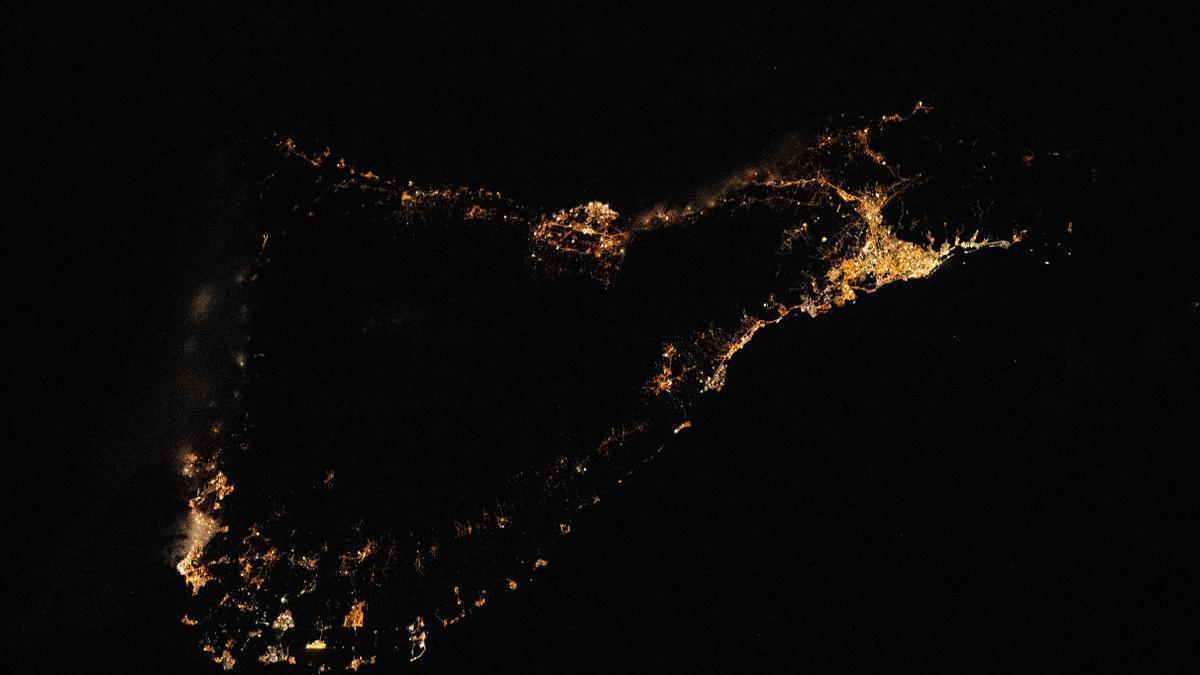
More than 400 kilometres above the Atlantic, in a slice of sky known as the thermosphere, NASA astronaut Chris Williams fixed his camera’s viewfinder and pressed the shutter. From the cupola of the International Space Station (ISS), while orbiting Earth at 28,000 km/h, he managed to photograph the night over Tenerife and Gran Canaria with the clarity of a Nikon Z9 and a 200mm telephoto lens. The images, taken recently during his mission as a flight engineer for Expedition 74—which he joined on 27 November after launching from the Baikonur Cosmodrome aboard a Soyuz MS-28—have become a first-rate scientific and journalistic document. Not just because they are beautiful, which they are, but because they confirm, from the most irrefutable perspective, that the Canary Islands have a serious problem with light pollution. Of a magnitude capable of overflowing the darkness, crossing the atmosphere, and flooding a camera lens with light.
The Problem of Wasted Light
“That is excess light we don’t need,” states Antonia Varela, president of the Starlight Foundation and a researcher at the Instituto de Astrofísica de Canarias (IAC). The scientific explanation for why this light is visible from space is called “upward flux.” It is the fraction of light energy that, instead of illuminating the ground where it is useful, is emitted directly upwards or reflected off walls, pavements, and other surfaces until it escapes outdoors. “In the images, everything we see in colour gives us an idea that it is wasted light,” explains Varela. In Starlight-certified zones—internationally recognised dark sky reserves, such as Teide National Park and its summits in Tenerife, or the Gran Canaria Biosphere Reserve, which covers 46% of its territory—that percentage should be zero, or at most one percent. Williams’s images demonstrate that in the urban and tourist areas of the two capital islands, that percentage is far higher.
“It is not enough for them to say they comply with the Sky Law. I believe even visitors would appreciate having sun and beach by day and darkness at night to be able to see the stars,” she adds.
An Unprecedented Perspective
One might think this was already known. That night-time satellites exist and have thoroughly documented the reality of the Canary Islands. They do exist and are essential, but most work with low-light sensors, specific bands, or scientific composites that are not equivalent to a natural colour photograph. Therefore, Williams’s document “is a previously invisible image.” NASA notes that the ISS completes an orbit every 90 minutes and that the crew sees 16 sunrises and 16 sunsets a day, which implies that from the atmosphere, Earth’s night can be interpreted in ways that are much harder to discern from the ground. Ultimately, it means space needs the human eye to understand Earth.
The Blue Light Effect
The reason Gran Canaria appears whiter and brighter than Tenerife in the photographs is related to the type of LED installed in the public lighting on each island. Luminaries with high colour temperature LEDs—so-called “cool LEDs” with a white-bluish spectrum—produce a type of light that scatters with particular intensity in the atmosphere. The reason is the same why the sky is blue during the day: blue light has the wavelength that scatters most in Earth’s atmosphere, invading the visible hemisphere more efficiently than any other colour. “Blue LEDs are like putting suns on during the night,” explains Varela. “That blue light scatters more due to the properties of our atmosphere and magnifies light pollution.”
A Call for Smarter Lighting
According to Varela, reducing photopollution does not mean turning off cities or sacrificing public safety. “We have always said it’s not about switching off, it’s about lighting properly. You have to light well what needs to be lit. When and how? With remote management. By shielding properly, with good-quality light, at the right intensity. Reducing it at night, when there are no longer enough pedestrians to have everything on,” she asserts.
What’s happening in the Canaries – straight to your phone
News, weather alerts and practical updates – direct from the islands, in English. We live here and know what’s going on – before the international media catch up. Everything lands on our WhatsApp channel – no middlemen, no algorithm. Curated for families, expats and travelers.

Iberdrola plans Tenerife’s biggest battery storage plant

The wild canary that gave its name to the Canary Islands

Canary Islands sea hits second-hottest year on record

Legal bid to halt tree felling in Santa Cruz’s La Salud

Fiesta del Charco: A journey through La Aldea’s past

Corralejo dunes power line set for removal

ULPGC launches 14 research projects at Las Canteras

TMT will never be built, says Canary Islands astrophysics chief

Pedro Duque: Canarias is the “ultimate dream” for rockets
