
Eight-Year Legal Battle Over Coveted Land
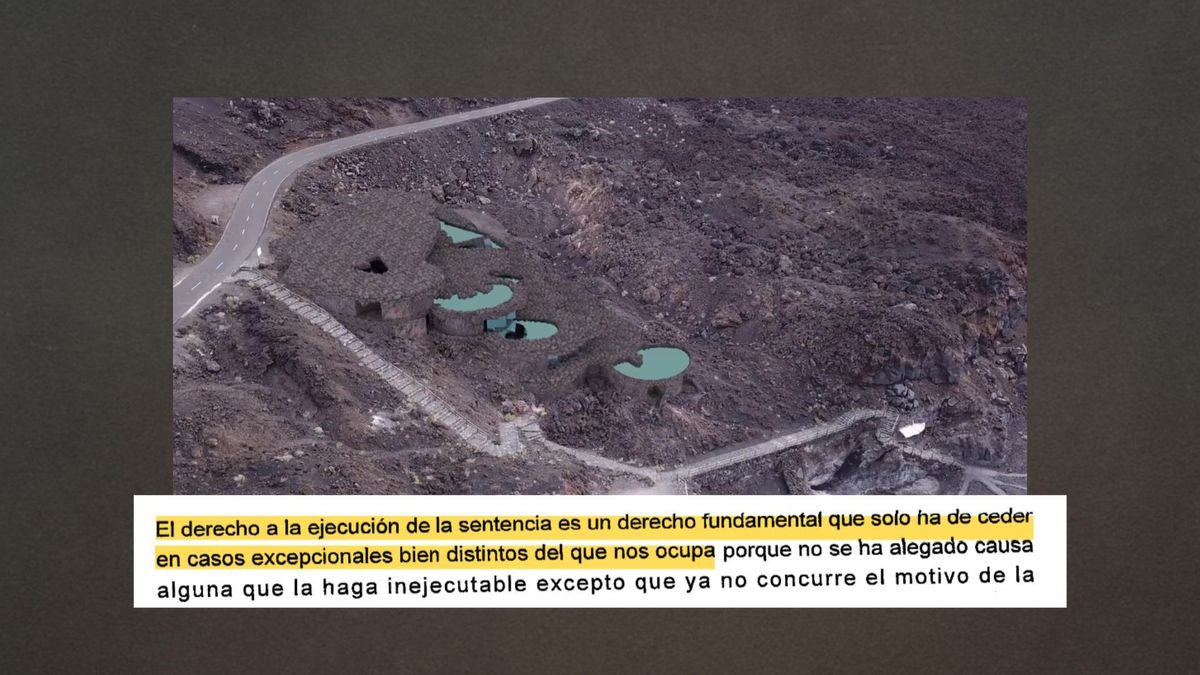
Eight years ago, sisters Carmen and Josefa (fictitious names at the interviewees’ request) learned their land in Fuencaliente, in the south of La Palma, was to be expropriated for the construction of the Fuente Santa spa. This is a thermal spring buried by the eruption of the San Antonio volcano in 1677, which the island council (Cabildo) now seeks to recover as a tourist attraction. Both sisters appealed. The council had initiated the expropriation in 2018, relying on a 2014 regulation that amended the Canary Islands Natural Spaces Law. This provided legal cover for the exceptional transformation of the volcanic badlands on which their farm is located, under which the Fuente Santa water gallery runs, within the Teneguía Volcanoes Natural Monument. However, that regulation was repealed in 2017. The controversial Land Law passed by the then President of the Canaries, Fernando Clavijo (Coalición Canaria), nullified it that same year. The Council of La Palma was then left without regulatory safeguards.
Court Victory Overturned by Legislative Change
The courts upheld the sisters’ appeal, ruling that if the regulation justifying the expropriation was not in force at the time of its appraisal, the consequence could only be the nullity of the act. The Administrative Court of the Canary Islands High Court (TSJC) indicated this in October 2022. The ruling became final after the Supreme Court rejected an appeal by the island council for “lack of sufficient grounds”. So, the land was to be returned to Carmen and Josefa. Or so they believed. But nothing could be further from the truth.
In March 2023, six months after the ruling that annulled the expropriation, the regional government modified the Land Law to restore the validity of what the 2014 regulation said about Fuente Santa: “the general interest of a project longed for by Palmeran society, the establishment of the installations, buildings and infrastructure necessary for its rational exploitation”. The regional government acted with precision. Instead of recovering everything that law said, which also established procedures for declaring Natura 2000 zones and regulated environmental assessments, it specified that each and every legislative modification introduced into the planning of the islands’ natural spaces was valid. Previously, the Land Law only maintained the effectiveness of the original guidelines for these spaces, agreed in 2000. Now it also includes that of all their modifications, including the 2014 one for the Teneguía Volcanoes Natural Monument.
Retroactive Law Revives Expropriation Justification
The government gave this new provision retroactive effect from 1 September 2017, meaning the legal framework to justify the expropriation of the Fuente Santa land had returned. The Council of La Palma took advantage of this manoeuvre and presented to the courts what is known in law as an ‘incident of legal impossibility of enforcing a judgment’. As it now again has cover to expropriate in favour of Fuente Santa, it has no intention of handing the land back to Carmen and Josefa, as it had been ordered to do in the final judgment.
Initially, the Administrative Court Number 3 of Santa Cruz de Tenerife did not accept the island council’s arguments, simply responding that the new law “does not expressly restore the validity of the repealed one”, and thus considered the ruling enforceable. However, with a divided court, the TSJC’s Administrative Chamber did uphold the Council’s appeal in the second instance. It declared the legal impossibility of executing the sentence and directed the sisters to seek “fair compensation”.
Divided Judicial Opinion and Supreme Court Appeal
The ruling states that with this new 2023 law, the Government of the Canary Islands “addresses the problems caused by deficient legislative technique”. It does so, it continues, by making an authentic interpretation, detailing that it is each and every modification introduced into the planning of the islands’ natural spaces that regains its force. This point is very relevant to the court because it emphasises that “we are not facing a law enacted to avoid compliance with the judgment”, as it refers not only to the modification of one protected natural space, but to several. The TSJC concludes that “such repeal never existed”.
The sentence, however, included a dissenting opinion from Judge Jaime Guilarte, who was also part of the court that annulled the expropriation in 2022. In his view, no fact has been raised that prevents the execution of the ruling, nor can the matter adjudicated – the return of the land to the sisters – be altered by a mere legislative modification with retroactive effect. He argues the correct course would have been to return the farms and begin the expropriation anew. The defence for both sisters, led by lawyer José Julio García Ramos, has filed an appeal with the Supreme Court. It argues the TSJC ruling violated two articles of the Spanish Constitution and appeals to European Court of Human Rights doctrine on not applying laws that seek to alter the outcome of already resolved litigation.
The Stakes for La Palma’s Tourism Project
The farm owned by Carmen and Josefa covers nearly 10,000 square metres. It is inherited land of a volcanic, arid, and very irregular nature, the closest thing to it being a couple of greenhouses. But it sits right on top of the Fuente Santa. And that gives it incalculable value at this time. The Council of La Palma has spent many years trying to unblock this project after engineer Carlos Soler discovered its location at the beginning of the century. They state it is a key, first-order tourist initiative that will represent a qualitative leap for the island, with an estimated cost of around €16 million. After approving the final draft of the plan in 2023, the Coastal Authority challenged it, arguing its location in the public domain zone was not fully justified. The Supreme Court has this year admitted an appeal to study its location. It remains to be seen if it will do the same regarding the island council’s expropriation methods.
What’s happening in the Canaries – straight to your phone
News, weather alerts and practical updates – direct from the islands, in English. We live here and know what’s going on – before the international media catch up. Everything lands on our WhatsApp channel – no middlemen, no algorithm. Curated for families, expats and travelers.

Civil Guard warns of digital skimming threat to online shoppers

Tenerife shifts FDCAN funds from roads to housing

PSOE warns Arrecife plan could ‘bury’ El Cable beach in concrete

Canary Islands faces loss of 20% of self-employed workers

Canary Islands to get 26 new substations by 2030

Canary Islands poverty rates stuck since pandemic

Court backs eviction over verbal room rental in Arona

Canary Islands pushes for 10-year residency rule for foreign buyers

Canary Islands public websites locked down over PHP security flaw
