Housing crisis in Canary Islands sparks three protest marches
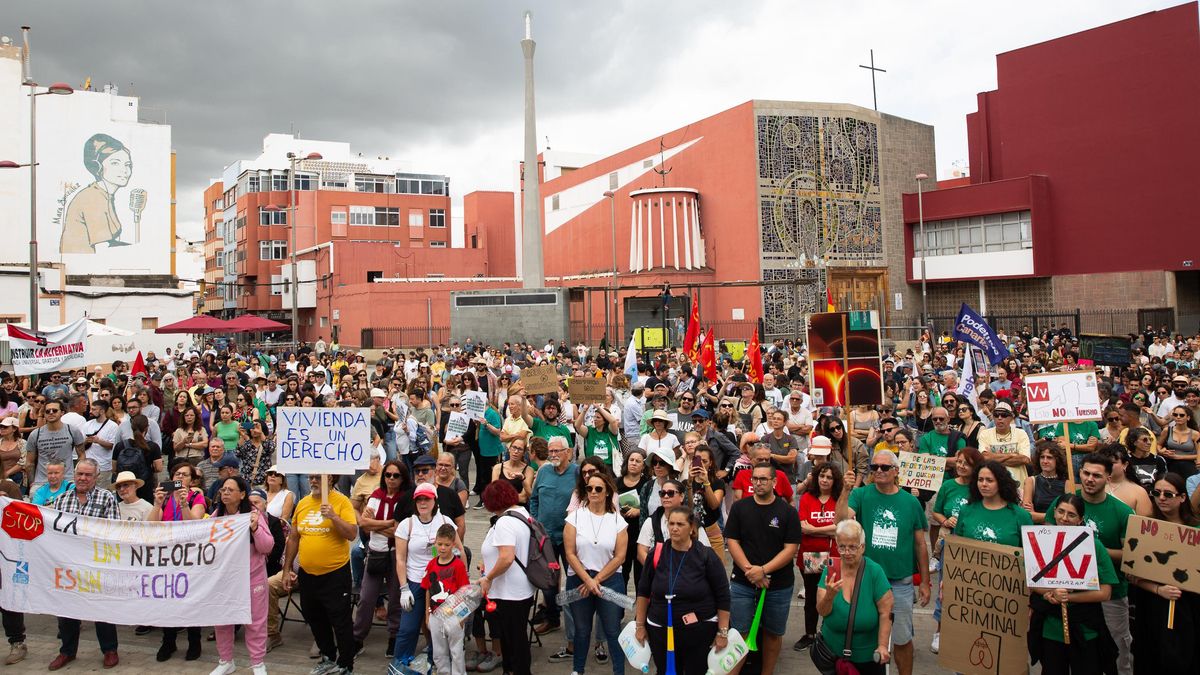
The Canary Islands are experiencing an unprecedented housing crisis. Social groups have called three protests across the archipelago as part of a national campaign for the right to housing, under the slogan: “Housing is costing us our lives.” Organisers hope the demonstrations will mark a turning point in the fight against the housing crisis affecting the islands.
Three protests in late June
The platform Derecho al Techo (Right to a Roof) has called a demonstration in Las Palmas de Gran Canaria on Saturday 20 June at 11:00, which will march from the Parque del Canódromo in the Schamann district to the Parque de Don Benito. On La Palma, a protest will take place on 26 June at 18:00 in Plaza España in Los Llanos de Aridane. The Tenerife Tenants’ Union (Sindicato de Inquilinas de Tenerife) has called another mobilisation for 27 June at 11:30 in the Parque Estudiante Javier Fernández Quesada in San Cristóbal de La Laguna.
The scale of the crisis
Rising population, tourist pressure from holiday rentals, and political management that social groups describe as an absolute failure have created a situation of collapse. The result is an alarming picture in which residents are being pushed out of their neighbourhoods and families are ending up on the streets. According to data from the General Council of the Judiciary (CGPJ), there were 1,426 evictions in the Canary Islands last year. Nearly 80% of them were due to non-payment of rent.
The housing crisis is one of the main factors making it increasingly difficult to escape poverty. Almost 700,000 people in the archipelago are at risk of social exclusion, meaning their income is below €965 a month. That represents more than 30% of the population, according to the European Anti-Poverty Network. Meanwhile, housing prices continue to rise.
Record prices and empty homes
In February 2024, the Canary Islands government brought in a decree on urgent housing measures, declaring a housing emergency across the archipelago. Since then, house prices have risen without interruption. The current average price stands at €2,234 per square metre, breaking the historical record once again. This represents an increase of 13.6% compared to last year.
According to those calling the protests for the right to housing, this reality is not the result of a natural market evolution, but rather “the direct consequence of policies that have favoured speculation and the commodification of a basic right.” The Canary Islands currently have around 18,000 public housing units, which represents less than 2% of the archipelago’s total housing stock, according to Provivienda. Yet there are 34,000 applicants for public housing. In the last three years, only 24 public homes have been delivered, according to the Canary Islands Housing Institute (ICAVI) itself.
Empty houses are far more numerous. An estimated 211,000 homes are unoccupied across the islands, roughly one in five. That figure comes from the 2021 Population and Housing Census by the National Statistics Institute (INE). Most of these empty homes are concentrated in tourist municipalities and the capitals, with Las Palmas de Gran Canaria having the highest number of empty properties in the entire archipelago. But the Canary Islands government has mobilised only one empty home in the last ten years. The ICAVI confirmed through transparency requests that it has managed to bring just one unoccupied house onto the market since 2015. That was in 2023, in Las Palmas de Gran Canaria, under the Canary Islands Housing Plan 2020-2025.
The regional government now promises to mobilise one hundred homes in the next two years with just one million euros. Even the property industry association agrees that empty homes should be put up for sale or rent. The Association of Real Estate Consultants (Asociación de Consultoras Inmobiliarias) says the Canary Islands need at least 44,000 homes to meet current demand. Mobilising just one-fifth of the empty properties would suffice.
Landlords and properties
As the housing crisis deepens, the number of property seizures (occupations) in the archipelago fell by more than 10% in 2025, according to the Ministry of the Interior. Last year, 596 offences of squatting and breaking and entering were recorded in the Canary Islands, with non-payment of rent being the main cause. At the same time, the Canary Islands is one of the regions where landlords own the most properties. Las Palmas de Gran Canaria and Santa Cruz de Tenerife have the highest concentration of multi-property landlords, with nearly 65% of landlords owning two or more rental properties – a higher percentage than in Madrid or Barcelona. Across the archipelago, there are more than 50,500 owners with over four properties. A further 14,000 owners have between 11 and 25 homes, and almost 3,000 own more than 25 properties.
The population of the Canary Islands identifies housing as their main concern, and 90% believe the tourist model needs to change. The islands are now the third region where people most struggle to find housing, according to the INE, behind only Madrid and Barcelona.
Tourist rentals and illegal homes
The Canary Islands holiday rental law has done nothing to ease the housing crisis. The number of tourist flats available has fallen from 47,100 to 42,300. Last month, the Ministry of Housing urged the Canary Islands government to inspect and close more than 14,200 illegal holiday homes detected by the Land Registry this year, making the islands the fourth region most affected by this problem. “They could be used to increase the supply of affordable housing in the Canary Islands, instead of expelling thousands of Canarians from their neighbourhoods, their cities and, ultimately, their islands,” the ministry said.
Emergency housing plan demanded
In response to this situation, the Tenerife Tenants’ Union and Derecho al Techo in Gran Canaria are calling for an Emergency Housing Plan, which includes 13 urgent measures that “can be applied immediately, aimed at directly intervening in the housing market and ending the gentrification of our neighbourhoods,” they say. The first measure is the immediate declaration of stressed areas and the effective application of rent caps, something the government of Fernando Clavijo has persistently refused to do – even dismissing the idea of declaring Las Palmas de Gran Canaria a stressed zone, claiming that “there are no large-scale landlords in the Canary Islands.”
The organising groups also propose indefinite tenancies to guarantee housing stability, and the recovery of empty homes through tough tax policies targeting large-scale landlords, such as banks and vulture funds, so that properties are used for social housing and/or affordable rent. They propose increasing their property tax (IBI) and penalising them fiscally for keeping homes empty, instead of the current voluntary incentives. They also call for an end to speculative property purchases, with a ban on acquisitions by investment funds, companies, large capital holders and individuals, regardless of their origin. They demand the scrapping of institutional campaigns to attract digital nomads, which “put pressure on the residential market and reduce the supply of permanent housing.”
They also call for control of public land to end its transfer to private or tourist interests, adjustment of urban planning to the capacity of the island territory, and regulation of the introduction of franchise chains through planning tools, in order to “protect local commerce and the economic diversity of neighbourhoods.” Both groups firmly reject exclusionary criteria for access to public housing and demand the removal of economic or administrative requirements that “push the most precarious sectors out of access to social housing.”
The organisations demand the recovery of tourist flats and temporary rentals for residential use, including a freeze on new holiday rental licenses. They require the expansion and protection of the public housing stock through the incorporation of SAREB housing and other public assets, preventing their future privatisation. Other proposals include: a right of first refusal and buy-back for public administrations when purchasing buildings, and a requirement that 50% of all new construction or major renovation be allocated to public housing or affordable rent. Finally, they call for a total suspension of evictions without a guaranteed housing alternative provided by public administrations, and the banning of eviction companies to end extrajudicial evictions.
Call to action
The organisations criticise that access to decent housing has become one of the main social problems in the archipelago, and denounce that the current economic model “has turned housing into a financial asset at the service of property speculation, investment funds and large landlords.” They insist: “Housing cannot continue to be treated as a commodity subject to the logic of private profit.” Derecho al Techo and the Tenerife Tenants’ Union are calling on people to join the demonstrations on 20, 26 and 27 June, aiming to turn them into a show of strength capable of opening a new cycle of struggle for the right to housing in the Canary Islands.
What’s happening in the Canaries – straight to your phone
News, weather alerts and practical updates – direct from the islands, in English. We live here and know what’s going on – before the international media catch up. Everything lands on our WhatsApp channel – no middlemen, no algorithm. Curated for families, expats and travelers.

Canary Islands tourism chief offers dialogue on residentialisation

Canary Islands office helps small councils ditch the peseta

Two tonnes of illegal tropical fruit seized at Tenerife port

Canary Islands approves new €1.6bn development fund

Mogán mayor says her €65,000 salary is too low

Abandoned cars in Canary Islands: hundreds left to rot
Work resumes on 27 affordable rental homes in Las Palmas

Los Realejos residents fight on against propane gas plant
Canarias among Spain’s poorest regions as 36.2% live on low incomes