Canary Islands hosts first Spanish edition of the Cosmos Awards
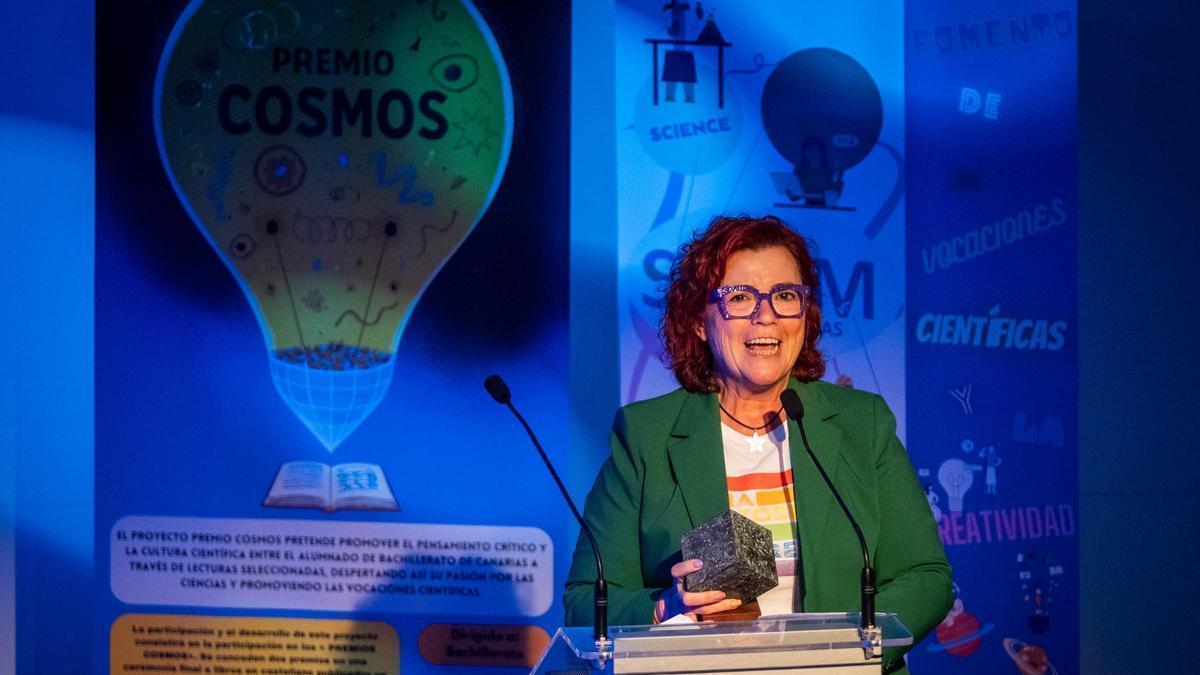
The Canary Islands became an international venue for the Cosmos Awards on Tuesday as they welcomed the first edition of this prestigious ceremony to be held in Spain. The initiative, driven by the Institute of Astrophysics of the Canary Islands (IAC), brought together over a hundred students, teachers and specialists from various scientific fields at the Auditorio de la Fundación CajaCanarias. The aim was to promote scientific outreach and critical thinking among the younger generation.
The winners: from algorithms to the edge of the abyss
Several accolades were presented during the gala evening. The Cosmos Student Award, decided by a jury made up of pupils from ten schools across Tenerife, La Palma and Gran Canaria, went to mathematician and science communicator Clara Grima for her work Con algoritmos y a lo loco. Meanwhile, the Cosmos Award, granted by a prestigious international scientific committee comprising experts in astrophysics, mathematics, biomedicine and other disciplines, recognised José López for La vida al borde del abismo and Lise Barnéoud for Las células errantes. In addition, the organisers acknowledged the IES Marina Cebrián school for an audiovisual project presented during the day.
Why Tenerife? A firm commitment to science outreach
The choice of Tenerife as the host venue was no coincidence. According to Jorge Martín, director of the Cosmos Spain 2026 Award, the IAC has maintained a firm commitment to scientific outreach for many years. “For us, fostering critical thinking among young people is essential,” he said. He added that the celebration of these awards was the culmination of great effort and immense enthusiasm. In his view, the gathering served to bring science and outreach closer to young people, whom he described as “the true protagonists of the country’s future generations”.
Global backing and an international outlook
The Cosmos Awards are backed by the International Decade of Sciences for Sustainable Development (2024–2033), a global movement led by Unesco that aims to boost international scientific collaboration. Beyond promoting scientific vocations and reading among young people, the awards aim to distinguish the best works of science communication published in Spanish.
Although the majority of the audience came from the Canary Islands, none of this edition’s finalists were from the archipelago. According to Martín, this reflects the international nature of the awards. “Although the organisation is local, the spirit of the awards is clearly international,” he noted. Indeed, the Cosmos Awards have previously been held in countries such as Italy, the Netherlands and France, establishing themselves as a benchmark in Spanish-language science outreach. However, the absence of Canarian authors among the finalists also prompted a call to action. “We hope that in the coming years more authors from the islands will take part, because there is no shortage of talent,” Martín said.
Future editions and a call for local talent
Fernando Sánchez, Director of Communications, Image and Institutional Relations at the Fundación CajaCanarias, the event’s main partner, expressed his desire to ensure the continuity of these awards and consolidate their celebration in future editions. “We want this to keep growing, and we will continue to support the Cosmos Award in the coming years,” he concluded.
During the event, attendees enjoyed two high-level round tables that addressed fundamental questions about the origin of life, biological identity, the universe and the importance of critical thinking in the face of misinformation.
What’s happening in the Canaries – straight to your phone
News, weather alerts and practical updates – direct from the islands, in English. We live here and know what’s going on – before the international media catch up. Everything lands on our WhatsApp channel – no middlemen, no algorithm. Curated for families, expats and travelers.

Tenerife stages Spain’s biggest volcanic eruption drill

Sonora Festival 2026 draws 16,000 to Las Palmas

Two men injured in fall from wall in Playa de Troya
Tenerife-forged bell rings again in tiny Rioja village
Canarian journalists to discuss a world in conflict at Las Palmas theatre
Festival del Sur returns to Agüimes with theatre from three continents
Man, 24, seriously hurt in buggy crash on Gran Canaria track

Woman, 81, rescued from sea at Las Vistas beach in Adeje
Tenerife to receive ES-Alert volcano drill messages