Slovenia opens onto the Adriatic along a slender strip of coastline just 45 kilometres long. As the crow flies, there are only 17 kilometres between the Balkan country’s border with Italy (with magnificent Trieste a stone’s throw away) and neighbouring Croatia. And in this narrow space, there is a remarkable concentration of things to see — including what is considered the most beautiful village in the country: Piran. Alongside this jewel, two other towns are well worth a visit: Izola and Koper. All three boast stunning harbours and historic centres packed with beauty: palaces, churches, castles, towers, and city walls.
The sheer density of heritage along this stretch of the Adriatic is explained by its proximity to one of the most important maritime powers of the European Middle Ages. We are talking about Venice, which dominated these coasts for centuries and filled them with busy commercial ports that served as stopovers and refuges on the race for the riches of the East. This tiny stretch of coastline is a surprise within a country that is already a top destination in Europe — a less crowded alternative to the Croatian coast, for example, with the added appeal of combining a little beach time with the stunning city of Ljubljana, Lake Bled, or the high mountain landscapes of the Slovenian Alps (with Triglav National Park as the main attraction).
What to see in Piran, the most beautiful village in Slovenia
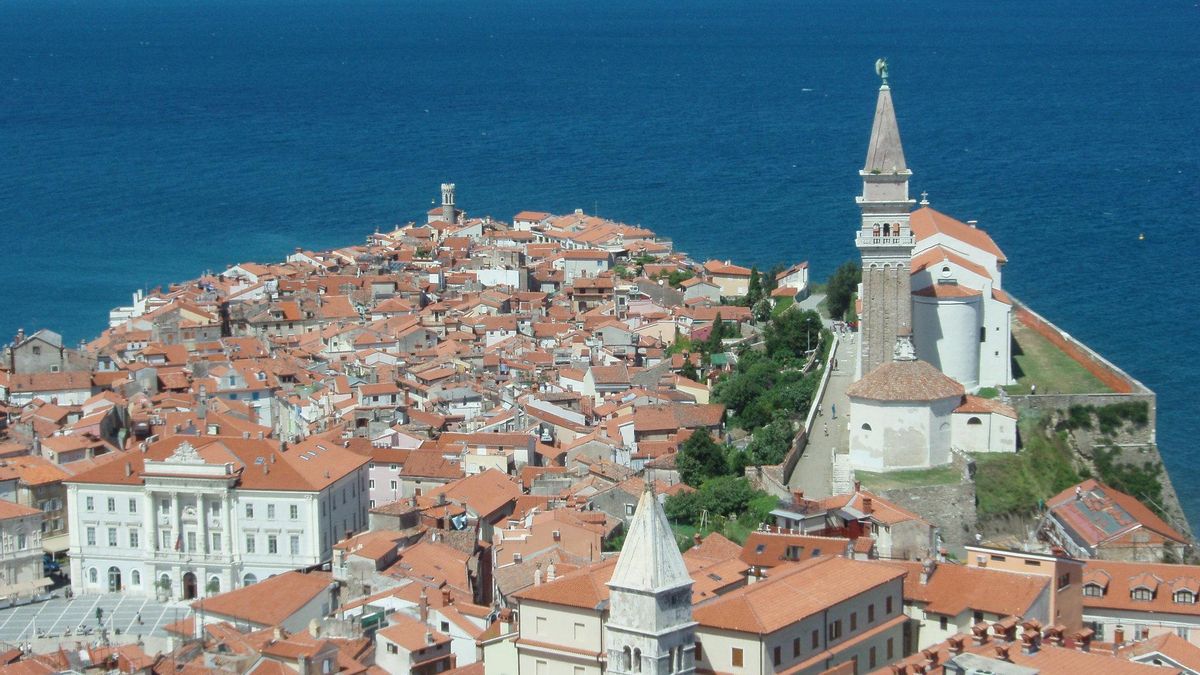
The first thing that strikes you about this tiny town of pastel-coloured houses is its location on a spear-shaped headland, dominated by the bold silhouette of the Church of St George and its tower, very much in the style of St Mark’s Square in Venice. But to explore Piran’s charms, you have to enter — and that means negotiating its imposing city walls. The walls of Piran were first built in the 7th century, when the town was conquered by the Franks, and were heavily reinforced and expanded in the 13th century, by then under the control of the Republic of Venice. Just over a kilometre of the original circuit remains open to visitors. From the battlements, the views are breathtaking.
Before heading down to Tartini Square, which serves as the town’s epicentre, first make your way to the Church of St George (Adamičeva ulica). The temple, a fine example of Venetian Renaissance architecture, occupies a promontory overlooking the entire town. From the outside it is simple, with a slender tower reminiscent of St Mark’s in Venice but in miniature. Inside, however, it is lovely: filled with a number of beautiful works of art and a coffered ceiling alternating gilded wood and religious scenes. From the tower, you can enjoy the best views of the whole city.
The centre of Piran is formed by the axis of Tartini Square and the harbour. Here you will find several of the main sights: Casa Tartini (Via Kajuh, 12), a beautiful 14th-century Venetian palace that now houses a museum dedicated to the violinist Giuseppe Tartini; the Sergej Mašera Maritime Museum (Cankarjevo nabrežje, 3), housed in another impressive palace and effectively Slovenia’s national maritime history museum; and the Piran Aquarium (Kidričevo nabrežje, 4), where you can get up close to the marine life of the northern Adriatic. But beyond the individual landmarks of museums and grand palaces, it is the ensemble that makes Piran special. Strolling along the harbour waterfront, looking up at the tower of St George, you will quickly agree with those who say this is Slovenia’s most beautiful village.
Wandering through the streets towards the Punta of Piran, you will come across palaces, small churches, and monumental spaces such as Maja Square, a truly beautiful spot. Before reaching it, you will have encountered Casa Benvenuti (Levstikova ulica, 5) or the Dolfinova vrata (Dolphin Gate) — two places that make clear the Venetian heritage that defines the town’s identity. In Maja Square, you must see the tiny Church of St Stephen (Trubarjeva ulica, 35), one of the oldest churches in the town, which preserves traces of the 13th century beneath its Baroque skin. This layering of styles is one of the town’s hallmarks. Beneath the 18th-century Baroque trappings and the 19th- and 20th-century eclecticism, you can still see the imprint of the Venetian past — or even older layers.
The Punta of Piran and its lighthouse
The third major monumental area of the town is the Punta of Piran. Here stands an old medieval lighthouse (known as the Lighthouse of St Clement), which also serves as the bell tower of the Church of Our Lady of Health. But let us take things step by step. Let us start with the lighthouse. Apparently, with the maritime expansion of the Roman Republic during the 2nd century BC, a beacon fire was installed here to prevent accidents. And that is the origin of the name Piran — an evolution of the Greek word ‘Phyr’, which gives us the word ‘lighthouse’ to this day. So Piran means ‘lighthouse’. Next to the lighthouse is the Church of Our Lady of Health (formerly St Clement’s), another Venetian trace dating from the 15th century, now used as an exhibition hall. Here, with your back to the sea, you can see the Siren of Piran, a sculpture paying homage to the ancient legends that placed the home of the beautiful and dangerous sirens on these Adriatic shores.
The beaches of Piran
Talking about the beaches of Piran is not like talking about Croatian beaches. Here, the order of the day is small gravel coves or swimming areas that alternate rocks and platforms for taking a dip. In the town itself, there is a designated swimming area near Punta Piran and platforms alongside the harbour. Piran’s main beach is at Portorož, although it is also a large concrete esplanade from which you can comfortably access the sea via ramps and steps (albeit with all the services of a tourist beach). To find more traditional beaches — albeit of stone and gravel — you need to head in the opposite direction from Portorož to find small bathing spots such as Fiesa, Pacug, and Salinera, where natural gravel and rock areas alternate with swimming platforms.
The neighbouring towns of Izola and, especially, Koper are more fortunate when it comes to beaches (all of gravel and stone), though in Koper the proximity of the large port of Luka Koper (which serves as Slovenia’s national port) is a significant drawback.
The Sečovlje salt pans (Seča, 115 – Portorož)
The mouth of the River Dragonja (which marks the border with neighbouring Croatia) forms the most important system of lagoons and wetlands in the entire country. This place is a paradise for birdwatching and also a first-rate cultural landscape, with large expanses of crops irrigated by canals. Since the 13th century, it has also been home to one of the most important salt pans in the Adriatic. The salt pans cover an area of more than 600 hectares and still maintain traditional production methods for a product sold under the protected designation of origin ‘Salt of Piran’. The salt history museum is well worth a visit.
Photos under Creative Commons licence: Fred Romero; fabcom; Patrick Müller; Sylvain Lafay; Mélisande*; Martin Wippel; Josefine Granding Larsson; Stephen Colebourne.
What’s happening in the Canaries – straight to your phone
News, weather alerts and practical updates – direct from the islands, in English. We live here and know what’s going on – before the international media catch up. Everything lands on our WhatsApp channel – no middlemen, no algorithm. Curated for families, expats and travelers.

How to apply for public housing in the Canary Islands

Viral meningitis outbreak hits three children on El Hierro

Canary Islands tourism chief offers dialogue on residentialisation

Canary Islands office helps small councils ditch the peseta

Two tonnes of illegal tropical fruit seized at Tenerife port

Canary Islands approves new €1.6bn development fund

Mogán mayor says her €65,000 salary is too low

Abandoned cars in Canary Islands: hundreds left to rot
Work resumes on 27 affordable rental homes in Las Palmas