
Supercalima’s Canary Islands sweep nears its end
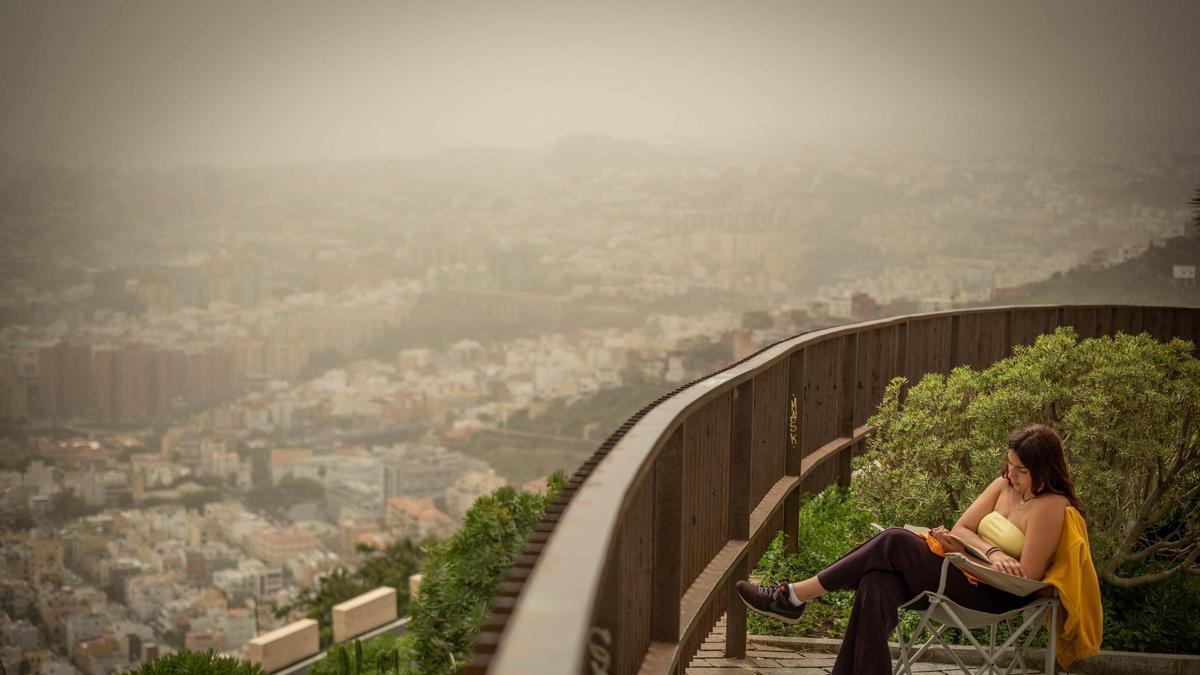
The intense ‘supercalima’ dust storm sweeping the Canary Islands is set to conclude its journey across the archipelago throughout Wednesday. While this episode’s impact has been localised, swift, and largely confined to coastal and mid-altitude areas, its presence has driven concentrations of PM10 particles – those typically associated with natural pollutants like calima dust or sea salt – above 1,000 micrograms per cubic metre for hours. This figure not only earns it the ‘supercalima’ title but far exceeds healthy exposure limits for the population.
Heat, disruption, and a historic comparison
Despite the dust layer being limited to a maximum height of 600 metres, its effects have been widespread. The calima has pushed maximum temperatures upwards, with some parts of the archipelago – primarily those on the southern slopes of the islands – reaching nearly 26°C. This is well above the more common springtime highs of 23-24°C. Furthermore, the dense ochre-coloured dust cloud has caused incidents in air traffic, specifically affecting several connections at Canarian airports, including three diversions and seven cancellations, according to data from the airport authority, Aena.
This extraordinary event, despite its intensity, did not reach the high suspended dust concentrations recorded in the March 2020 episode, when peaks of 3,000 micrograms per cubic metre were hit. Its formation was also different. During the supercalima episodes of 2020, 2021, and 2022, a vast influx of Saharan dust was triggered by a high-pressure system over North Africa meshing with a low-pressure area south of the Canaries like interlocking gears. This time, strong northerly winds – the Canaries’ trade winds, known as the Harmattan in Africa – have generated a wave or wall of suspended dust over 1,300 kilometres wide. This swept across the Sahara and parts of North Africa as a sandstorm (haboob) and reached the Canaries as an unusual calima episode.
A defined dust layer and its westward path
“We have encountered a very well-defined dust layer,” explains Sergio Rodríguez, a researcher at the Institute of Natural Products and Agrobiology (IPNA-CSIC) and head of the Canary Islands Air Quality Laboratory. He notes that the suspended dust entered the Canaries in a stratified band at altitude. “That’s why in Lanzarote and Fuerteventura they didn’t notice its presence during Monday – it passed over them,” the researcher highlights. By Tuesday, not even those eastern islands could escape the supercalima.
Once it reached the higher islands, the calima became trapped, first over the coasts and then progressively moving into mid-altitude areas. “As it advances westward, that band of calima becomes wider but also less intense,” reveals the researcher. Despite this slight dispersion, most municipalities in the archipelago have recorded concentrations quadrupling healthy limits, with PM10 levels up to 300 micrograms per cubic metre. In many others, the calima intensified so much that concentrations exceeded 1,000 micrograms per cubic metre for hours. This was the case at the El Río station in Arico, where limits were surpassed for six hours, and in Granadilla de Abona, where it also exceeded them for at least four consecutive hours. “The southern areas of Tenerife and Gran Canaria are usually the worst affected,” Rodríguez insists.
Clear skies return and a chemical analysis begins
However, this episode is on its last legs, as most of the calima was concentrated at the “front” of this peculiar structure, which has now passed over the islands. “On Wednesday, high concentrations of suspended dust will still be recorded, but it will tend to dissipate,” explains the researcher. By Thursday, the trade winds will blow over the Canaries again, clearing all the suspended dust in one fell swoop.
Meanwhile, the Air Quality Laboratory hopes to begin work as soon as possible to analyse the chemical composition of the suspended dust that reached the Canaries in this event. “We will know the load of pollutants from African industries carried by this episode,” explains the researcher, who stresses that, in any case, calima by itself can cause damage to the respiratory and cardiovascular systems. “They are connected; a problem in the respiratory system aggravates other heart conditions,” he insists. Hence the recommendations to use face masks on days with the highest particle concentrations.

Calima pre-alert declared across all Canary Islands

Tuesday: calima and cloud as temperatures dip

Monday: calima and 34C heat across the Islands

Canary Islands weather: Calima, storms and 34°C heat

Sunday: calima and 30°C as alisio winds strengthen

Calima and 30C heat to hit the Canary Islands this Sunday

Calima and 30°C heat to hit the Canary Islands this Sunday

Friday: trade winds return and skies clear

Rain alert declared for three Canary Islands from midnight
