
Tourists Ignore Barriers at Fragile Dune Ecosystem
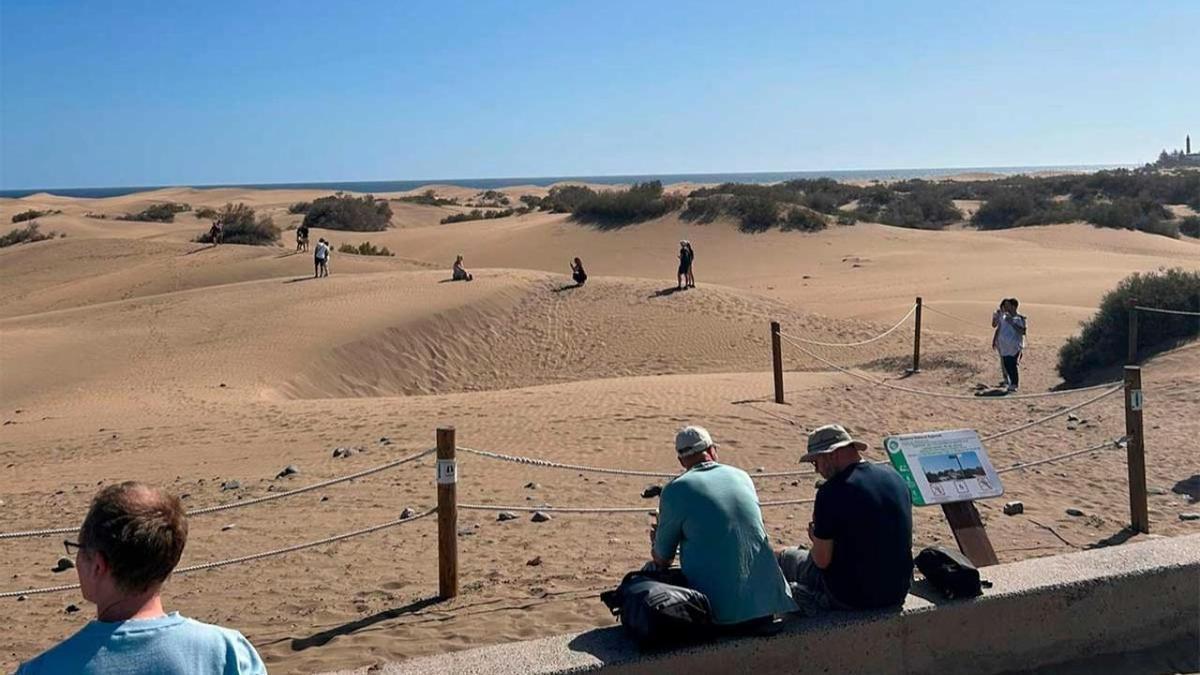
There are places where silence should reign out of respect. Where every step counts. Where beauty is not to be touched, only contemplated. The Maspalomas Dunes, in the south of Gran Canaria, are one of those spaces. And yet, on Thursday 9 April, they once again became the scene of an all-too-familiar sight: tourists walking where they shouldn’t, crossing visible boundaries, seeking the perfect photo without a thought for what they tread upon.
A Symptom of Disregard, Not Ignorance
This is not just an image. It is a symptom. Photographs circulated in recent hours show dozens of people scattered across the dune system, beyond the ropes and posts that mark the permitted paths. There can be no confusion: the signs are there, the walkways are there, the rules are there. What is lacking, judging by what happened, is the willingness to respect them. And that is where the frustration begins.
The Invisible, Cumulative Damage
What for some is a fleeting snapshot is, for others, constant deterioration. A slow wear, almost invisible to the naked eye, but cumulative. Every footstep off the compacted path compresses the sand, breaks the delicate balance of the terrain, and damages the vegetation that holds the dunes together. It is not an immediate impact, nor spectacular damage. It is something worse: it is progressive.
A Living Landscape Under Threat
The Maspalomas dune system is not a stage set. It is a living organism, in constant motion, shaped by the wind and sustained by a fragile balance between sand and plant life. Altering that balance, even minimally, has consequences. And those consequences are already here. Erosion is advancing, sand is being lost, and the landscape is changing.
Protection Measures Versus Individual Choice
This is why, in recent years, protection measures have been intensified: demarcated paths, signs in several languages, information campaigns, and surveillance. Even restoration projects, like the one developed to recover the natural flow of sand. All with one goal: to conserve what can still be conserved. But there is one thing no infrastructure can fully control: individual choice.
Indifference in Pursuit of the Perfect Photo
The images from this 9 April do not show a lack of knowledge. They show indifference. People crossing the ropes, walking on the dune crests, stopping in restricted zones. Not because they don’t know, but because they choose to. The reason, almost always, is the same: a photo.

Iberdrola plans Tenerife’s biggest battery storage plant

The wild canary that gave its name to the Canary Islands

Canary Islands sea hits second-hottest year on record

Legal bid to halt tree felling in Santa Cruz’s La Salud

Fiesta del Charco: A journey through La Aldea’s past

Corralejo dunes power line set for removal

ULPGC launches 14 research projects at Las Canteras

TMT will never be built, says Canary Islands astrophysics chief

Pedro Duque: Canarias is the “ultimate dream” for rockets
