
Coastal authority halts works at protected site
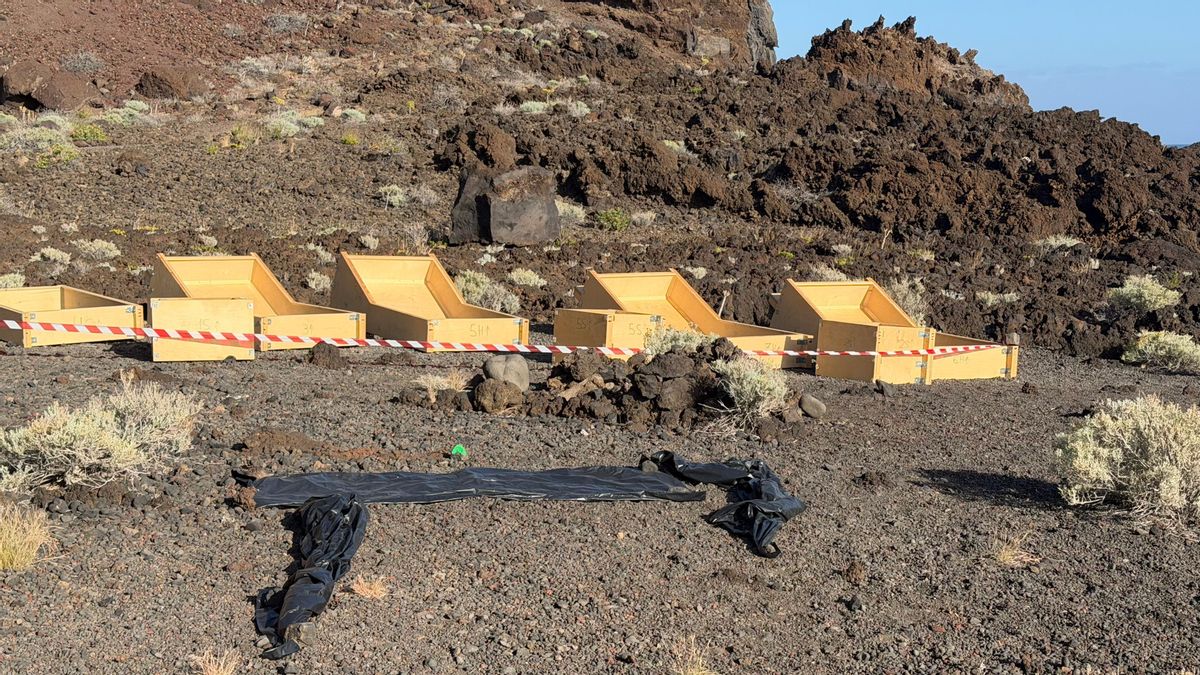
Spain’s General Directorate of Coasts (Costas) on Wednesday halted works being carried out by El Pinar council (governed by the PSOE) in the south of El Hierro, within the protected area of Tecorón. The council had begun installing around 80 mobile sunbeds with parasols on concrete platforms, as well as laying out paths and carrying out other small-scale works.
Mayor confirms suspension after public complaint
This was confirmed to Canarias Ahora by Magaly González, the council’s Tourism councillor, who had spearheaded the project. She stated that the public complaint made by the Salvar Tacorón platform, reported by this newspaper on Tuesday, had been key to the intervention. This is despite the fact that both Costas and the regional government were aware of the project and had given it the green light. However, she acknowledges they were lacking a permit relating to the Special Protection Area for Birds (ZEPA), and that this is why Costas stepped in, “though only because of the media coverage of the complaint,” she stressed.
Earlier on Wednesday morning, the president of the El Hierro Cabildo, Alpidio Armas, had told this newspaper that the works would be rectified. González confirmed this after they had analysed the reasons for Costas’s intervention and the absence of the ZEPA permit. She explained that the sunbeds cannot fit into another area where others have already been placed, so they will now look into where to locate them in the future, making clear that this part of Tecorón has been definitively ruled out. She did not, however, hide her surprise at Armas’s prior announcement.
Environmentalists warn of damage to protected species
In recent days, a group of nature defenders, specifically on the island of El Hierro, launched a social media campaign to gather signatures against the installation of these 80 sunbeds with concrete frames and parasols near the famous Tecorón cove. According to these activists, the council had acted without warning, occupying protected land that had been free of construction. In their explanation of the works, they claimed that the works were destroying lava fields and pouring gravel onto the sand (jable) to create paths. In this regard, they pointed out that this coastal area is part of the ZEPA and emphasised that Tecorón’s platform is home to a colony of Cory’s shearwaters (Calonectris borealis) which could be affected in the middle of their breeding season.
They also argued that the habitat of a protected fern (under the Special Protection Regime in the Spanish and Canarian Catalogues of Protected Species), the adder’s tongue fern (Ophioglossum polyphyllum), was being disturbed, as the plain is one of its last strongholds on El Hierro. “Because of these serious environmental impacts, the works should be suspended immediately, and should be limited to repairing existing facilities (picnic areas, car parks, and the solariums by the pool),” they said. Their complaint has had the desired effect, and Costas has today issued a precautionary suspension of the works.
A symbol of El Hierro under threat
These conservationists criticised not only the environmental damage but also the destruction of a symbol of El Hierro: “a site of extraordinary geological and landscape value, where nature expresses itself with a force and authenticity rarely found elsewhere in the world. The mass installation of concrete sunbeds at Tecorón represents an aggressive and disrespectful occupation, degrading the harmony of the landscape with its artificiality.” In their view, turning an untouched volcanic coastline into an area of intensive tourist use, with infrastructure that weighs visually and symbolically on the environment, means “a clear loss of environmental quality and territorial identity. An intervention totally out of place on an island classified as a geopark and a Biosphere Reserve.”
For this reason, they believe that “decisions by certain political and institutional authorities must be consistent with a model of the island founded on sustainability. To defend Tecorón is to defend the soul of El Hierro, a space for tranquillity, contemplation, and connection with nature. If we allow concrete to prevail over geology in this natural sanctuary, it is not only the landscape that is eroded; our lives are also impoverished.”
Council praised for land purchase but questioned on execution
Other island sources told Canarias Ahora on Wednesday that, while the mobile sunbeds and the rest of the intervention may be questionable, the council got it absolutely right in acquiring three plots of land at Tecorón that still belonged to three families, thus incorporating key land into the local public estate. They stressed, however, that the works had not involved the use of bulldozers or backhoes.
What’s happening in the Canaries – straight to your phone
News, weather alerts and practical updates – direct from the islands, in English. We live here and know what’s going on – before the international media catch up. Everything lands on our WhatsApp channel – no middlemen, no algorithm. Curated for families, expats and travelers.

Iberdrola plans Tenerife’s biggest battery storage plant

The wild canary that gave its name to the Canary Islands

Canary Islands sea hits second-hottest year on record

Legal bid to halt tree felling in Santa Cruz’s La Salud

Fiesta del Charco: A journey through La Aldea’s past

Corralejo dunes power line set for removal

ULPGC launches 14 research projects at Las Canteras

TMT will never be built, says Canary Islands astrophysics chief

Pedro Duque: Canarias is the “ultimate dream” for rockets
