
Marine Lucid Dream: a surreal journey through displacement and transformation
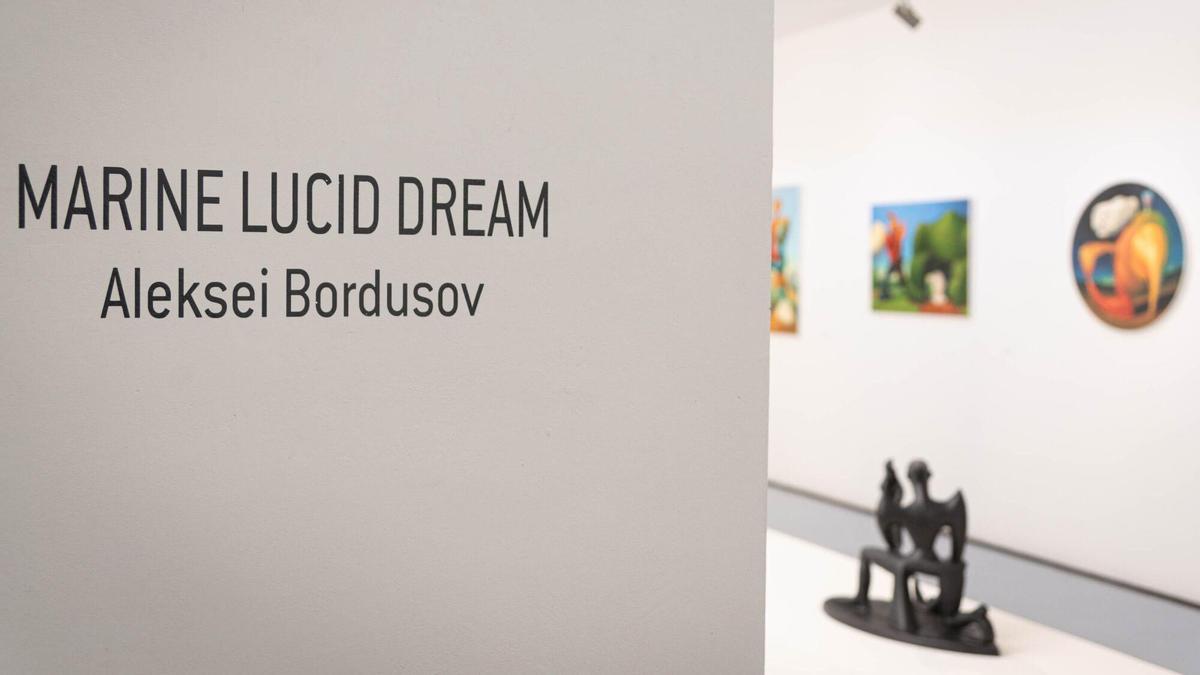
Step into a space suspended between wakefulness and dream, where reality dissolves into a symbolic narrative brimming with contemporary resonance. That is the premise of Marine Lucid Dream, an exhibition now showing at Espacio Bronzo in La Laguna until 26 June. The show brings together paintings, sculptures, and drawings created between 2022 and 2026 by Ukrainian artist Aleksei Bordusov, who settled in Tenerife after leaving his homeland at the outbreak of war.
The project is the result of a collaboration between Espacio Bronzo and Adda Gallery Ibiza, an alliance that has broadened the reach of Bordusov’s work. For the first time, he has produced three-dimensional pieces, adding a new dimension to his practice, while maintaining an international connection with audiences already familiar with his artistic journey. Visitors can view three bronze works, two ceramic pieces, four drawings, and several paintings, all sharing a recognisable visual vocabulary now charged with a fresh atmospheric tension.
Curating the liminal: between past and present
Curated by Anna Dimitrova, the exhibition offers a journey in which the experience of displacement is presented not as rupture, but as transformation. “The selection responds precisely to that liminal condition between two states. What was interesting was to present pieces that reflect a consciousness not fully anchored in either the past or the present, nor in the place of origin or the place of welcome,” Dimitrova explains. She adds that the concept of “lucid dreaming” serves as the narrative backbone of the show.
Undoubtedly, the exhibition could not have been the same in any other setting. “This series was born from a specific geographical and temporal experience. The relationship between isolation, ocean, volcano, and light creates conditions that permeate the entire exhibition,” Dimitrova argues. Yet Bordusov never seeks to escape his past; instead, his approach revolves around a metaphor of active consciousness in the midst of uncertainty. “In a lucid dream, one recognises they are dreaming but continues to participate in the dream. That image perfectly describes the artist’s position in response to the changes that have marked his life in recent years,” she notes.
From war to Tenerife: a story of adaptation, not rupture
The exhibition does not limit itself to a biographical or political reading, even if the starting context is unavoidable. Specifically, Aleksei Bordusov was forced to leave his country when Ukraine entered the war and found in Tenerife a new space for production and reflection. However, the show avoids any narrative oversimplification: “It does not tell a story of rupture, but a process of adaptation, and the works show how the artist incorporates new visual references without abandoning his own language,” the curator states.
In this sense, Marine Lucid Dream can also be read as an open reflection on contemporary rootlessness. “It speaks about the need to rebuild a relationship with the world, an issue that recurs today more than we would like due to migratory currents,” Dimitrova says. She also highlights the resilience, imagination, and ability to generate new forms of belonging that the artist brings to this project.
Identity, territory, and a dialogue of visual worlds
The dialogue between identity and territory forms another core of the exhibition at Bronzo. Far from cultural substitution, Bordusov’s work presents itself as a hybrid space that “does not abandon his visual universe, but proposes a dialogue between both concepts”—those long present in his work and those that have inevitably emerged with his arrival in Tenerife. The result is “a work in constant motion, between memory and the present,” Dimitrova explains.
A multimedia ecosystem of complementary mediums
Marine Lucid Dream unfolds as an ecosystem of complementary mediums. While the paintings build a symbolic narrative with strong mythological undertones, the drawings offer a more intimate and reflective register. Finally, the sculptures introduce a physical dimension that allows the figures to share space with the viewer. “More than independent disciplines, they function as different states of the same imagination,” the curator notes.
She also speaks of Tenerife’s presence in every detail of the Ukrainian artist’s work. The volcanic light, the ocean, and the island’s architecture permeate the pieces: “Tenerife appears as a space of transformation. It is not simply a backdrop, but configures itself as an active presence that conditions the creator’s perception.” The introduction of these elements has allowed the artist to expand his vocabulary, as the curator explains: the light of Tenerife gives a distinct quality to the colours and the presence of figures in Bordusov’s works, while the ocean introduces a sense of openness.
What’s happening in the Canaries – straight to your phone
News, weather alerts and practical updates – direct from the islands, in English. We live here and know what’s going on – before the international media catch up. Everything lands on our WhatsApp channel – no middlemen, no algorithm. Curated for families, expats and travelers.

Hotel facade fire in Las Palmas causes material damage

Tenerife comic salon returns with 40 exhibitions and 80 artists

Buenavista del Norte and Villa de Mazo compete for Christmas lights glory

Tourism overcrowding and its impact on Canary Islands healthcare

WOMEX 2026 closes in Gran Canaria as Tenerife named 2027 host

Five French sailors injured as yacht hits rocks off Lanzarote

Amaia Montero’s emotional tribute at Gran Canaria concert

Netflix begins filming new thriller in Tenerife

Loquillo and Amaia headline Tenerife Peñón Fest 2026
