
‘Run, the English are coming!’
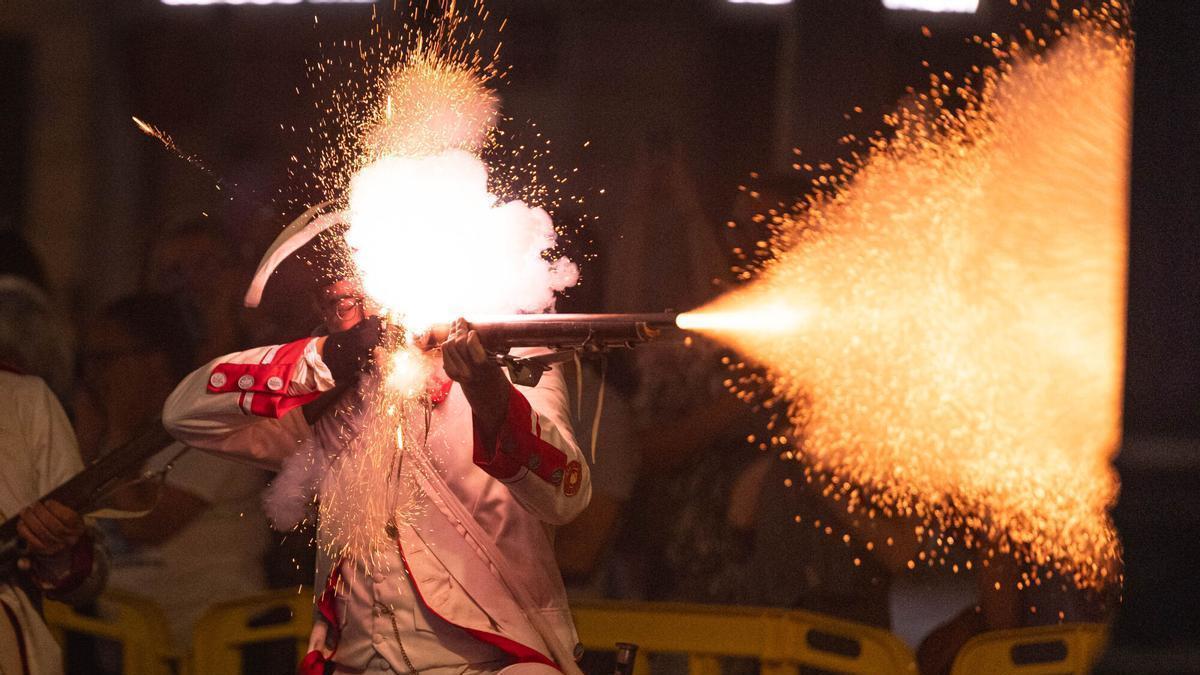
“Neighbours, run—the English are coming!” A woman dressed in period costume cries out from El Cabo bridge and breaks into a sprint. Moments later, the bells of La Concepción church begin to peal. A group of men dressed as 18th-century British soldiers, in distinctive red and white uniforms, emerges from the mouth of the Santos ravine. Then the shooting starts—an exchange of cannon fire that fills the air with smoke and the sharp smell of gunpowder. On the opposite side, descending from Serrador bridge, the Tenerife forces, wearing blue and purple or white and crimson, take up positions to defend against the invasion.
Santa Cruz de Tenerife recreated its greatest historical feat on the night of Friday, 24 July 2026, journeying back to those summer days of 1797 when the city was taken by surprise by an attack unlike the usual raids of the era. This time, the threat was not pirates or corsairs, but the forces of the most daring and admired commander in the history of the British Royal Navy: Horatio Nelson.
‘It was a miracle’
José Núñez, playing a member of the Taganana militias, declares with utter conviction that what the troops led by General Gutiérrez achieved 229 years ago was “a miracle.” “The number of soldiers and civilians who united to defend the capital was smaller, and so were the resources at their disposal,” he explains. “The key was General Gutiérrez’s organisational ability and his strategy. Communication was carried out through bonfires on the mountains, and the support of the civilian population was decisive.”
Domingo Suárez, 73, a volunteer dressed as a first sergeant, jokes with other re-enactors that he would have been called Dominic had the islanders not triumphed. He has not missed a single re-enactment since the event began to be organised on a grand scale in 2018. “We’ve won every time, thank God,” he says with a laugh.
Beside him, Miguel Mendiguchía, a retired colonel born in Seville who has lived in Tenerife for over a decade, explains the weaponry they are carrying. The re-enactors use Spanish rifles and British Brown Bess muskets, replicas of those used on these same streets in 1797, when the city had just 8,000 inhabitants. “Today they are manufactured in England, India, and in Spain’s Basque Country,” Mendiguchía reveals. “If we fitted them with projectiles—which back then were lead balls—we would kill someone. But that’s not the idea, because today the men playing the English are locals.” He adds reassuringly: “No one need worry: we only use gunpowder, and we have a special permit to handle weapons like these; otherwise, we couldn’t take part.”
Women on the front line
Domingo Suárez is struck by how Taganana’s mayor at the time, Andrés Perdomo, managed to recruit civilians during his long, arduous walk to Santa Cruz from the Anaga massif via La Laguna. But Ana Bravo is captivated by the dedication of the many women who, defying death, joined the battle and risked their lives. “It was a woman who warned the soldiers that the English were coming, having spotted their ships from the mountains; it was women who carried water, food, and bandages; and it was women who not only tended to the local soldiers but also to the English who fell wounded,” recalls this member of the Historical-Cultural Association La Gesta of 25 July 1797.
For Ana Bravo, that episode was “far more than a military victory.” “It was not just a win; Tenerife prevailed with values—tending to wounded English soldiers, treating the enemy with the utmost respect despite the circumstances,” she emphasises. “It was a demonstration of resilience, courage, honour, and humanity. That is why Nelson, after losing both a battle and an arm, later wrote that he would never again attempt to attack the Islands, given the honourable treatment they received.”
Fire, smoke, and history
Before the skirmish, a video-mapping display projected the most significant facts about La Gesta onto the façade of the Museum of Nature and Archaeology (MUNA): 3,700 English soldiers distributed across nine ships on the invading side, 1,669 soldiers in the Tenerife defensive force, a battle that raged between 24 and 25 July 1797, 226 dead on the British side—97 of them drowned when the Cutter Fox sank—and 32 on the island side. Among the local heroes were many civilians who had received military training. It was common in an era when frequent pirate attacks on the islands forced farmers, craftsmen, officials, and the rest of the civilian population, regardless of their background, to be prepared for the worst.
Cristina Sánchez, a native of Santa Cruz who lives in Candelaria and is attending the re-enactment for the second time, knows the basics but admits she is not familiar with many more details. “I know the essentials, for example that Nelson lost an arm,” she says, accompanied by two friends who, like her, did not want to miss the spectacle. What would she have preferred—Tenerife to be Spanish or English? The question catches her off guard. “Given the state of the Spanish government, I’m not so sure…” she replies with a mischievous smile.
History repeats itself—with the same result
Around her and the several thousand spectators crowding the edges of the ravine, the confrontation intensifies. Sparks from the gunfire and the thunder of the cannons jolt the night air. On the bridge, the President of the Canary Islands, Fernando Clavijo, and the Mayor of Santa Cruz, José Manuel Bermúdez, cover their ears after each detonation. The battle moves to other parts of the capital, such as Calle del Castillo. Those playing the English speak in English. “Hurry up,” urges one of the enemy commanders. But haste and technological superiority were of no use. The outcome is written. The island wins—and wins convincingly. Tenerife 229, England 0. They will never defeat us, no matter how hard they try.
What’s happening in the Canaries – straight to your phone
News, weather alerts and practical updates – direct from the islands, in English. We live here and know what’s going on – before the international media catch up. Everything lands on our WhatsApp channel – no middlemen, no algorithm. Curated for families, expats and travelers.

Hotel facade fire in Las Palmas causes material damage

Tenerife comic salon returns with 40 exhibitions and 80 artists

Buenavista del Norte and Villa de Mazo compete for Christmas lights glory

Tourism overcrowding and its impact on Canary Islands healthcare

WOMEX 2026 closes in Gran Canaria as Tenerife named 2027 host

Five French sailors injured as yacht hits rocks off Lanzarote

Amaia Montero’s emotional tribute at Gran Canaria concert

Netflix begins filming new thriller in Tenerife

Loquillo and Amaia headline Tenerife Peñón Fest 2026
