
Hundreds of volunteers become a living work of art
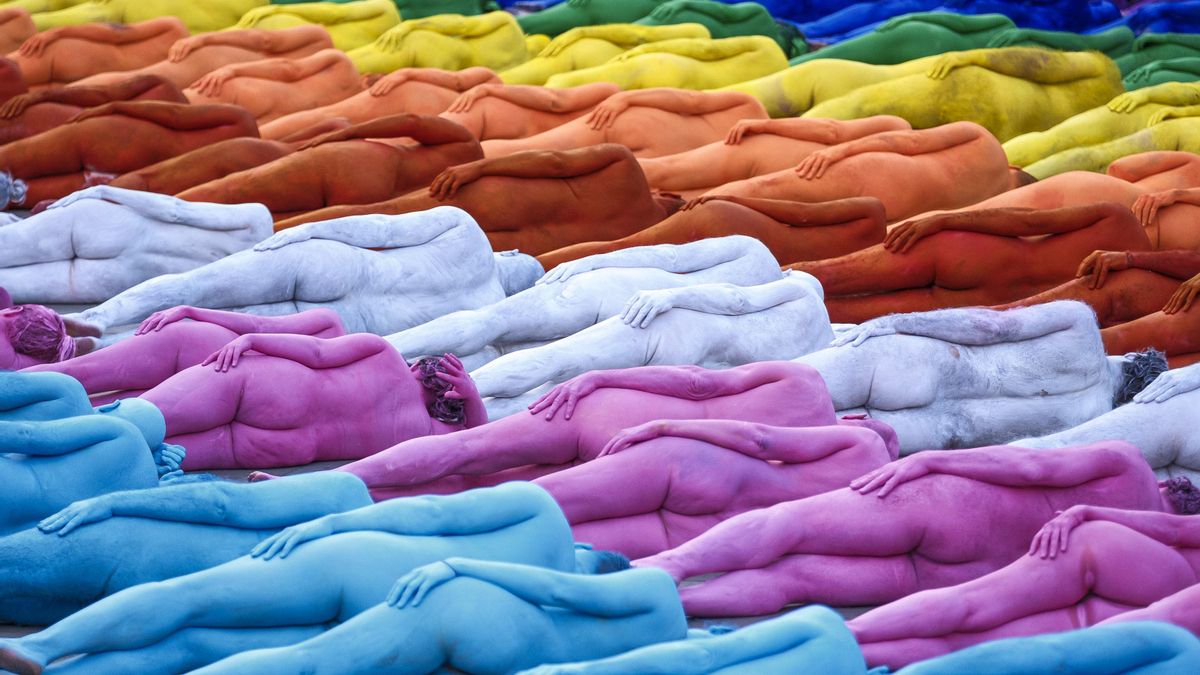
The first light of Sunday had barely begun to illuminate the facade of Santa Ana Cathedral when the usual silence of Vegueta was replaced by an unprecedented scene. Hundreds of naked people, painted in eleven different colours, filled the square following the directions of American photographer Spencer Tunick until they formed a giant rainbow flag made of human bodies.
The installation, titled Gran Spectrum, brought together nearly 500 participants in the historic heart of Las Palmas de Gran Canaria as part of the programme for Culture Business Pride 2026. For a few minutes, the work transformed one of the most emblematic spaces in the Gran Canarian capital into a symbol of diversity, freedom, and a rallying cry for LGTBIQA+ rights.
From the roof of the Casas Consistoriales, Tunick directed the composition as the volunteers, arranged by colour range, took their positions on the square’s paving stones to complete the enormous human rainbow flag. The photograph used the dawn light to capture one of the most extraordinary images the city has seen in recent years.
Las Palmas joins an exclusive list of cities
With this installation, Las Palmas de Gran Canaria joins the select group of cities chosen by Spencer Tunick for his artistic interventions, alongside locations such as New York, Barcelona, London, Vienna, Sydney, and Mexico City – where the photographer once gathered more than 18,000 people.
Participants began gathering early in the morning on the streets surrounding the Plaza de Santa Ana. After receiving a pot of body paint, each person applied their assigned colour before entering the space where the artist reorganised the rows until the final composition was achieved. Following the main session, the team moved to a second location near the Casa de Colón, which was carried out without media access.
Why Tunick rejected the Maspalomas dunes
Although Tunick studied various locations in Gran Canaria during the months leading up to the event, the American photographer ultimately decided to place the work in Vegueta and ruled out one of the island’s most iconic sites: the Maspalomas dunes. Tunick explained that working in a protected natural space did not fit with the philosophy of his work. During his visit, he observed the high tourist pressure the area is under and refused to add further impact to a particularly sensitive ecosystem.
“I would never do something like that in the middle of a virgin place, because my intention with my work is never to dirty the land,” the artist said during the presentation of the project.
Instead, he found in Vegueta the ideal setting for an intervention where the human body could enter into dialogue with the city’s history. According to Tunick, the hundreds of participants were able to temporarily reconfigure the meaning of a space with more than five centuries of history without altering the environment.
Nudity as artistic material, not provocation
Far from presenting nudity as provocation, Spencer Tunick once again uses the human body as artistic material. In Gran Spectrum, the volunteers became the canvas itself for a work conceived to represent the plurality of identities and sexual orientations through eleven different shades.
The installation also opens the programme for Culture Business Pride 2026, which will bring together conferences, cultural activities, and performances focused on the defence of human rights and diversity in Gran Canaria until 1 August.
What’s happening in the Canaries – straight to your phone
News, weather alerts and practical updates – direct from the islands, in English. We live here and know what’s going on – before the international media catch up. Everything lands on our WhatsApp channel – no middlemen, no algorithm. Curated for families, expats and travelers.

Hotel facade fire in Las Palmas causes material damage

Tenerife comic salon returns with 40 exhibitions and 80 artists

Buenavista del Norte and Villa de Mazo compete for Christmas lights glory

Tourism overcrowding and its impact on Canary Islands healthcare

WOMEX 2026 closes in Gran Canaria as Tenerife named 2027 host

Five French sailors injured as yacht hits rocks off Lanzarote

Amaia Montero’s emotional tribute at Gran Canaria concert

Netflix begins filming new thriller in Tenerife

Loquillo and Amaia headline Tenerife Peñón Fest 2026
