
World’s largest gamma-ray observatory nears first light on La Palma
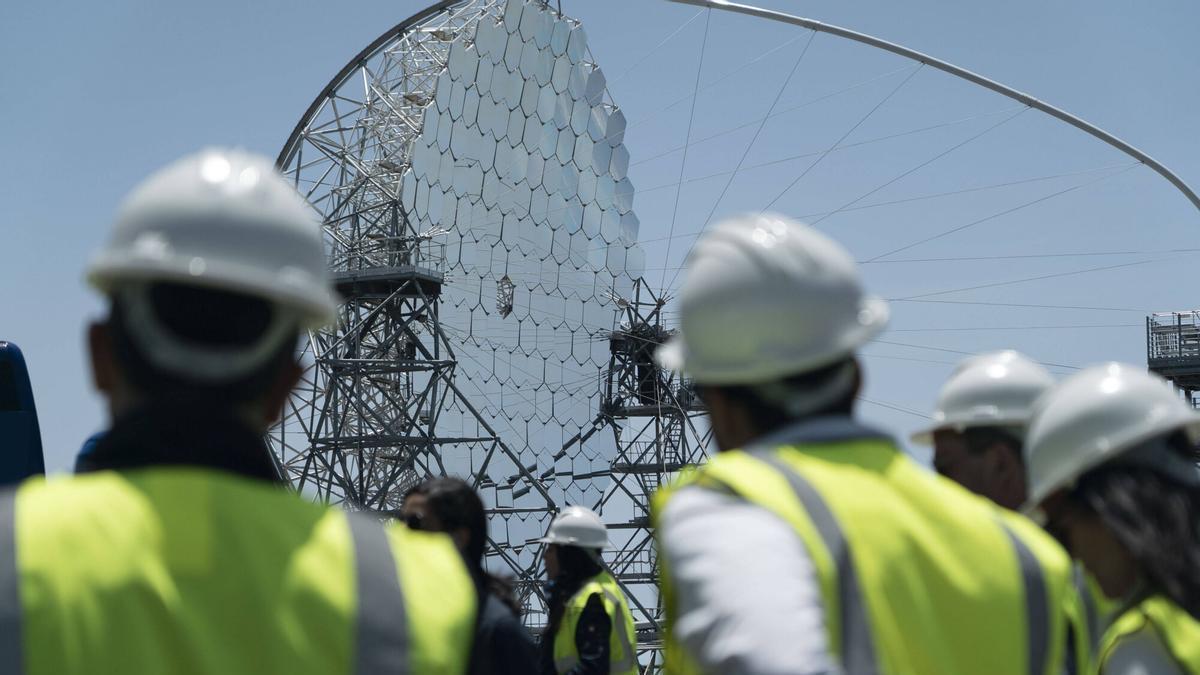
The world’s largest gamma-ray observatory is on the verge of seeing its first light from the summit of the island of La Palma. This summer, the Roque de Los Muchachos Observatory will bring online three new Cherenkov telescopes, completing the CTA (Cherenkov Telescope Array) network. These distinctive telescopes, shaped like giant antennas and covered in tiny mirrors, represent the final component needed to activate this ambitious network, designed to detect the most violent phenomena in the cosmos.
International authorities gather for key meeting
This morning, officials from countries around the world gathered in Los Cancajos, Santa Cruz de la Palma, to discuss progress and the future of this large-scale infrastructure, which will become almost fully operational this summer. Representatives from eleven nations – all partners in the international CTAO ERIC consortium backing the project – along with the Institute of Astrophysics of the Canary Islands (IAC) and La Palma’s island council (Cabildo), attended the meeting. This event serves as a prelude to the observatory’s official inauguration, scheduled for 15 October of this year.
“Holding this meeting this week is confirmation that La Palma is a world reference in astrophysics and that the relationship between society and the authorities is a model of success,” said Valentín Martínez Pillet, director of the Institute of Astrophysics of the Canary Islands. He explained that “this network reflects the support of the Spanish government for the construction of these telescopes using European Regional Development Fund (ERDF) resources, in addition to support from the Government of the Canary Islands and the Cabildo of La Palma.” The Spanish government has contributed around €50 million to the project.
Juan Ramón Felipe San Antonio, vice-president of the Cabildo of La Palma, highlighted that “this meeting and these telescopes are proof that La Palma remains, by right, one of the world capitals of science and one of the clearest windows to the sky.”
Completing a network years in the making
These three new telescopes, known as LSTs (Large-Sized Telescopes), will complete a network that first began to take shape in 2018. That year saw the start of operations for LST-1, the first of these giant gamma-ray hunters. Even without the support of the other telescopes, it has already contributed to our understanding of the cosmos. In 2023, it detected the most distant quasar ever observed by ground-based gamma-ray instruments.
The technology is designed to capture gamma rays – a form of light emitted by some of the most extreme and violent phenomena in the universe, such as supermassive black holes and supernovae. “Some events can happen in a matter of seconds, like the merger of two black holes, and with other technology they escape us,” says Juan Cortina, chair of the CTAO LST Collaboration Steering Committee.
Exploring the frontiers of physics
Once operational, the observatory will also help scientists understand the origin and role of relativistic cosmic particles, and explore the frontiers of physics, including the search for dark matter and deviations from Einstein’s theory of relativity. However, this ambitious scientific project began to take shape back in 2010, with the goal of upgrading the technical and scientific capabilities of its predecessors, the MAGIC telescopes. “They are actually very similar in terms of structure,” observes Cortina. However, the Cherenkov telescopes are twice as large – increasing from 17 metres to 23 metres in diameter – and far more sophisticated. “With MAGIC, there was a room housing all the telescope electronics; now, a single camera inside the telescope itself is sufficient,” the researcher adds.
Working together in perfect sync
The uniqueness of this telescope network lies in its ability to work in unison. The great advantage of the four antennas that will begin capturing gamma rays from the summit of the ‘Isla Bonita’ (Beautiful Island) is that they can be synchronised to observe the same phenomenon at the same time. “They are very obedient,” jokes Cortina, summarising their method of operation: “It’s like having two eyes and being able to see the world in 3D.” These structures are also designed to move very quickly. “In just 20 seconds, they can all point at the same target,” he emphasises.
More telescopes to come in the Canary Islands
These four LSTs represent only the first phase of a project that also has a counterpart in the southern hemisphere. In addition to these larger telescopes, nine smaller ones, measuring 12 metres, will be built in the Canary Islands. “The tendering process has already begun, and our goal is to start construction on the first one this year,” says the project lead. These are known as MSTs (Medium-Sized Telescopes). Although they have less capacity to probe the depths of the cosmos, they will support the observations carried out and provide greater resolution.
A global project spanning both hemispheres
However, this major international project would remain incomplete without also encompassing observations in the southern hemisphere. To this end, the Paranal Observatory of the European Southern Observatory (ESO) in the Atacama Desert (Chile) is also set to host part of this infrastructure, allowing the two locations to complement each other. CTAO-South, as it is known, will house five Small-Sized Telescopes (SSTs), measuring just nine metres, and two MSTs. Progress is being made on the construction of the SSTs, with software integration tests carried out in early May.
Under the currently approved design, known as the Alpha Configuration, the CTAO will consist of 64 telescopes in total: 13 in the northern hemisphere and 51 in the southern hemisphere. It will also be the first ‘open’ observatory, with its data and analysis software available worldwide after an initial period of exclusive use.
What’s happening in the Canaries – straight to your phone
News, weather alerts and practical updates – direct from the islands, in English. We live here and know what’s going on – before the international media catch up. Everything lands on our WhatsApp channel – no middlemen, no algorithm. Curated for families, expats and travelers.

Canary Islands sea hits second-hottest year on record

Legal bid to halt tree felling in Santa Cruz’s La Salud

Fiesta del Charco: A journey through La Aldea’s past

Corralejo dunes power line set for removal

ULPGC launches 14 research projects at Las Canteras

TMT will never be built, says Canary Islands astrophysics chief

Pedro Duque: Canarias is the “ultimate dream” for rockets

Court blow to Tenerife motor circuit project
La Palma faces new volcanic risk planning deadline
