
Green fireball spotted across the islands
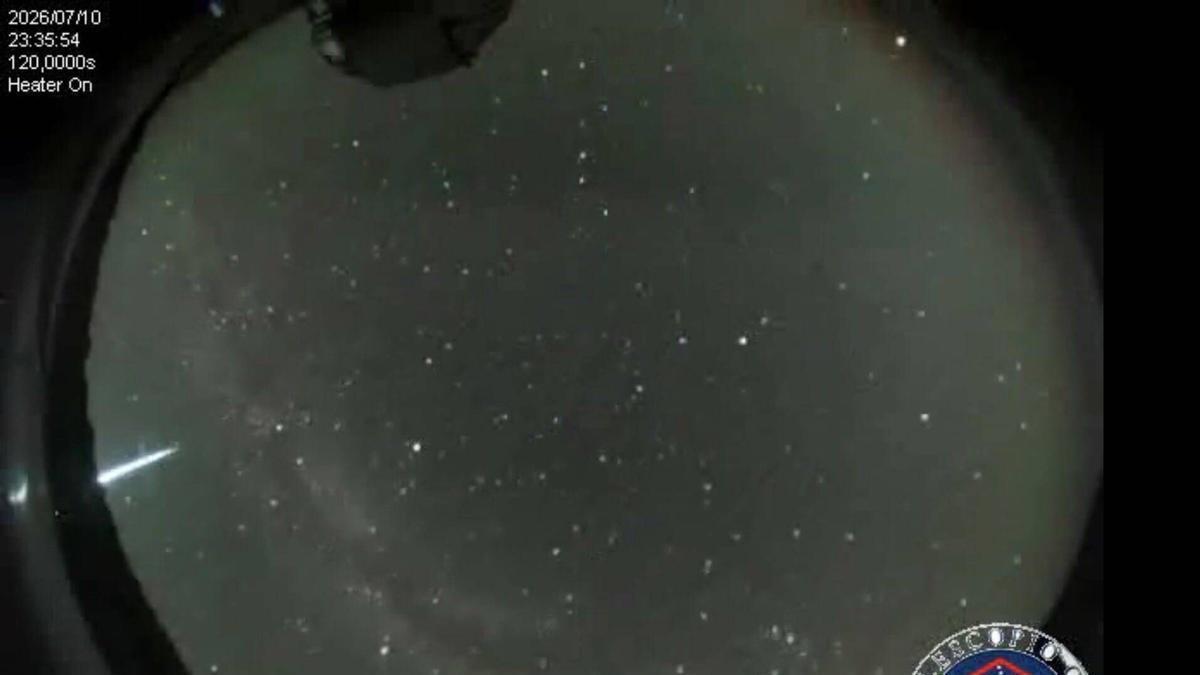
Just a few minutes before midnight on Saturday, a green trail from an unidentified object streaked across the sky over the Canary Islands, astonishing thousands of onlookers. Seconds later, the 112 emergency hotline was inundated with calls like never before in decades, while telescopic lenses immortalised that intense emerald glow.
Size of a football, burned up in the atmosphere
Today, preliminary analyses carried out by the Institute of Astrophysics of the Canary Islands (IAC) reveal that the culprit behind that flash of light was a fireball the size of an orange or a football – between 10 and 30 centimetres across. This is confirmed by IAC astrophysicist Javier Licandro, an expert in meteorite monitoring and other celestial bodies, who also states that it fell along the eastern and northeastern slopes of the Canary Islands, heading towards the constellation of Pegasus. This trajectory made it equally visible from both La Palma and Tenerife.
Indeed, the object was caught by the celestial camera lens of the Gran Telescopio Canarias (GTC), located at the Roque de los Muchachos Observatory on La Palma. It was also captured by the cameras of the AMOS experiment (All-Sky Meteor Orbit System), installed at both the Teide Observatory and the Roque de los Muchachos Observatory.
Did it land anywhere?
This space rock did not end up landing anywhere near the Canary Islands. Due to its small size, the most likely scenario is that it burned up completely as it crossed the atmosphere. However, even if it had been larger, it most likely would not have fallen on the islands either. As the researcher explains, in that case it would have come down near the ocean, relatively far from the archipelago.
What happens next
The information to be gathered from now on depends on the analysis of data from the AMOS system. This experiment will allow scientists to triangulate its trajectory and, thanks to the spectra obtained during the fireball’s passage, analyse both its brightness and its composition. This data is currently being examined by a Slovakian scientific team. The AMOS system consists of a fisheye lens, an image intensifier, a projection lens and a digital video camera. This simple setup is designed for meteor observation, although it could also be used for meteorological, geophysical, aeronautical or satellite observations.
Emergency services flooded with calls
Before these findings were made public, the 112 service confirmed that it received numerous calls around 23:37 from various locations across the Canary Islands. Those who reported the phenomenon described it as a “point of light” crossing the sky, although the emergency services were unable to determine its nature at the time.
What’s happening in the Canaries – straight to your phone
News, weather alerts and practical updates – direct from the islands, in English. We live here and know what’s going on – before the international media catch up. Everything lands on our WhatsApp channel – no middlemen, no algorithm. Curated for families, expats and travelers.

Canary Islands sea hits second-hottest year on record

Legal bid to halt tree felling in Santa Cruz’s La Salud

Fiesta del Charco: A journey through La Aldea’s past

Corralejo dunes power line set for removal

ULPGC launches 14 research projects at Las Canteras

TMT will never be built, says Canary Islands astrophysics chief

Pedro Duque: Canarias is the “ultimate dream” for rockets

Court blow to Tenerife motor circuit project
La Palma faces new volcanic risk planning deadline
