
What are dark galaxies?
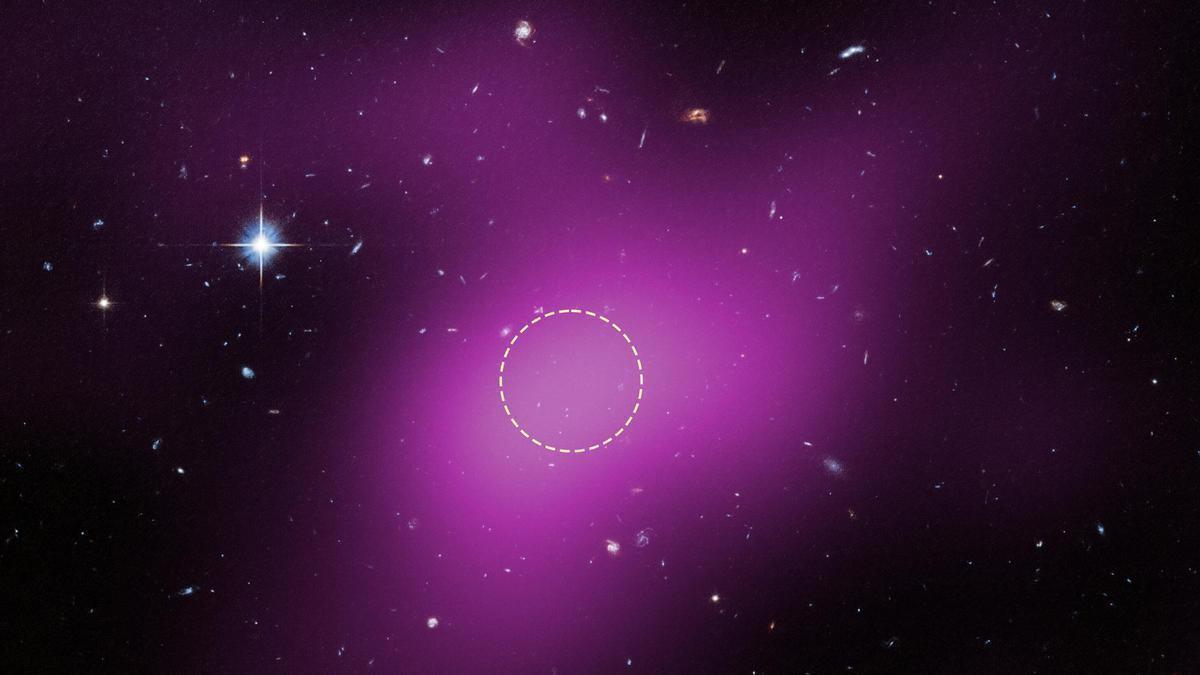
There are galaxies that do not shine with their own light. In fact, they emit no light at all because they cannot form stars. These are known as “dark” galaxies, another piece in the intricate ecosystem of dark matter — that hypothetical cosmic property almost as elusive as it is abundant, making up nearly 85 per cent of the universe. Their existence presents an uncomfortable reality for astronomy, as until now, scientists did not understand why they were unable to create celestial clusters around them.
Breakthrough study from the Canary Islands
Today, a study carried out in the Canary Islands sheds light into this shadowy darkness. The pioneering research, published in the journal Astronomy & Astrophysics and led by the Instituto de Astrofísica de Canarias (IAC) and the University of La Laguna (ULL), demonstrates that these galaxies form under specific conditions to which dark matter is exposed.
“These galaxies arise in dark matter halos with particular properties, where the gas never reaches the densities needed to trigger star formation,” explains Guacimara García Bethencourt, a doctoral student at ULL who is developing her thesis on this subject.
How dark galaxies stay dark
The study, co-authored by García Bethencourt alongside her supervisors Arianna Di Cintio and Sébastien Comerón — both professors in ULL’s Department of Astrophysics and IAC researchers — also provides key insights for detecting these objects across the vastness of the universe, despite the fact they emit no light. And this discovery could not come at a better time, as dark galaxies are among the current obsessions of cosmological debate.
Recent observations by NASA and ESA
In recent weeks, both NASA and the European Space Agency (ESA) have announced the discovery of the first observational candidates for dark galaxies, including the object known as Cloud-9, confirmed using the Hubble Space Telescope. Cloud-9 is a gigantic gas cloud that contains not a single star. It is located near the spiral galaxy Messier 94, some 14 million light-years from Earth, and was quickly determined to be dominated by the gravity of dark matter.
The gas that makes up Cloud-9 consists mainly of neutral hydrogen — the most abundant element in the universe and the fundamental raw material for star formation.
A roadmap for discovery
In this context, the researchers from the Canary Islands predict that up to eight dark galaxies could be observable in the vicinity of the Milky Way through the emission of neutral hydrogen, opening the door to their detection in future surveys. However, this work does more than reinforce one of the fundamental predictions of the Lambda-Cold Dark Matter (ΛCDM) cosmological model — the standard theoretical framework describing the origin, evolution and fate of the universe. It also offers a concrete guide for discovering a population of galaxies that has, until now, remained hidden.
“The universe could be full of invisible galaxies… and we are closer than ever to finding them,” the researcher concludes.
What’s happening in the Canaries – straight to your phone
News, weather alerts and practical updates – direct from the islands, in English. We live here and know what’s going on – before the international media catch up. Everything lands on our WhatsApp channel – no middlemen, no algorithm. Curated for families, expats and travelers.

New map reveals 60+ closed beaches in Canary Islands

Tenerife strikes deep geothermal milestone

La Gomera named among world’s quietest islands

Geothermal energy breakthrough in Tenerife

Tenerife strikes geothermal energy in Vilaflor

Canary whales face ship strike risk warns new study

The underwater ‘grandmothers’ of the Canary Islands

Galaxy M74’s hidden star disc discovered by IAC

Canary banana prices hit year low in August
