Concrete sunbeds at Tacorón spark outrage
The placement of concrete sunbeds in a cove on the island of El Hierro has ignited a fierce controversy. El Pinar town council has begun installing nearly 80 sun loungers at Tacorón, on the southwestern coast of the island, as part of a package of improvements funded by €3.6 million from European coffers. According to a press release issued in April by the Canary Islands government’s tourism department, the project aims to “diversify the tourist offering and reinforce the heritage and natural value of the municipality”.
‘Environmental assault’ claims
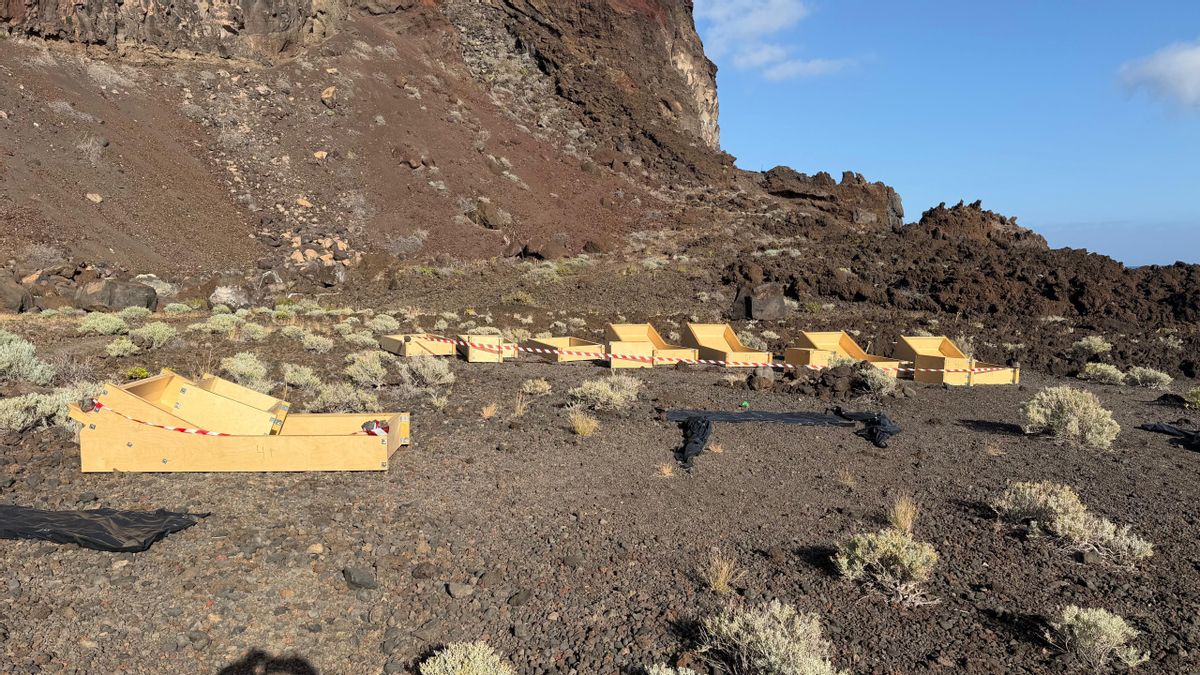
However, the campaign group Save Tacorón has branded the works an “environmental assault” and is demanding they be halted immediately. Asked for comment by this newspaper, El Pinar’s tourism councillor, Magaly González, said the sunbeds “are furniture; they are not anchored to the ground, they are movable and are placed on the ground as it is. No modifications will be made to the land,” she insisted. On the number of sunbeds and their material, she confirmed they are concrete loungers and that, although 80 were planned, “they will surely be fewer, almost certainly.”
“Because you cannot touch the terrain, fewer will probably be installed because they have to be spaced apart, and you have to place them where there are no stones. They will be put where the land allows,” she added. In a video posted on the council’s Facebook page, González justified the choice of material by saying it was intended to have as little visual impact as possible, and that the colour – grey – matches the ground. “Although they are designed in concrete and grey, we will try to make them as integrated as possible. That is, they can later be given some treatment,” she told this newspaper.
Protected land and vulnerable species
Two photographs seen by this newspaper show black plastic bags on the ground in the area. The tourism councillor explained they were “just to see where [the sunbeds] could be placed.” Save Tacorón has launched a campaign on change.org which has already gathered 1,633 signatures. In it, they denounce that the council is going to occupy “protected land, free of buildings.” “This coastal area is part of the El Hierro Special Protection Area for Birds (SPA),” they warn, highlighting that among the birds native to this space is the Cory’s shearwater, a vulnerable species.
According to the group, the habitat of the protected fern or adder’s tongue is also being disturbed, “which has in the plain one of its last refuges on El Hierro.” “Given these serious environmental impacts, work should be suspended immediately; it should have been limited to repairing existing facilities (picnic areas, car parks and sunbathing areas by the pool),” they stress. Furthermore, the group warns that beyond the environmental damage, a symbol of the island is being destroyed – “a site of extraordinary geological and landscape value.”
‘Loss of environmental quality and territorial identity’
“The mass installation of concrete sunbeds in Tacorón represents an aggressive and disrespectful occupation, degrading the harmony of the landscape with its artificiality,” they state. Save Tacorón insists that “turning a volcanic coastline” into an area of intensive tourist use “represents an obvious loss of environmental quality and territorial identity.” In response to the criticism, González said that “just as there is a group against it, there are also other people who think it is a good idea.”
How the project unfolded
The councillor explained that before this work could begin, they first had to approve the General Planning Plan (PGO) because Tacorón belonged to three different companies, and only then could expropriation begin. “Once approved, we had to find money to carry out the execution,” she noted. So they applied for a European project worth nearly €3.7 million, which included the expropriation of Tacorón and the renovation of the entrance to La Restinga. In 2024, she continued, when Tacorón was already publicly owned, they began projects to renovate the footpaths, picnic areas and the kiosk at this site.
“We had a deadline to finish by early summer this year, and the permits for the kiosk were taking longer. We separated the kiosk from the rest and continued with the shades and the paths,” she indicated. The European project had several strands. Each one had to account for 10% of the total budget. When the kiosk was separated from the joint project, the amount allocated to the Tacorón strand fell below that 10%. That is why, the councillor acknowledges, they included the installation of sunbeds and umbrellas.
Part of a wider sustainability plan
The placement of sunbeds in Tacorón is part of the Destination Tourism Sustainability Plan (PSTD) ‘Mountain, Sea, Volcanoes and Traditions’, which involves an investment of €3.6 million. During a visit to El Hierro, the Canary Islands government’s tourism minister, Jéssica de León, explained that the interventions covered iconic spaces such as Tacorón beach and various footpaths in the municipality to “diversify the visitor experience and encourage tourists to explore and enjoy the surroundings beyond the tourist accommodation.” Among the works included in this plan are the adaptation of the footpath and renovation of the pergolas in Tacorón (€616,433), the completion of the urban footpath in El Pinar (€353,000), and the digitisation of the Cultural Heritage Assets of Las Casas and Taibique (€60,151).
What’s happening in the Canaries – straight to your phone
News, weather alerts and practical updates – direct from the islands, in English. We live here and know what’s going on – before the international media catch up. Everything lands on our WhatsApp channel – no middlemen, no algorithm. Curated for families, expats and travelers.

Canary Islands fish could hold key to fighting cancer

Earthquake felt in Tenerife and Gran Canaria

Rare deep-sea codlet confirmed in Canary waters for first time

Tenerife faces summer with just two campsites amid outdoor tourism boom

Canary Islands to get first dedicated biodiversity law

Tenerife seismic activity: 550 events recorded in 24 hours

Contigo La Palma slams ‘unethical’ banana aid compensation
Canary Islands observatories get major data network boost
Energy storage framework finally approved for Canary Islands