Like a time machine offering a trip to the past, the hour it takes to cover almost a hundred kilometres from the Tenerife capital to the historic centre of Santiago del Teide transports you back to the first half of the last century, when bartering agricultural produce governed relations between neighbours to secure their livelihoods.
Twenty years of tradition
The recreation was born twenty years ago, according to its promoter, Juan Antonio Jorge Peraza, who has the backing of the Fundación Tenerife Rural, to which he belongs, and the Cabildo (island government). At the time, he was working at El Tanque town hall and one day, after spending the night in his car, he noticed the number of people moving around in the early hours and decided to rescue the ethnographic memory of the mountain pass. But not by travelling back in time by car—rather by recreating period scenes, with goatherds, people who worked in galleries, Civil Guards, rural women…
The route of the recreation
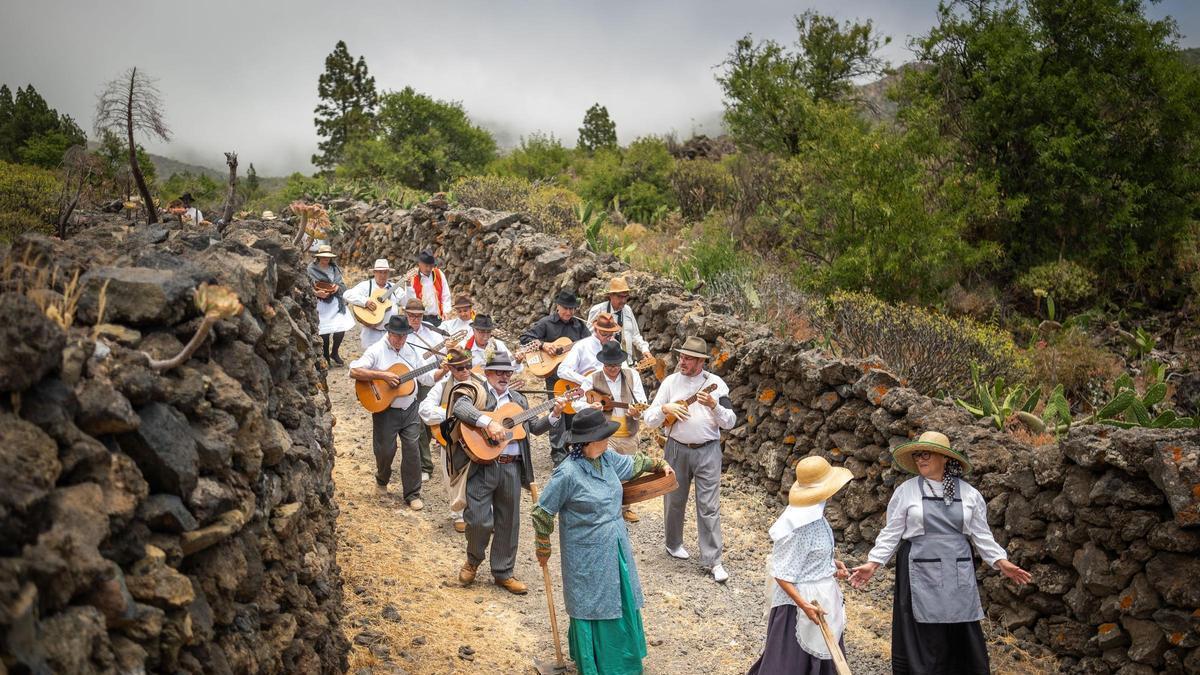
The encounter with the past begins this Sunday, 28 June, at ten in the morning in San Francisco de La Montañeta, in Garachico, and continues almost two hours later in San José de Los Llanos, in El Tanque, before ending in the main square of Santiago del Teide. In the third act, upon arrival at the old royal road once used to travel to the square for bartering, the first to arrive are half a dozen members of the Santiago del Teide Folk Dance Workshop, which has been running since 2017 and has been taking part in this ethnographic recreation ever since, explains one of its founders, Raquel Lorenzo. The workshop includes participants from eight-year-old children to people over 75, she says with a knowing smile. She keeps an eye on the older members; she is not in costume herself.
On the path, waiting for the expedition that travels by bus for the final leg from El Tanque, time is passed with jokes, such as the advice a photographer gives to one of the participants to adjust her zacho (a traditional headscarf), freshly bought from the hardware store. “Put it up, at least for the photo,” he asks her.
MasterChef alongside tradition
From the municipal organisation, Martín González recalls that, just a few metres from where the mountain pass and barter are being re-enacted, the second edition of El Reto de MasterChef is taking place at the Casona del Patio, bringing together Raquel Meroño and her daughter Martina, Nagore Robles, Rubén García, Estefanía de Andrés, Luzu, Chefenials and Daniel del Toro, who are on hand to advise participants during the challenges.
Mary Carmen, the heart of the barter
As if to serve as the antithesis of that digital talent show, Mary Carmen Luis prepares for the barter, waiting for the group to arrive with her basket, in which she keeps everything from pepper to precious saffron, which she trades for three loaves of bread. Mary Carmen, at 79 years old—though she hides it perfectly—recalls that she has lived in Santiago del Teide for forty years; in the past she worked at Galerías Preciados in Santa Cruz, and her commercial skills remain intact. “We used to go to La Montañeta and even down to an embankment at La Culata, in Garachico, to continue along the main road, where the bartering was done,” she says, lamenting that the route has shortened over the years.
Mary Carmen’s husband was visually impaired, and the ONCE organisation assigned him a pitch in Santiago del Teide, where he built his life until he passed away during the COVID pandemic. She speaks with the vitality of an entrepreneur capable of bringing people together; she has a word and a smile for all her companions.
While waiting on the royal road, they recall that this year the group from Icod el Alto has not come, nor have “those from the move, from Fasnia, who did theirs on Saturday,” they comment to explain their absence, explaining that la muda was when neighbours changed residence in search of better temperatures. “The one they do in Chirche is beautiful—they recreate weddings, sales, schools…”
Mary Carmen comes closer and, in a hushed voice, shares a confidence: “This is where it all begins, and they take it away,” while showing the cord of the habit of the Virgin of Candelaria that her mother dressed her in and which, decades later, she does not wear with her traditional costume. “Here, I have almonds from Los Baldíos,” she offers to another neighbour. “Mine has volcano blood,” she says in an improvised exchange. Mary Carmen is an artist.
International flavour in the folk dance group
In the folk dance workshop group, most are foreign neighbours, such as Helga O’Hondt, from Belgium, who has been living in Puerto de Santiago for three years; or the Frenchwoman Beatriz Morionet, who has lived in Puerto de Santiago for two years after ending her working life as a language teacher, among other roles. She says she first discovered Santiago del Teide because her father moved there in 1968 from France to meet the clients he sold strawberry plants to. Also in the group is the Dutchwoman Fabiana Hoogeland, who ended up in Tamaimo because her son asked for a change of life. She had already been there in 2005 and returned two years ago. From this Tenerife town, she teleworks for a national park in her home country, while her husband is busy renovating their house and her son is preparing to start a higher-level computing course in Adeje next academic year.
The landowner and the priest
After all introductions… the main group arrives, though there are not many more—the equivalent of a busload plus a couple of extra people. On foot along the royal road, in character, is Don Fernando del Hoyo y Salazar, the first landowner of the area, who allows the barter on his estate; in real life, Roque Armas, from Garachico, raised in Los Silos, married in Cabo Blanco and a resident of Tamaimo, who was roped in last year by the director of the Santiago del Teide Municipal School of Folklore and did so well that he is repeating the role. And all because of his son Daniel Armas, who started at the school when he was seven and has now been there for sixteen years; it runs in the family, as his mother, María del Mar, was a dancer in Cabo Blanco and has taken up the art again. Roque’s profession is waiter, though his passion for acting shines through.
With the landowner present, another authority of the time is missing: the priest, a role played by Fabio Gangarossa, in his first time taking on such duties, though it does not show. At the cry of “photo,” he stands next to a parishioner and, clad in a cassock that seems to make his height eternal, squares up and adopts a blessing posture. Originally from northern Italy, eleven years ago he decided to leave the cold temperatures behind. “Of course, when I arrived here it was forty degrees, just like now,” he comments. A language teacher in his working life, he enjoys retirement in Guargacho.
A sound and colour-filled procession
With no more time for homilies, Juan Antonio Jorge calls him to continue the procession along the royal road towards the village square. The organiser thanks the collaboration of the Arona Municipal School of Folklore, as well as the Group of Friends of Traditions of San Juan de la Rambla, the Nivaria mountaineering group, the Southern Heritage Group, and the Santiago del Teide Municipal School of Folklore. This year the pig farmers are missing, there is no doctor and no Civil Guard in the recreation, admits the promoter of the initiative, who advances along a comfortable path where a folk group provides the soundtrack with a string of isas and traditional songs, beautifully linked together, while demonstrations of stick-fighting, shepherd’s jumping and washerwomen enliven the walk and the subsequent barter.
Arrival in the square and return to the present
Upon arrival at the Santiago del Teide square, the “landowner” hands over to the person waiting at the foot of the step, the mayor—this time the real one—Emilio Navarro, who had just come out of the MasterChef Challenge’s Canarian tea-time, which provided 3,000 euros to one of the participants. Back in real life after the mountain pass performance, there is a feast of ribs, potatoes and pineapples to seal the journey to the past, under a giant marquee that offered relief from the heat that was beginning to take hold. The cloud had begun to clear, but the passion for the past remains alive.
What’s happening in the Canaries – straight to your phone
News, weather alerts and practical updates – direct from the islands, in English. We live here and know what’s going on – before the international media catch up. Everything lands on our WhatsApp channel – no middlemen, no algorithm. Curated for families, expats and travelers.

Sonora Festival 2026 draws 16,000 to Las Palmas

Two men injured in fall from wall in Playa de Troya
Tenerife-forged bell rings again in tiny Rioja village

Canarian journalists to discuss a world in conflict at Las Palmas theatre
Festival del Sur returns to Agüimes with theatre from three continents
Man, 24, seriously hurt in buggy crash on Gran Canaria track

Woman, 81, rescued from sea at Las Vistas beach in Adeje

Tenerife to receive ES-Alert volcano drill messages

Canary film Benito Pérez Buñuel to premiere in Venezuela