Tenerife’s very own World Cup with a powerful message
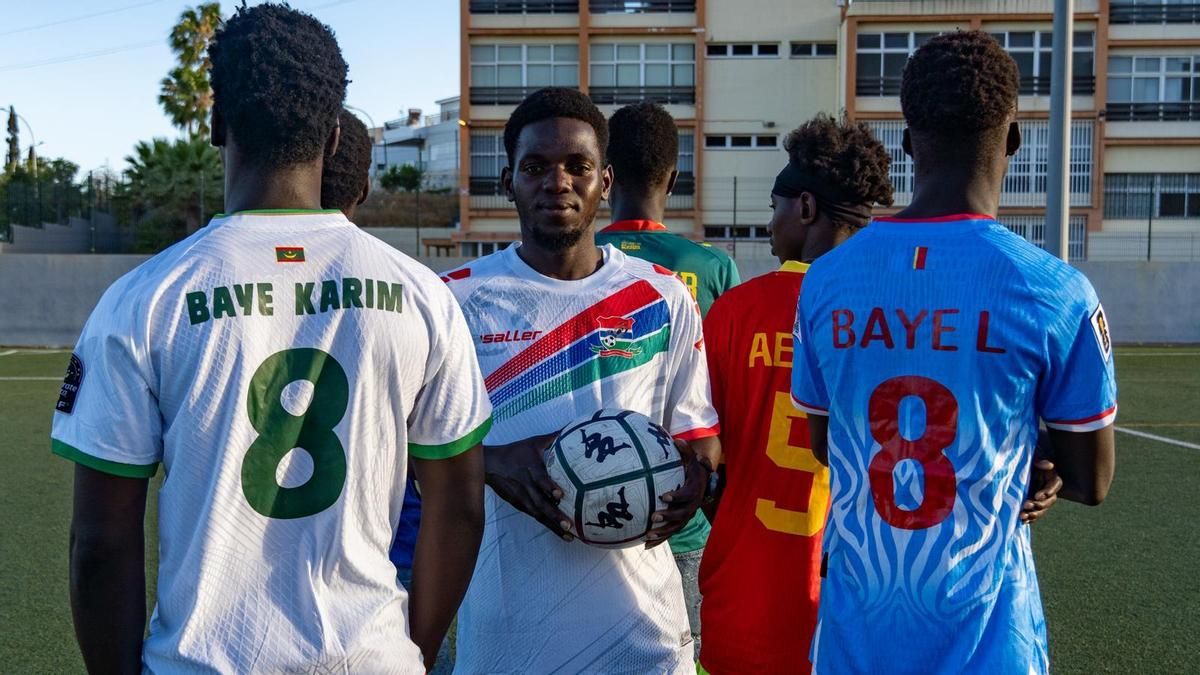
While the entire world has its eyes fixed on the football World Cup taking place in America, another tournament is being played out more than 8,000 kilometres away in the Canary Islands. In Tacoronte, a rural municipality of just over 20,000 inhabitants, young Africans living in Tenerife have organised the Mini Copa África 2026. At the El Cantillo pitch, there may not be the floodlights or cameras seen in the United States, but there is a clear set of values and a firm intention: to promote respect, integration, and coexistence. “In the face of the hate speech that is out there, and talking about national priorities, for us the national priority is respect for human rights,” says Miguel Llorca, one of the people who made this competition possible and who coordinates Campus Sansofé, a project backed by the University of La Laguna to encourage the inclusion of young migrants and minors in care through sport.
An idea born on Instagram, driven by passion
The Mini Copa África involves 150 players aged between 14 and 22, from different countries and divided into eight teams: Mauritania, the Democratic Republic of the Congo, Cape Verde, Gambia, Morocco, Senegal, Guinea, and the Canary Islands. The idea came to Modou Lamin (Gambia, 2007) via Instagram. “I saw that in Barcelona they’ve been doing it for years and that people went to watch the matches, and I thought: if they can hold this tournament in Barcelona, we can do it in the Canary Islands, where there’s also a lot of immigration,” he told this newspaper. Modou shared his idea with his friends Buba, Alex, and Babacar, and they got to work.
Modou arrived in the Canary Islands aged 14 from Serekunda, Gambia’s most populous city. “My first choice was to be a footballer,” he says. However, like many other young migrants who travel to the islands, he had to prioritise finding other work to pay the rent once he came of age. Now 19, he works as a kitchen assistant but still enjoys football every time he steps onto the pitch.
For Buba (Gambia, 2007), another of the tournament’s organisers, football is “a way to integrate, make friends, and get to know people, their stories, their cultures, and their traditions.” He arrived in the Canary Islands at 14 in 2020. “Football for me is like it is for any kid who dreams of playing; whether they go on to become a professional or not, at least they enjoy it and have a good time,” he says.
More than just a game: unity and a positive image
For this reason, the Mini Copa África 2026 also includes a team called ‘Canarias’, made up of young people from Tenerife. “We thought it was a good gesture because we are where we are today thanks to the islands, which are supporting us,” Buba explains. The young Gambian insists that for them, this goes far beyond football. It is about uniting cultures, offering a positive image of the African community in Tenerife, and supporting newly arrived young people. “We are coming here to have a better life, to help, to work, to be happy,” he emphasises.
“We are doing this so that people who think bad things about us can see that it doesn’t matter whether I’m from Gambia, you’re from here, or someone else is from there. What matters is that we are all equal and that we have a good time,” adds Modou.
Tackling bureaucratic hurdles and nurturing talent
Another aim of the competition is to support young talent on the islands. For years, many of them have been unable to play matches due to the difficulties imposed by FIFA for registering with a club. Miguel Llorca explains that, following a complaint lodged with the Office of the Ombudsman (Diputación del Común), this issue has now been resolved, although he notes that unaccompanied migrant minors still face a cumbersome bureaucratic process to obtain a licence. As a token of gratitude, the Ombudsman, Lola Padrón, was tasked with making the ceremonial kick-off at the championship’s opening on 29 June.
“The Canary Islands and Africa are united by geography, but also by human, social, and cultural ties that we must look after. Initiatives like this help us to see young migrants not from a distance, but through participation, talent, effort, and coexistence,” Padrón commented.
A final to remember, with an eye on the future
The championship kicked off with a match between the veterans’ team of Unión Deportiva (UD) Las Palmas and a team made up of young Africans. The UD Las Palmas Foundation, through its CONVIDA project, is one of the organisations that has helped bring this tournament to life, alongside Campus Sansofé, UD Tacoronte, the Aquí Estamos Migrando association, Casa África, and the referees’ association ATANFE.
The final is being played on 11 July at El Cantillo, between the Gambia and Senegal teams, but the players are already thinking about the next edition, Llorca admits. Between matches and work, Buba and Modou try to find some time to follow the World Cup. “Since I was little, from the African teams I’ve always supported Senegal because my country doesn’t play, but from the Western world I always go with Spain, because I’m a Barça fan and my all-time favourite player is Iniesta,” he laughs. Modou, his teammate, said he wanted Portugal to win because it is Cristiano Ronaldo’s last World Cup.
What’s happening in the Canaries – straight to your phone
News, weather alerts and practical updates – direct from the islands, in English. We live here and know what’s going on – before the international media catch up. Everything lands on our WhatsApp channel – no middlemen, no algorithm. Curated for families, expats and travelers.

Sonora Festival 2026 draws 16,000 to Las Palmas

Two men injured in fall from wall in Playa de Troya

Tenerife-forged bell rings again in tiny Rioja village

Canarian journalists to discuss a world in conflict at Las Palmas theatre

Festival del Sur returns to Agüimes with theatre from three continents

Man, 24, seriously hurt in buggy crash on Gran Canaria track

Woman, 81, rescued from sea at Las Vistas beach in Adeje

Tenerife to receive ES-Alert volcano drill messages

Canary film Benito Pérez Buñuel to premiere in Venezuela