An intimate exploration of landscape and belonging
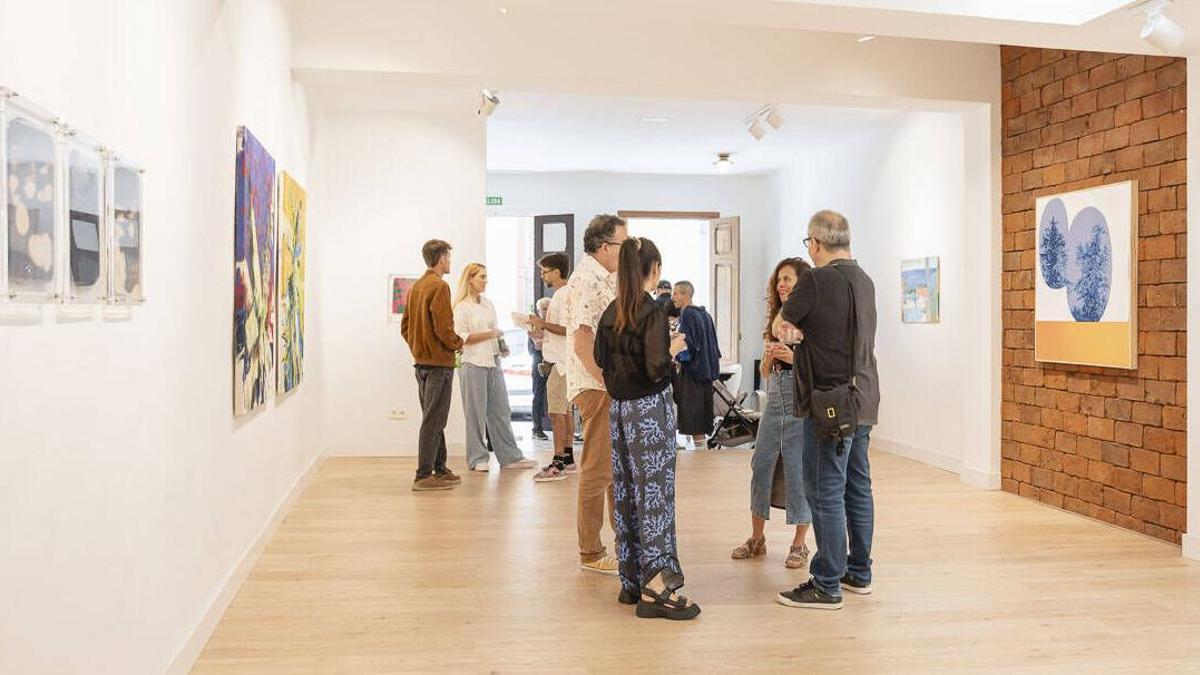
The relationship between territory and identity takes centre stage in the latest exhibition at La Panera, which is hosting Apenas somos paisaje (We Are Barely Landscape) by Chilean artist Gabriel Tondreau (Santiago de Chile, 1989) until 31 July. The proposal stems from an intimate perspective connected to the experience of living in the Canary Islands and is curated by Elena Marrero, in collaboration with Espacio El Palmeral. The exhibition brings together a collection of works that distil a creative process developed over recent years in Tenerife.
A project shaped without haste
Tondreau has lived on the island for almost five years and presents this proposal as the crystallisation of work that has taken shape without urgency or rigid planning. “It is a personal project that developed naturally, without foresight or rush, it simply accumulated,” explains the artist, who now translates this unhurried evolution into a solid body of work, where each piece engages in dialogue with the environment and a personal transformation marked by a change of landscape.
The inspiration behind the title
The exhibition’s title references a well-known phrase by Chilean poet Nicanor Parra: “We believe ourselves to be a country, but the truth is we are barely a landscape.” This idea runs through the entire exhibition, with the artist constructing a visual language in which landscape is not merely a representation but also a space of belonging and refuge. “The landscape is a place where one can also dwell, and so through these works I have put down roots and protected myself from the elements,” he states.
Historical references and subjective reinterpretation
Tondreau’s work draws on historical references such as the tradition of 19th-century travelling painters, who roamed distant territories documenting nature and capturing the light. However, his approach does not seek faithful reproduction but rather a subjective reinterpretation. “It has to do with different versions of the landscape, with presenting it as a space that develops and accumulates, where one also settles,” he notes.
A diverse body of work
In Apenas somos paisaje, visitors encounter a range of pieces combining painting, textile collage, assemblages and other formats. Each work functions as a microclimate, a space where the fragmented finds order. The artist himself describes his practice as a process of reorganising the scattered. The influence of the Canarian territory proves decisive in this process, as the light, rugged geography and changing atmosphere of northern Tenerife have transformed his vision.
The transformative power of light and geography
“I don’t know exactly what the characteristics of the light are, but I do know how it affects the territory. It’s like watching a film every day,” he comments. He adds: “The light falls so arbitrarily on the mountains that everything seems changeable, sudden and spontaneous.” This visual dynamism translates into works that capture the tension between stability and transformation. The landscape appears as something alive, in constant mutation, where light, climate and topography generate a unique sensory experience. “It is the combination of light, geography and climate that creates this special atmosphere,” the artist points out, also highlighting the cultural influence of the surroundings: “There is a lightness, an idiosyncrasy that makes me feel more at home.”
Nature takes centre stage
Although nature predominates in this exhibition, the human presence has not entirely disappeared. Tondreau acknowledges that his work has also explored architectural elements such as balconies, buildings or abandoned spaces. However, for this selection he has chosen to focus attention on the natural world. “Here the architecture is more set aside, because I wanted to take the viewer towards an introspection on geography and the environment, rather than the social,” he explains. This decision reflects a desire to generate a more introspective experience, where viewers can project their own emotions onto the landscape. In contrast to the narrative weight of the urban, the natural offers an open space for personal interpretation. “This leads you more to explore what it generates in you, on a personal level,” he notes.
A turning point in the artist’s career
The journey through the exhibition reveals an artistic practice that oscillates between direct observation and mental reconstruction of the territory. The artist works from a dual perspective: he inhabits the landscape and simultaneously reinterprets it from a distance. From this displacement emerge images that are not merely descriptive but evocative, charged with memory and experience. The exhibition at La Panera represents a turning point in his work. “This is the exhibition that condenses everything because the concept is better assembled and becomes more solid,” he states. Beyond the artistic discourse, Tondreau also emphasises the value of the collective effort that makes such projects possible and extends a direct invitation to the public: “People have to see it because there is very powerful work behind it and a professionalism that also deserves recognition.”
An invitation to see the Canary Islands anew
Apenas somos paisaje presents itself as an opportunity to engage with a contemporary perspective on the Canarian territory, filtered through the migrant experience and the search for identity. It is an exhibition that invites visitors to pause, observe and, above all, to inhabit the landscape from a new vantage point.
What’s happening in the Canaries – straight to your phone
News, weather alerts and practical updates – direct from the islands, in English. We live here and know what’s going on – before the international media catch up. Everything lands on our WhatsApp channel – no middlemen, no algorithm. Curated for families, expats and travelers.

Tenerife faces huge tourism expansion despite moratorium calls
El Bejeque in Las Canteras adds sea to its fire
Siam Park Gran Canaria must build its own desalination plant
Fuerteventura’s biggest resort to open on 1 November
Gran Canaria to teach tourism history in schools
Canary Islands see 0.3% rise in foreign tourists in August
Row over 368-bed hotel project in La Gomera
Spanish astronaut trains in Lanzarote for Moon mission
Tivoli La Caleta hosts first red tuna Kaitai in Canarias