Drago tree reborn as stunning mural
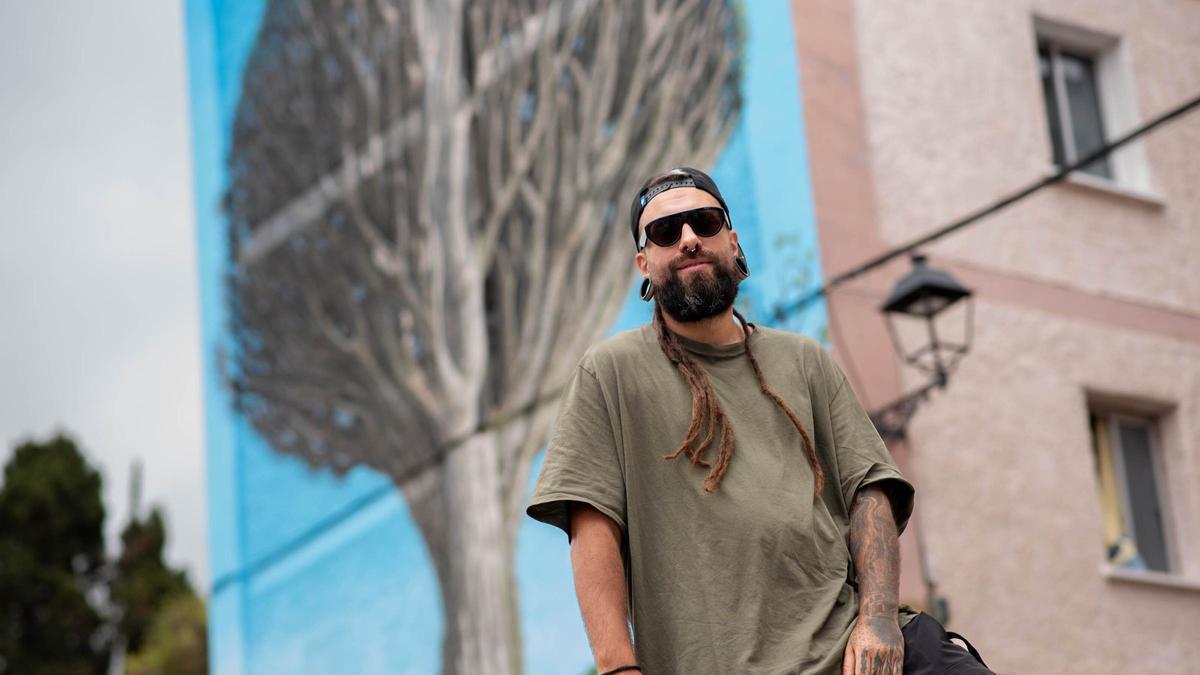
In Los Realejos, on the island of Tenerife, a drago tree is putting down roots once again. Not in soil, but on a concrete wall, brought back to life through the aerosol artistry of Adán Pérez Farráis. The tree, which stood 17 metres tall and was over two centuries old, was felled by low-pressure system Regina on 4 March 2026. Now it has risen again as urban art, continuing to guard the memories of generations who grew up in its shadow.
Community memory preserved in art
“It’s a place full of memory, of meeting, and where everyone in the town had a story connected to the drago tree. It was a very important place,” says the muralist, summing up the significance of the famous emblem in the lives of residents in the San Francisco neighbourhood. Months after the tree fell, the town council, at the request of local people, contacted the artist. He accepted without hesitation. “They felt it was a gift for them and for the memory of that special drago tree. It was beautiful,” says Farráis with a smile.
Logistical challenges on a steep slope
The work, which took just a couple of weeks, involved several stages before it was unveiled, though some proved a real challenge. The muralist, a native of Los Realejos, always works in a realistic style. After receiving several reference photographs, he began preparing the piece. “The main problem we had,” admits the artist, “was finding a company that could provide me with a crane, rather than a fixed scaffold anchored to the facade.” The tricky location, in the middle of a steep slope, and the large dimensions of the wall—nearly 12 metres high and almost 6 metres wide—made it difficult to use the first option. The alternative would have meant working without being able to see the project taking shape. “In the end, I managed to get the blasted crane in place,” he celebrates.
Residents reconnect with their landmark
Now, throughout the day, several residents come to admire the new image of the tree that once held their secrets. “I won’t give my name because I’m embarrassed—I’m a bit old now and they’ll all be on my case,” says one woman from San Francisco, watching the mural with great emotion. Carrying a couple of baskets, she recalls the drago tree as an inseparable part of her life and that of many local families. “I grew up seeing it there, always. It was a reference point, a place you always came back to,” she adds, speaking of the tree that was part of the neighbourhood’s sentimental landscape for decades. For her, the design not only beautifies the wall but restores a part of the community’s history and memories. She also praises the artist’s work, thanking him for capturing the essence of the emblem in a realistic and accessible style: “It’s beautiful. It looks like it’s still watching over the neighbourhood from the wall.”
Painstaking preparation for a textured wall
The work was not straightforward. The wall, belonging to a block of flats, was not in the best condition. Its repair was essential. “I removed the old paint, sanded the entire surface with a wire brush, and touched up some imperfections. In total, it took two or three days to treat the wall, and then the mural itself was painted in a week,” he recalls. Before that, he also had to apply a high-quality exterior emulsion base coat and then a layer of blue for the background. He used nearly 15 litres just for that colour. “On a flat surface, that amount would go much further, perhaps three times as much, but because the wall had a rough, grainy texture, it was more complicated. With those bumps, you can’t just run the paint over it. You have to work it in, in circles, carefully, so it covers the entire surface,” explains the muralist.
From childhood passion to professional artistry
For Adán Pérez Farráis, projects like this are much more than a simple commission. Behind each design are years of learning, practice, and a relationship with painting that began long before he could make a living from it. Although he is now one of the most recognised muralists in the region, his story began when he was still a child. “As a boy, I used to spend hours drawing on sheets of paper and would stand watching anyone painting a wall, fascinated. That was my way of having fun: painting,” he recalls. That hobby grew over the years, drawing him closer to urban art. He started experimenting with aerosols in secluded spots, teaching himself and developing his own technique through trial and error. He painted his first graffiti at just 13, and from then on, cans of paint became a constant in his life. “While my friends were out partying, I was saving up to buy paint so I could go out and draw the next day,” he confesses with a laugh.
A decade of murals and community connection
Over time, that hobby turned into a profession. He has now been working as a muralist for more than a decade. Among his most significant works is the mural honouring Don Antonio Hernández Oliva, a former parish priest of the municipality, in Realejo Alto. That piece was nominated among the best of May 2025 and, according to Farráis, stood out because of “the enormous reception” and “the affection it received” from local residents. Despite everything, he still describes himself as “a kid who likes to paint.” And perhaps that is why he seeks to break free from the strange feeling of having always had to operate on the margins—symbolised by the tattoo of a rat he carries—to champion an art form that, for a long time, has not always been well recognised.
What’s happening in the Canaries – straight to your phone
News, weather alerts and practical updates – direct from the islands, in English. We live here and know what’s going on – before the international media catch up. Everything lands on our WhatsApp channel – no middlemen, no algorithm. Curated for families, expats and travelers.

Sonora Festival 2026 draws 16,000 to Las Palmas

Two men injured in fall from wall in Playa de Troya
Tenerife-forged bell rings again in tiny Rioja village

Canarian journalists to discuss a world in conflict at Las Palmas theatre
Festival del Sur returns to Agüimes with theatre from three continents
Man, 24, seriously hurt in buggy crash on Gran Canaria track

Woman, 81, rescued from sea at Las Vistas beach in Adeje

Tenerife to receive ES-Alert volcano drill messages

Canary film Benito Pérez Buñuel to premiere in Venezuela