
Earthquake swarm detected across the Canary Islands
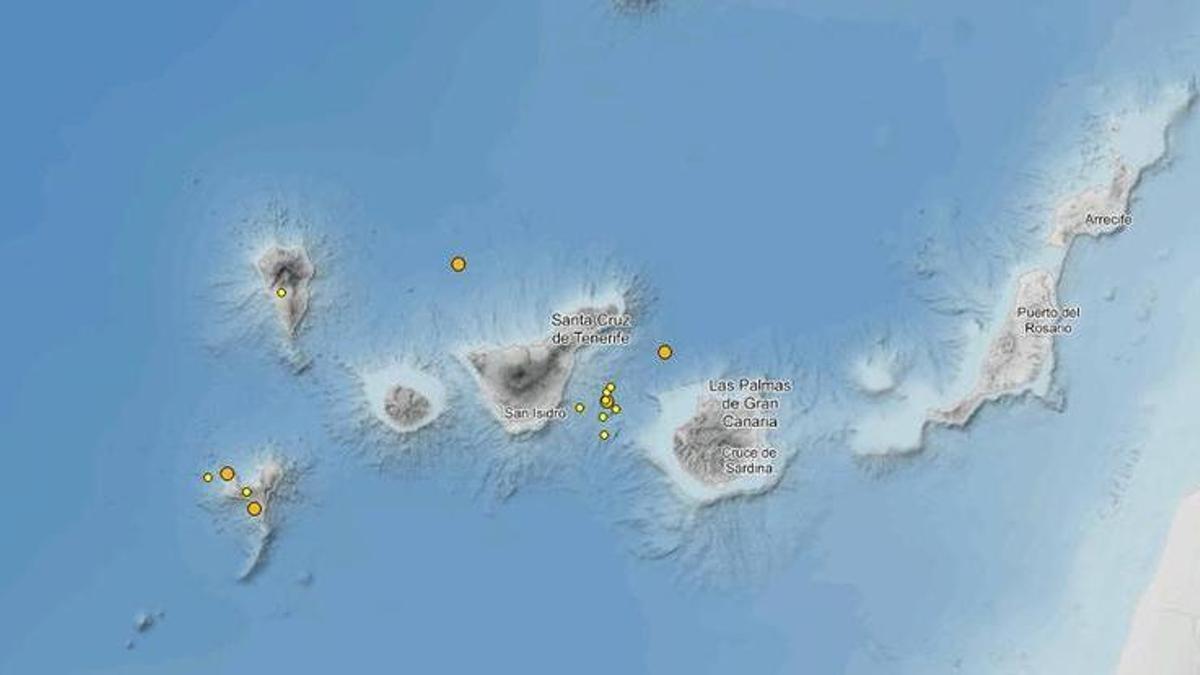
The National Geographic Institute (IGN) has detected a dozen earthquakes of magnitude 1.5 or higher, or which were felt by the population, since last Saturday, 13 June, according to data published on its website. Of these, the most striking figure is that five were above magnitude 2. Most were concentrated in the Atlantic, more specifically in the channel between the islands of Tenerife and Gran Canaria, with only three located on an island itself, in this case, El Hierro.
Five strongest tremors on El Hierro and in the ocean
All five of the strongest earthquakes were recorded on El Hierro and in the ocean. In chronological order, the first occurred on Saturday at 01:27 hours in the Atlantic, with a magnitude of 2.1; the second, of 2.4, northwest of Frontera (El Hierro) at 08:19 hours; the third, of 2.2, also in the ocean at 13:55 hours; and the fourth of the day, in El Pinar at 21:08 hours, with a magnitude of 2.5, the largest recorded. On Sunday, the fifth tremor above magnitude 2 was located in the Atlantic. Specifically, it was of magnitude 2.1 and occurred in the Atlantic, also between Tenerife and Gran Canaria, though further north.
Low-magnitude seismicity continues
Regarding last week’s seismic activity, the Canary Islands Volcanological Institute (Involcan) has published on its social media channels that the Canary Islands Seismic Network recorded 313 low-magnitude earthquakes, of which the highest value of 2.5 is linked to a tremor that occurred last Tuesday, 9 June, located between the islands of Tenerife and Gran Canaria. The total seismic energy released in the archipelago last week was 0.06 gigajoules, the institute explains. Specifically, the earthquakes were located mainly on the islands of Tenerife, Gran Canaria and La Palma.
Tectonic activity and advice for the public
Furthermore, Involcan reminds us that the Canary Islands are also characterised by moderate tectonic activity; therefore, some earthquakes have also been recorded along active seismic faults, such as the one between Tenerife and Gran Canaria. Although the earthquakes that occur in the islands are not usually especially strong, it is always wise to be prepared and know how to act in such an event.
To this end, the IGN offers a series of tips on what to do during an earthquake: drop, cover and hold on by getting under a table; stay calm and keep your balance as much as possible; if indoors, move away from furniture, windows and light fittings; if outside, move away from buildings, walls and electricity poles; if driving, stop in a safe place, switch on hazard lights and remain inside the vehicle; if using a wheelchair, lock the brakes in a safe place and protect your head with your arms; if in a crowded place, protect your head with your arms and take shelter under seats and tables.
What’s happening in the Canaries – straight to your phone
News, weather alerts and practical updates – direct from the islands, in English. We live here and know what’s going on – before the international media catch up. Everything lands on our WhatsApp channel – no middlemen, no algorithm. Curated for families, expats and travelers.

Canary Islands sea hits second-hottest year on record

Legal bid to halt tree felling in Santa Cruz’s La Salud

Fiesta del Charco: A journey through La Aldea’s past

Corralejo dunes power line set for removal

ULPGC launches 14 research projects at Las Canteras

TMT will never be built, says Canary Islands astrophysics chief

Pedro Duque: Canarias is the “ultimate dream” for rockets

Court blow to Tenerife motor circuit project
La Palma faces new volcanic risk planning deadline
