
Final phase for Tenerife’s western ring road
The completion of Tenerife’s Insular Ring Road (Anillo Insular) along its western side has entered its decisive phase. The Canary Islands government’s Department of Public Works maintains the first quarter of next year as the target date for finishing the section between Santiago del Teide and El Tanque. This is one of the most significant road infrastructure projects currently being undertaken in the autonomous community, and will complete the connection between the northern and southern corridors via the west of the island.
Project scale and workforce
The work is being carried out by a temporary joint venture (UTE) made up of FCC Construcción, Syocsa-Inarsa and El Silbo. The current budget stands at €288.7 million, of which €202.2 million has already been spent on completed works – representing more than 70 per cent of the project. The infrastructure project is sustaining significant economic and employment activity. At present, 50 workers are directly involved, while another 110 indirect jobs are linked to the various auxiliary works and supplies associated with the scheme.
Transforming journeys between north and south
The new road will directly link the TF-1 and TF-5 motorways via western Tenerife, replacing the current TF-82 on this route. The improvement will bring a significant increase in road safety and will cut travel time between north and south by almost half when traffic conditions are favourable. Mobility forecasts underline the importance of the infrastructure. Studies estimate that during the first year of operation, the road will carry around 17,000 vehicles a day – a figure far higher than the 5,000 vehicles anticipated in analyses carried out at the end of the 1980s. In the long term, average daily traffic could reach 30,000 vehicles.
Opening this stretch will also help redistribute some of the traffic currently using eastern Tenerife, reducing pressure on the North Motorway (TF-5) and helping to ease congestion problems affecting the metropolitan area of Santa Cruz de Tenerife and La Laguna. Beyond its impact on mobility, the new infrastructure is set to become a major driver of economic development for the island’s northwestern districts, facilitating freight transport and improving accessibility for businesses and residents.
The Erjos tunnel: a record-breaking feat of engineering
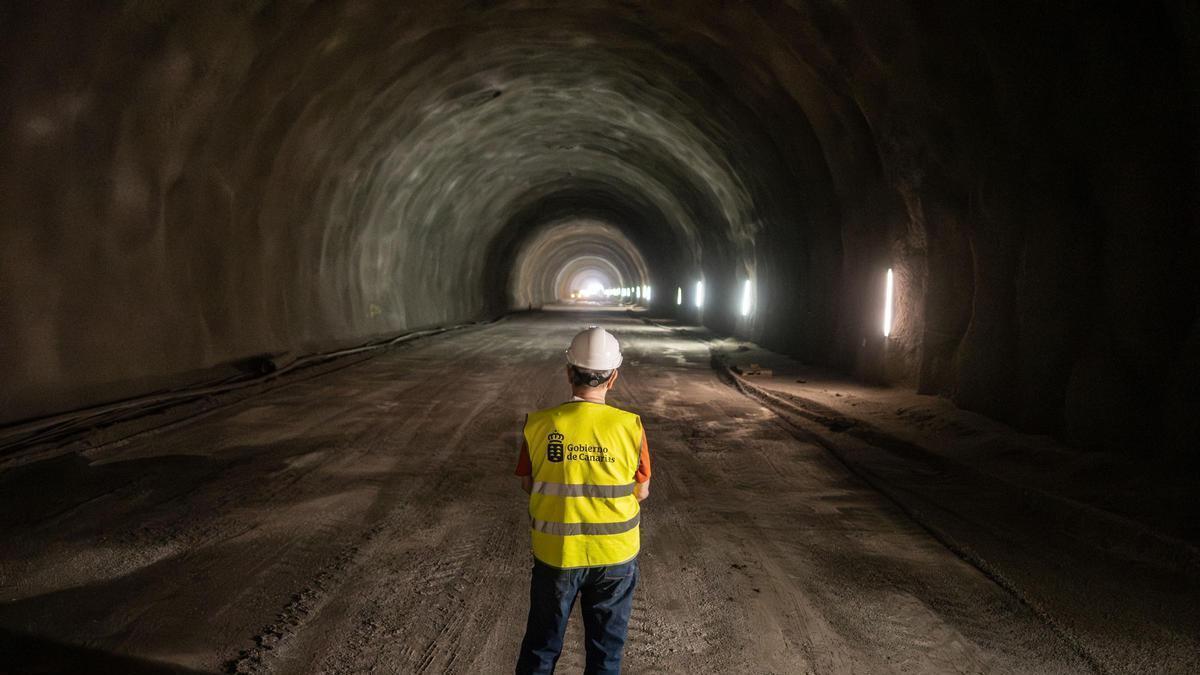
The most emblematic structure of the entire project is the Erjos tunnel, which is set to become the longest in the Canary Islands. The works consist of two parallel tubes, each 5,095 metres long, of which 4,855 metres correspond to tunnel excavated by mining. Drilling was carried out mainly using controlled blasting, supplemented by mechanical means where geological conditions required it. The works advanced simultaneously from four access points and proceeded around the clock, 24 hours a day, in three shifts.
The excavation fronts met on 26 June 2023 for the tube heading towards Santiago del Teide, and on 14 August of the same year for the tube heading towards El Tanque. Later, on 10 October 2024, the complete excavation of both tubes was completed in the so-called ‘breakthrough’ phase. Alongside its technical significance, the project incorporates numerous environmental measures, including the restoration of former quarries using excavated material, the recovery of habitats of community interest, the construction of a perimeter park in Santiago del Teide, and various design modifications to minimise the impact on sensitive natural areas.
Sustainability upgrades and solar power
One of the most recent administrative milestones for the project came in January 2026, with final approval of the so-called modification number 2, promoted by the Directorate General for Road Infrastructure. The modification incorporates works worth €21.49 million, equivalent to 8.9 per cent of the current budget, and pursues three fundamental objectives: reducing greenhouse gas emissions, decreasing energy dependence on fossil fuels, and upgrading the safety systems of the Erjos tunnel.
Among the planned measures is the construction of a solar photovoltaic plant for self-consumption, located on the false tunnel of the Santiago del Teide portal. The installation will have a capacity of 589.68 kWp and will consist of 936 photovoltaic modules of 630 watts each. The energy generated will cover around 55 per cent of the tunnel’s electricity demand under normal operating conditions. The system will also include four inverters with a nominal capacity of 125 kW each and a transformer centre to enable integration with the infrastructure’s energy installations.
The modification also introduces a significant construction change to the tunnel lining. Replacing certain traditional solutions with sprayed concrete lining will reduce concrete consumption and avoid the emission of approximately 32,000 tonnes of carbon dioxide. These measures are complemented by the modernisation of ventilation, lighting, communications and control systems, bringing them up to the latest technological and safety standards.
Legal disputes and resolution
The recent history of the project has been marked by a complex administrative and legal controversy. The contract was initially awarded in June 2019 to a joint venture led by OHL, during the previous term of Pablo Rodríguez as head of the Department of Public Works. The award was made for €213.4 million, excluding IGIC (the Canary Islands indirect general tax), after technical services concluded there were no grounds to consider the bid abnormally low.
The FCC-led joint venture appealed, questioning the winning bidder’s compliance with labour and social regulations. The Canary Islands Public Contracts Administrative Tribunal upheld the arguments and ordered OHL’s exclusion. As a result, the regional administration finally awarded the contract to the joint venture formed by FCC Construcción, Syocsa-Inarsa and El Silbo. However, the conflict continued in the courts. In March 2024, a ruling was notified from the First Section of the Administrative Litigation Chamber in Santa Cruz de Tenerife, annulling both the Public Contracts Tribunal’s resolution and the administrative order relating to OHL’s exclusion.
The Canary Islands government reached a compensation agreement with the OHL-led joint venture for €13.78 million. The aim was to comply with the court ruling, guarantee the continuity of a strategically important project for Tenerife, and avoid further delays or stoppages. Councillor Pablo Rodríguez argued at the time that the solution adopted protected the public interest, minimised the economic cost to the public purse, and ensured that construction would continue without interruption.
A historic transformation for Tenerife
With more than two-thirds of the work completed and the most complex tasks behind it, the closure of the Insular Ring Road is now entering its final stretch. Once operational, it will represent a historic transformation for mobility in Tenerife, culminating one of the most eagerly awaited infrastructure projects on the island over recent decades.
What’s happening in the Canaries – straight to your phone
News, weather alerts and practical updates – direct from the islands, in English. We live here and know what’s going on – before the international media catch up. Everything lands on our WhatsApp channel – no middlemen, no algorithm. Curated for families, expats and travelers.

Vueling plane lands with landing gear fault at Los Rodeos

Ferry contract to Canary Islands declared void

Bomb threat on Vueling flight triggers Gran Canaria airport security operation

Cruise to Canaries cancelled after collision in port

Tenerife tram delays worsen amid staff shortages

Titsa adjusts night bus times for clock change on Tenerife

Night roadworks to disrupt TF-1 traffic from Sunday

Public service obligation for Canary inter-island flights announced

Iberia accused of ejecting passengers from paid seats
