
May Day rallies across the islands
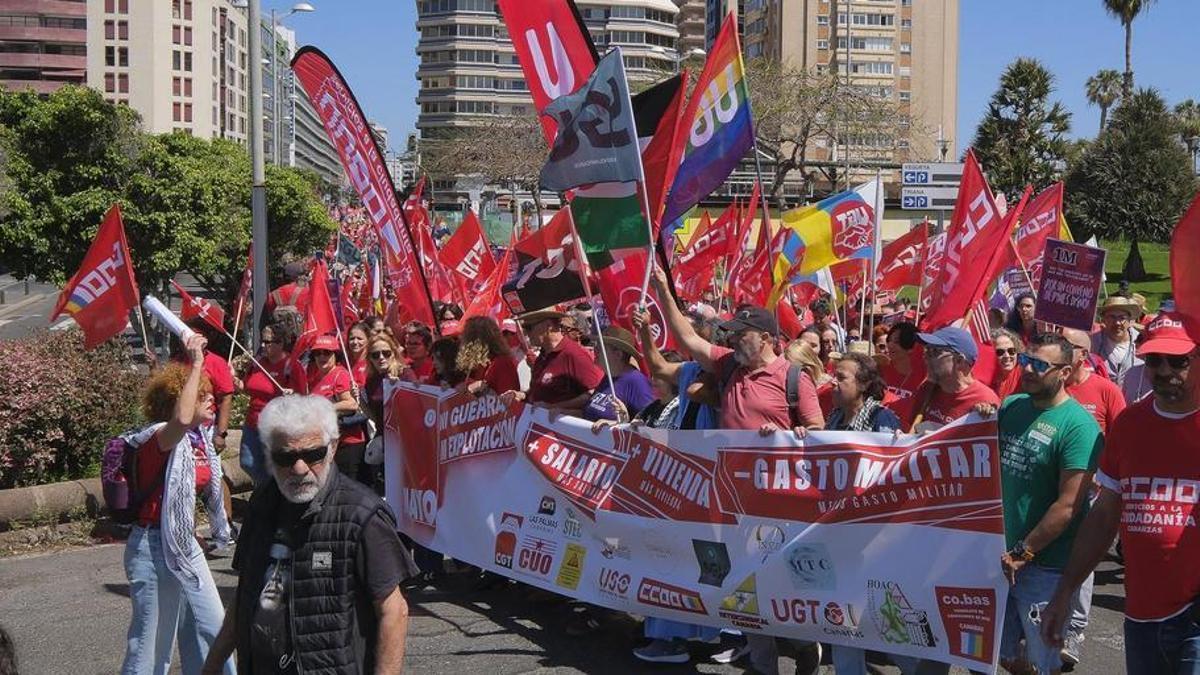
May has begun in the Canary Islands just as it has for more than 130 years: with the celebration of International Workers’ Day. More than 3,000 Canary Islanders took to the streets across the archipelago this morning to celebrate hard-won rights, but also to demand improvements for a workforce that, according to the organising unions, continues to suffer from “job insecurity” despite improvements in employment figures.
Raising wages, ending the phenomenon of the “working poor,” opposing the war in Iran, and gaining access to housing were the main demands of a day that, falling as it did during a long weekend, drew smaller crowds than in previous years. According to figures from the Government Delegation, around 1,100 people joined the rally in Las Palmas de Gran Canaria, while in Santa Cruz de Tenerife, where two marches were held – one called by UGT, CCOO and USO and the other led by the Workers’ Trade Union Federation (Federación Sindical Obrera) – a total of around 2,100 people were counted, though organisers put the figure at 4,000.
‘We want better conditions so we can stay in our own land’
Luis de la Barrera, a temporary lawyer working for the regional administration, attended the rally in Las Palmas de Gran Canaria this morning before heading to the beach, complaining that wages in the Canary Islands remain “at the bottom of the national table,” which he said translates into growing difficulty meeting basic costs such as rent and the weekly shop. The 33-year-old defended the importance of mobilisations like the May Day marches to highlight the need for better working conditions and to ensure that working people can build a life in the archipelago without being forced to emigrate. “The aim is to have better wages and better working conditions so we can live better in our own land without having to leave,” he said.
His sentiments echoed one of the most repeated ideas of the day: the concept of the “working poor.” “It’s not just about having jobs in the islands, but about the conditions being offered by employers and the authorities being of decent quality,” De la Barrera explained at the start of the protest.
Tourism boom not reflected in workers’ pockets
That perception was widely shared in key sectors such as hospitality. Jordana García, a waitress at a hotel, complained this morning that, despite the weight of tourism in the regional economy, that growth is not reflected in the incomes of those working in the sector. “They tell us we live off tourism, but workers don’t see it in our wallets. Only the big players see it,” she said. For the young woman, such protests are necessary to, in that unbalanced reality, “consolidate existing rights and push for new labour improvements.”
Housing crisis hits the young hardest
The difficulties faced by Canary Islanders in accessing housing was another recurring theme at today’s rallies across the islands. The general secretary of CCOO Industry in the Canary Islands, Juan Miguel Hernández, noted that, despite increases to the minimum wage, a significant proportion of young people lack a “viable life plan.” He linked this situation directly to the soaring cost of housing and called for the development of public policies that “make it easier to access a home in decent conditions.”
Unpaid carers demand recognition
Alongside these demands, other less-represented realities also made themselves visible this morning. Miriam Tejera, spokesperson for the State Platform of Primary Carers, took to the street to demand recognition for work that, she said, is carried out around the clock without comparable employment rights. She insisted on the need to make this work visible so that it can be recognised institutionally and socially, in a context where many of her colleagues could not attend the mobilisations because of the very demands of caregiving. “There’s a bit of a lack of drive among young people, and people need to see that taking to the streets has an impact. We can’t give up; we have to keep shouting,” she said.
Anti-war and pro-freedom messages
“No to war” was also a strong theme at the May Day celebrations. Retiree María Ángeles Sánchez Domínguez shielded herself from the sun with her hat and sunglasses and did not hesitate to take to the street to support the Labour Day marches. The Canary Islander defended the importance of not remaining indifferent to international problems and of demanding respect for international law. “We can’t ignore the problems there are in the world. We have to defend our rights, which are being trampled on by those who think they are the elite,” she said. Sánchez regretted that not all young Canary Islanders are aware of how important it is to defend freedom. “We haven’t managed to teach our children that freedom must be defended every day, even though they were born into it,” she added.
Ángel Escarpa, an 89-year-old retired bookseller, attended the protest in solidarity with the working class and recalled that social rights have been the fruit of decades of struggle. In his view, defending those gains requires constant commitment and greater participation in public life. “Complaining from your armchair at home is easy. You have to fight for things and take to the streets every day,” he insisted.
Union leaders attack ‘absolute disloyalty’ to workers
On the union front, representatives of the main organisations also stressed the need to make concrete progress for the Canarian working class. The general secretary of UGT Canarias, Manuel Navarro, who attended the rally in Santa Cruz de Tenerife, called for advances in occupational health and for wage increases in light of the economic “repercussions” arising from the international context, which, he warned, “very directly affect the pockets of Canarian families.”
In a similar vein, the general secretary of CCOO in the Canary Islands, Vanesa Frahija, attacked employers, arguing that the region’s current economic growth is not translating into a real improvement for workers. She criticised business “enrichment” while, in her view, there is “absolute disloyalty towards the working class,” with a redistribution of wealth that is “conspicuous by its absence.”
Political presence and social media messages
The President of the Government of the Canary Islands, Fernando Clavijo, used his social media to send a message of recognition to the archipelago’s workers. “There are achievements that have been made, but there are important challenges we must face, such as job stability and the general distribution of wealth in the productive sectors,” he posted on X (formerly Twitter). In his message, he also called for strengthening “dialogue and agreements” as a way to ensure that work enables improvements in living conditions.
The May Day celebrations also had a political presence. Taking part in the rally in Las Palmas de Gran Canaria were minister Ángel Víctor Torres, along with socialist representatives including Carolina Darias, Sebastián Franquis and Elena Máñez.
Focus on Málaga as similar demands echoed nationwide
Beyond the archipelago, marches were held in numerous Spanish cities. The main focus this year was on Málaga, where the union leaders of CCOO and UGT led a day marked by demands similar to those raised in the Canary Islands, with particular attention to access to housing and improving wages in a context of economic growth that, they argued, is not translating equitably into the purchasing power of the working class.
What’s happening in the Canaries – straight to your phone
News, weather alerts and practical updates – direct from the islands, in English. We live here and know what’s going on – before the international media catch up. Everything lands on our WhatsApp channel – no middlemen, no algorithm. Curated for families, expats and travelers.

Hotel facade fire in Las Palmas causes material damage

Tenerife comic salon returns with 40 exhibitions and 80 artists

Buenavista del Norte and Villa de Mazo compete for Christmas lights glory

Tourism overcrowding and its impact on Canary Islands healthcare

WOMEX 2026 closes in Gran Canaria as Tenerife named 2027 host

Five French sailors injured as yacht hits rocks off Lanzarote

Amaia Montero’s emotional tribute at Gran Canaria concert

Netflix begins filming new thriller in Tenerife

Loquillo and Amaia headline Tenerife Peñón Fest 2026
