Countdown to arrival
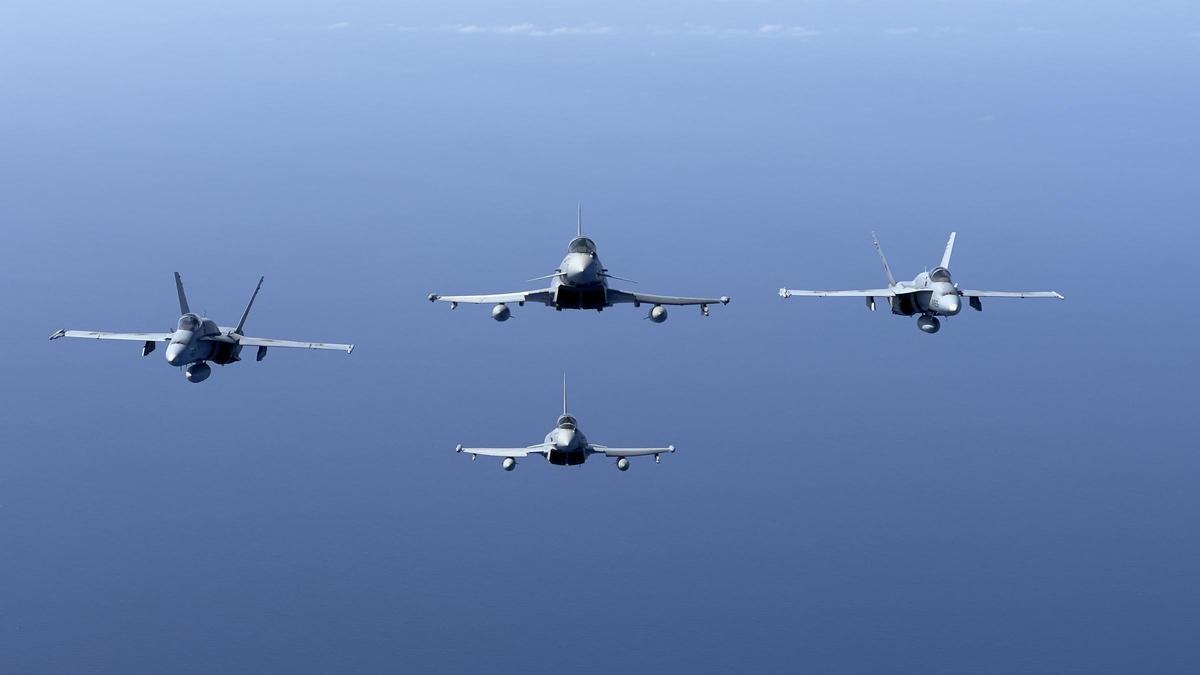
It is a matter of days. The countdown is finally coming to an end. Next week, the first Eurofighter jets touch down at Gando Air Base in Gran Canaria, bolstering the surveillance and defence capabilities of the Canary Islands’ airspace. This deployment officially kick-starts the progressive replacement of the EF-18 Hornet aircraft, which have served as the region’s primary aerial shield for more than two decades.
The new fighter jets land on Tuesday and will be officially unveiled next Friday. However, the modernisation of the fleet has been meticulously planned over the course of several months. With the introduction of the Eurofighter, Wing 46 positions itself among the most advanced combat units in Europe.
Part of the Halcón I modernisation programme
The arrival of the first Eurofighters in the islands is part of a modernisation programme known as Halcón I, designed to reinforce and update the Spanish combat fleet. The Ministry of Defence signed a contract with Airbus in 2022 for the acquisition of 20 fighter jets to replace the current F-18s.
However, the Canary Islands will not be receiving brand-new aircraft for now. The first eight jets arriving this Tuesday at Gando, which will be presented during the Weapons Systems Handover Ceremony on Friday 26 June, are coming from other already operational units. Four are arriving as part of the permanent detachment from Wing 14, based at Los Llanos Air Base in Albacete, and another four have been temporarily loaned from Wing 1, based at Morón de la Frontera Air Base in Seville.
These four aircraft will gradually be returned to Wing 11 as Wing 14 receives new jets from the Halcón 1 programme and transfers its Eurofighter Tranche 3 models to Wing 46. The final complement for Wing 46 will be 20 aircraft. Because these are fully operational jets, the Canary Islands unit can now adapt and familiarise itself with the new technology. This follows a very common transition model used by air forces, aimed at minimising risks and ensuring a gradual integration.
Intensive preparation for personnel
Although the aircraft are not brand-new, both the base and its personnel have had to adapt to the new model’s operations. Wing 46 has been preparing for this moment for more than a year. Flight crews, maintenance technicians, and weapons systems specialists have taken part in specific training programmes to guarantee a safe and effective transition. This process has been carried out without reducing the unit’s response capacity, which has maintained its 24-hour surveillance missions active.
So far, eleven pilots from Wing 46 have completed an “operational conversion” course in Seville, lasting between four and six months. The first four began the course in April 2025 and, upon completion, were assigned to Wings 11 and 14, where they have remained gaining experience. In addition, another four pilots with prior Eurofighter experience have been posted to Wing 46. The courses cover flight procedures, electronic systems management, advanced maintenance, and the use of next-generation weaponry.
But the change does not only affect the pilots. The arrival of the fighters has prompted a complete “reinvention” of the entire team. Around 120 mechanics from Wing 46 have received training at the Albacete Arsenal (Maesal) and at Wings 11 and 14, with courses lasting between three and nine months. Operations Support personnel, Individual Flight Equipment staff, and Electronic Warfare specialists have also received training – all to understand and master the new weapons systems associated with the Eurofighter.
A technological leap forward
Among these systems stand out the Iris-T, Amraam, and Meteor missiles, considered some of the most advanced air-to-air systems currently available in Europe. This technology represents a significant step up from the Sidewinder and Sparrow missiles used by the EF-18 Hornet. The difference between the two models goes far beyond purely aeronautical performance.
The introduction of the Eurofighter means entering a new way of operating, based on the integration of sensors, communications, and weaponry within a real-time connected combat environment. Compared to the systems used by the F-18, the new fighters offer advanced capabilities for information exchange, navigation, and target acquisition, which significantly expand awareness of the operational environment.
The new platform also incorporates next-generation weaponry capable of engaging at greater distances, along with designation systems that allow the pilot to locate and track targets even outside the aircraft’s visual axis. Added to this is a set of electronic warfare equipment capable of detecting, identifying, and prioritising threats, facilitating decision-making in increasingly complex scenarios.
For this reason, the Spanish Air and Space Force insists that the arrival of the Eurofighter should not be understood merely as the replacement of one model with another. The introduction of this new system represents a far-reaching technological leap that will place Wing 46 among the units equipped with the most advanced means in Spanish military aviation, guaranteeing the surveillance and defence of Canarian airspace for decades to come.
Infrastructure and environmental adaptations
The implementation of this new system brings changes not only in terms of equipment, but also in infrastructure, personnel, training, and organisation. “Perhaps the most significant, because they have ad hoc plans, are sustainment, personnel, infrastructure, and Communications and Information Systems (CIS),” acknowledges Lieutenant Colonel Rubén Antonio López González, head of the Air Forces Group at Wing 46.
Among the various adaptation measures, an ambitious project was launched to modernise the energy infrastructure at Gando Air Base. This work focuses on the complete refurbishment of the power plant and the energy distribution system at the facility, with a base tender budget of more than €12 million.
The adaptations are not limited to operational areas. The particular environmental conditions at Gando have also required specific measures to protect the aircraft from wear caused by the marine environment. The proximity to the ocean and high levels of salinity make corrosion one of the main challenges for any air system permanently deployed in the Canary Islands. As part of the implementation plan, adaptations have been planned for hangars and shelters, the installation of humidity control systems, and a review of certain maintenance procedures.
No overlap period between models
The transition will take place without an operational overlap period between the two models. Although six F-18 Hornet aircraft currently remain at Gando, these will be transferred to Wing 15, based in Zaragoza, once the Weapons Systems Handover Ceremony has concluded next Friday. Their withdrawal is part of the progressive replacement of the fleet and precedes the final decommissioning of these aircraft, scheduled for the end of the year.
Among the final missions performed by the F-18s of Wing 46 is an operation with particular public visibility. The Canarian fighters escorted Pope Leo XIV – after his visit to the Canary Islands – on his return flight to Rome following a technical incident on his aircraft, a situation that forced a change to the originally planned arrangements. One of the last images of these aircraft in service in the Canaries is thus linked to an aerial escort mission before their final withdrawal.
A new era for Canarian air defence
In this way, the Eurofighter will exclusively assume air surveillance and defence missions in the Canary Islands, closing a chapter that began more than two decades ago with the arrival of the Hornet in the archipelago, and opening another marked by the incorporation of significantly more advanced technological capabilities. This is not the first time Eurofighters have been deployed in the islands. These fighters have been flying through Canarian skies since 2010, taking part in air combat training exercises known as DACTs, as well as in Ocean Sky. They have also been supporting the alarm service since the end of last year.
What’s happening in the Canaries – straight to your phone
News, weather alerts and practical updates – direct from the islands, in English. We live here and know what’s going on – before the international media catch up. Everything lands on our WhatsApp channel – no middlemen, no algorithm. Curated for families, expats and travelers.

Work on TF-5 third lane between Guamasa and Los Rodeos to start in November

Canary Islands international air arrivals fall 1.3% in September
Helicopter evacuates US cruise passenger near Tenerife
El Hierro airport sees 3.6% rise in September passengers

Gran Canaria approves €509k works to shore up GC-200 slope

Canary Islands gets €47.5m for free public transport in 2026
Canary Islands airports see 0.9% fall in September passengers
El Rejo road in La Gomera to close for six hours on Tuesday

Man, 65, seriously injured in GC-1 crash in Agüimes