Government demands urgent talks
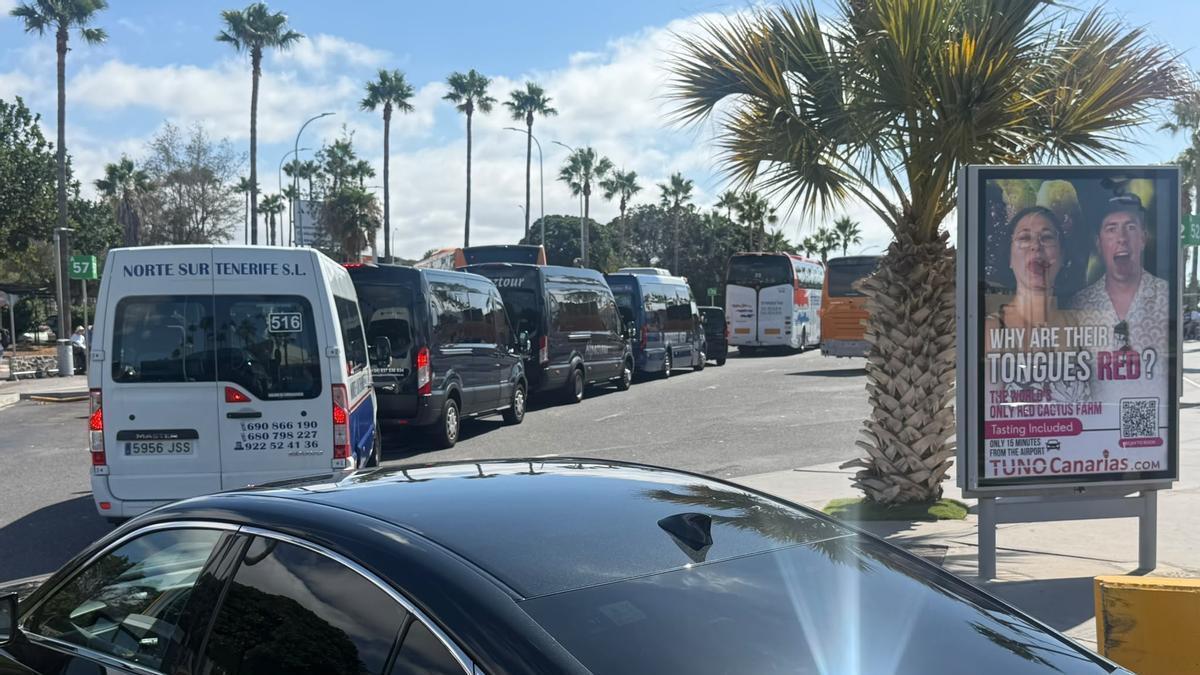
The Government of the Canary Islands has requested a meeting with Aena, the operator of Spain’s airports, before the end of July to conduct an “urgent” review of the new system restricting bus access and parking at Tenerife South Airport. The request comes in response to incidents recorded over the past weekend, when tourists were forced to queue for more than half an hour, and to the government’s concern over the measure’s impact on public transport, operating companies, airport mobility, and the island’s tourism image — its main economic driver.
Urgent action needed
The Director General for Transport and Mobility, María Fernández, considers it necessary to open a “working space” with Aena “immediately” to analyse what is going wrong, evaluate the consequences of introducing what has become known as the ‘bus tax,’ and agree on solutions to prevent the problems recurring. The Canarian government insists that the management of airport access must be adapted to the reality of operations in the Canary Islands, where coaches are the only mass public transport alternative for connecting terminals with major urban and tourist centres. The urgency of the meeting is also due to the fact that the government says it has “not received any institutional information about the definitive implementation of the system.”
Months of deadlock
Canarias raised its objections as early as December 2025 and, in January 2026, requested that Aena suspend the measure temporarily and convene the Airport Coordination Committee. According to the regional government, at that committee Aena communicated that implementation would be postponed and that, before applying it, solutions to reduce its impact — including the creation of waiting bays and other organisational measures — would be studied. However, the Canarian government maintains that since then it has received no details about the progress of the process or the alternatives planned. Aena, for its part, has dismissed the incidents over the past weekend as “isolated.”
Why the system doesn’t work
The main disagreement centres on the fact that the regulations do not take into account common factors at an airport like Tenerife South. Flight delays, document checks for international passengers, baggage delivery, or the need to group travellers from different flights can force a bus to remain at the terminal longer than planned. The government warns that such delays are not always the responsibility of transport companies, and that penalising them could raise costs, complicate transfer organisation, and affect tour operators. There is also a fear that making operations more difficult for buses will end up favouring taxis, hire cars, and private vehicles, leading to increased congestion at the airport approaches.
High season pressure
The government learned of the first incidents through transport companies and media reports. It therefore intends the meeting to take place before the end of July in order to correct the situation as quickly as possible and prevent the system from continuing to cause problems during a period of high tourist activity. The Regional Ministry for Public Works, Housing and Mobility argues that any regulation should strengthen public transport, not hinder its operation. In its view, the situation is already affecting regular passenger transport, drivers’ working conditions, tourism activity, and the image of the Canary Islands as a destination.
Flexibility demanded
The Director General insists that the meeting must serve “to stop further incidents and agree on a solution before the system is consolidated. The incidents recorded in recent days show that it is necessary to open an immediate working space with Aena. That is why we have requested a meeting before the end of this July,” she said. She recalled that operations at Canary Islands airports require greater flexibility: “Flight delays, document checks for international passengers, or the coordination needed to collect travellers from several flights can mean a bus exceeds the planned courtesy time without this being due to any improper practice by the transport companies.”
What the government wants
The Government of the Canary Islands is now calling for the implementation of those aspects that are causing problems to be halted, for institutional dialogue to be restored, and for a system to be defined that allows the efficiency of Tenerife South Airport to be reconciled with the normal operation of buses.
What’s happening in the Canaries – straight to your phone
News, weather alerts and practical updates – direct from the islands, in English. We live here and know what’s going on – before the international media catch up. Everything lands on our WhatsApp channel – no middlemen, no algorithm. Curated for families, expats and travelers.

Work on TF-5 third lane between Guamasa and Los Rodeos to start in November
Canary Islands international air arrivals fall 1.3% in September

Helicopter evacuates US cruise passenger near Tenerife
El Hierro airport sees 3.6% rise in September passengers

Gran Canaria approves €509k works to shore up GC-200 slope
Canary Islands gets €47.5m for free public transport in 2026
Canary Islands airports see 0.9% fall in September passengers
El Rejo road in La Gomera to close for six hours on Tuesday
Man, 65, seriously injured in GC-1 crash in Agüimes