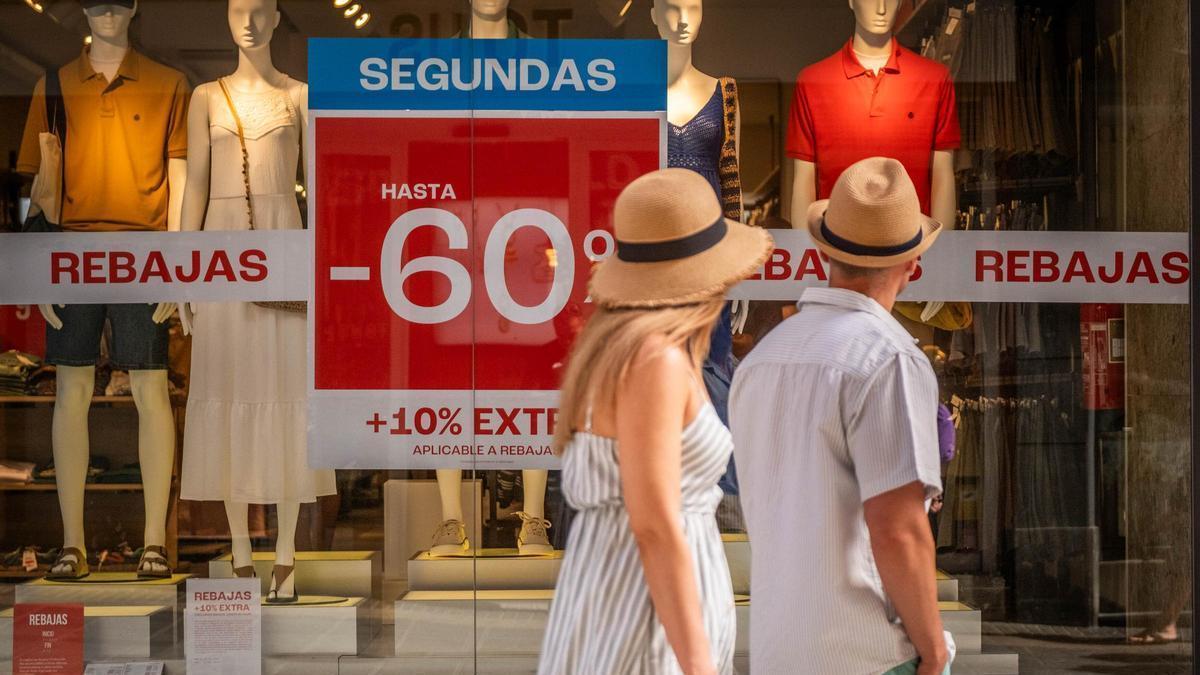
Canarian retailers eye repeat of strong summer sales
Businesses across the Canary Islands are hoping to match the strong sales figures achieved in last year’s summer discounts, even though the economic climate this year looks very different from 2025. Uncertainty caused by the war in the Middle East, a drop in tourist numbers and increasingly squeezed household budgets have all slowed spending in the first six months of the year. Even so, the sector is confident of a good season, hoping at least to repeat last year’s numbers — or perhaps even nudge them slightly higher.
Early discounts and a short, sharp season
To achieve this, retailers are aiming to hit the ground running in what has become a shorter discount period, with most activity expected to be concentrated in the first week. Many will be launching significant offers from the last weekend of June.
“We expect it to be a good campaign, and we’re optimistic despite how sales have been trending in recent months,” says Abbas Moujir, president of the Federation of Urban Areas of the Canary Islands (Fauca). He notes that last April saw the first stumble in Canarian retail turnover in over five years, following months of steady month-on-month growth. The index published by Spain’s National Statistics Institute (INE) recorded a 0.7% drop for the Canary Islands, a region that had previously been leading the country in retail sales growth.
Consumer caution and the impact of war
The slowdown has been felt across the sector, as confirmed by Alfredo Medina, secretary general of the Association of Medium and Large Retail Distributors in the Canary Islands (Asodiscan). “Consumers have become very sensitised. The tension and uncertainty caused by the war has led to much more rational behaviour, with basic needs taking precedence in spending,” he explains.
The sector also attributes the sales dip to a reduction in tourist arrivals, which suffered its first major setback in seven years in April, with an 8.3% drop in international visitors. “This illustrates our dependence on tourism and how it affects supporting activities like retail,” Moujir points out. However, he stresses that the target audience for the summer sales — heavily focused on holiday essentials — is the local population.
What shoppers are buying
Although the sales period has now been deregulated and retailers can offer discounts at any time of year, the summer sales remain popular for buying seasonal items. Refreshing a holiday wardrobe, shopping for a trip, kitting out a terrace to enjoy the good weather, or getting an early start on back-to-school preparations are among the most popular purchases.
That said, deregulation has made the start of the summer sales period — and particularly its launch — somewhat blurrier. This is certainly more noticeable than in the winter sales, where the traditional starting pistol is fired on 7 January. In summer, there is greater variation. Although the most common start date was once 1 July, a large part of the sector will now bring forward the start of offers to the weekend of 27 and 28 June.
Discounts of 50% and up to 70%
So what discounts can consumers expect? Generally speaking, 50% off will be the most common offer in the first few days, although the sector says reductions could reach as high as 70% as the weeks go on.
“Sales will certainly increase compared to May and June, but since deregulation the impact of the summer sales has been minimised, and there are other periods of the year with much higher sales volumes,” says Raju Daswani, president of the Las Palmas Trade Federation (Fedeco). He also highlights the uncertainty hanging over the sector. Despite their optimism, retailers do not know how positive the results will be, as stores have also faced significant cost increases resulting from the war in Iran, which have hit small businesses hardest. “In this context, any increase in sales is welcome, but the result won’t be anything to write home about,” he adds.
The rise of online shopping and new EU rules
Daswani points to another factor that has dented sales results for physical shops across the Archipelago in recent years: e-commerce. “The younger generation only knows how to shop online, and many other customers — put off by the traffic jams in Santa Cruz de Tenerife, Las Palmas de Gran Canaria and other shopping areas in the Islands — are also choosing this route to buy what they need,” he insists.
For this reason, he hopes that the mandatory fees the European Union will impose from July on online purchases made outside the bloc will provide some relief. The same would apply if the Canary Islands finally decides to remove the IGIC (Canarian indirect tax) exemption for purchases under €150.
What’s happening in the Canaries – straight to your phone
News, weather alerts and practical updates – direct from the islands, in English. We live here and know what’s going on – before the international media catch up. Everything lands on our WhatsApp channel – no middlemen, no algorithm. Curated for families, expats and travelers.

Tenerife faces huge tourism expansion despite moratorium calls

El Bejeque in Las Canteras adds sea to its fire

Siam Park Gran Canaria must build its own desalination plant
Fuerteventura’s biggest resort to open on 1 November
Gran Canaria to teach tourism history in schools
Canary Islands see 0.3% rise in foreign tourists in August

Row over 368-bed hotel project in La Gomera

Spanish astronaut trains in Lanzarote for Moon mission

Tivoli La Caleta hosts first red tuna Kaitai in Canarias