Compiled with the help of artificial intelligence, based on Spanish-language information. Source below the article.
Tenerife to test ES-Alert system during volcanic risk drill
Residents of Tenerife will receive an ES-Alert message in the coming days, specifically on 22 October, as part of the island’s emergency warning system. The message forms part of the VOLCANEX Tenerife 2026 volcanic risk drill organised by the Cabildo de Tenerife, which will take place in the municipality of Guía de Isora.
The ES-Alert test, managed by the Department of Territorial Policy, Territorial Cohesion and Water through the Directorate-General for Emergencies, aims to strengthen public familiarity with this tool of the National Civil Protection System, following similar exercises held across the archipelago in recent years.
Three test messages between 9am and 2pm
The Emergency and Security Coordination Centre (CECOES) 112 is scheduled to issue three ES-Alert messages between 9am and 2pm. People may receive them at the moment they are sent, or when they enter their phone operator’s coverage area if they were outside it at the time. However, they will not receive the message if their phone is switched off or in aeroplane mode.
The first alert has the island of Tenerife as its target area, although it could also reach parts of Gran Canaria, La Palma, La Gomera and El Hierro, as well as the inter-island sea channels. This message will announce the move to the orange volcanic traffic-light level as set out in the Special Plan for Civil Protection and Emergency Care for Volcanic Risk in the Canary Islands (PEVOLCA).
However, it does not in any way signal the start of an eruption or evacuation or confinement measures for the population of Tenerife, and therefore requires no action from residents. Should additional measures be adopted during the drill, they would only be communicated to specific areas where their application is necessary.
Second message to simulate evacuation in Guía de Isora and Santiago del Teide
The target area of the second ES-Alert message covers the municipalities of Guía de Isora and Santiago del Teide and will announce the simulation of a preventive evacuation of the Chirche and Aripe areas only. Nevertheless, it may reach the municipalities of Adeje, Los Silos, Buenavista del Norte and El Tanque, as well as certain parts of La Palma, La Gomera and El Hierro and the corresponding sea channels.
The third message will announce the end of the drill. If the alert is received outside the target territorial area in which the drill is taking place, this does not mean the recipient is affected by the exercise or by the measures included in the text.
Advice for drivers and older relatives
It is important that people who are driving do not panic and pull over in a safe place to read the emergency message and press “accept”. Once the message has been accepted, it will disappear from the mobile phone screen. Those with elderly relatives are also advised to explain the alert system to them beforehand so they do not become alarmed.
The alert message can also be received in English if the mobile phone is set to a language other than Spanish. Compatible mobile phones are able to receive civil protection alerts when this option is activated. Devices running Android version 11 or higher, or iOS version 15.6 or higher, have this option enabled by default.
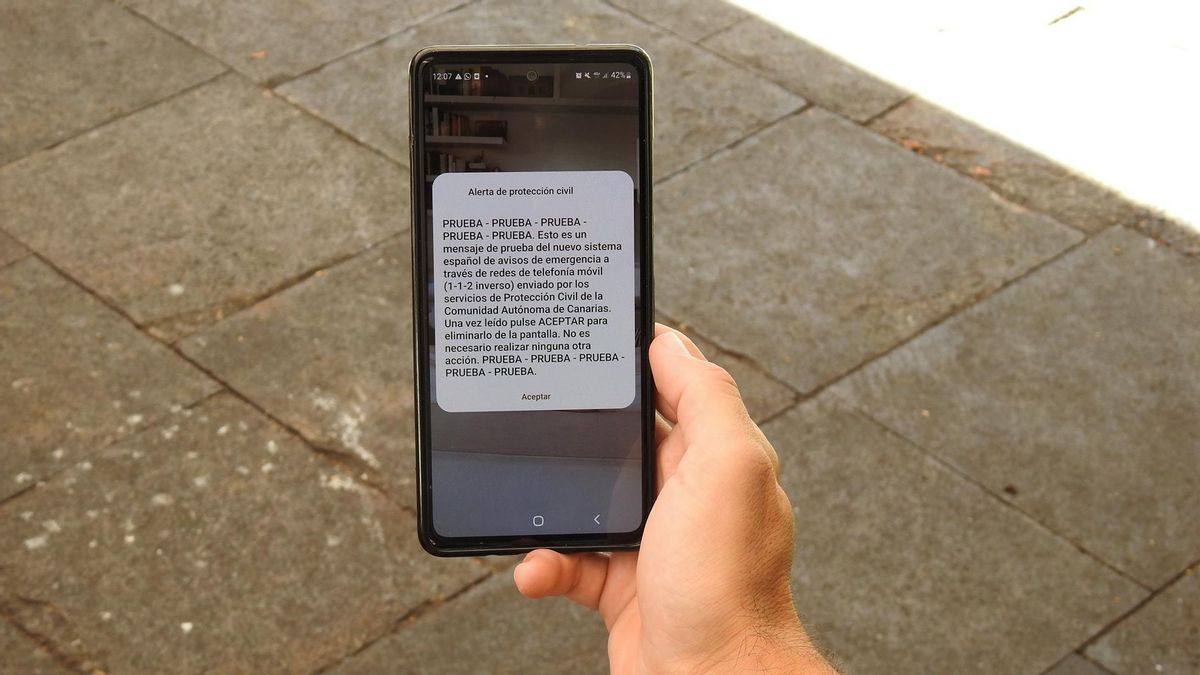
These tests are published and publicised in advance so that the population is aware of them and alarm is avoided. Compatible devices connected to the mobile network within the coverage area will receive a text message with the word “PRUEBA” (TEST), accompanied by a beep and vibration, which will disappear once it has been read and the word “Accept” has been pressed. There is no need to reply or call 112.
A system already used in real emergencies
This new tool of the National Civil Protection System is operational in the Canary Islands and has been used in real incidents, such as the most recent wildfires on La Palma and Tenerife and during the passage of Storm Therese in Tenerife and La Gomera. With the aim of ensuring it works optimally, tests continue to be carried out periodically at different points across the Canary Islands so that the population becomes familiar with the system.
ES-Alert allows alerts to be issued in the event of catastrophes or emergencies such as fires, floods, volcanic eruptions or adverse weather phenomena, without the need to install any application or register anywhere, thereby passing on self-protection instructions to residents of the affected area. It is one more channel for warning the population, complementing the usual methods such as evacuation bulletins, the media, social networks and public address systems. All information about the ES-Alert system is available on the 112 Canarias website.
What’s happening in the Canaries – straight to your phone
News, weather alerts and practical updates – direct from the islands, in English. We live here and know what’s going on – before the international media catch up. Everything lands on our WhatsApp channel – no middlemen, no algorithm. Curated for families, expats and travelers.
Tenerife-forged bell rings again in tiny Rioja village

Canarian journalists to discuss a world in conflict at Las Palmas theatre

Festival del Sur returns to Agüimes with theatre from three continents
Man, 24, seriously hurt in buggy crash on Gran Canaria track

Woman, 81, rescued from sea at Las Vistas beach in Adeje

Canary film Benito Pérez Buñuel to premiere in Venezuela

Teen rescued after ravine fall in Güímar, Tenerife

Young woman dies after falling from flat in Santa Cruz de La Palma

Quad rider, 44, injured in crash on Lanzarote road