
His presence brought the most human touch to the launch. Against the figures for investment, capacity and kilometres, Manuel represented the everyday user: someone who waits at a stop, changes plan because of the weather, travels across the island and gets on the bus that comes along. This time, a different bus, taller and more modern.
A new sight on the southern motorway
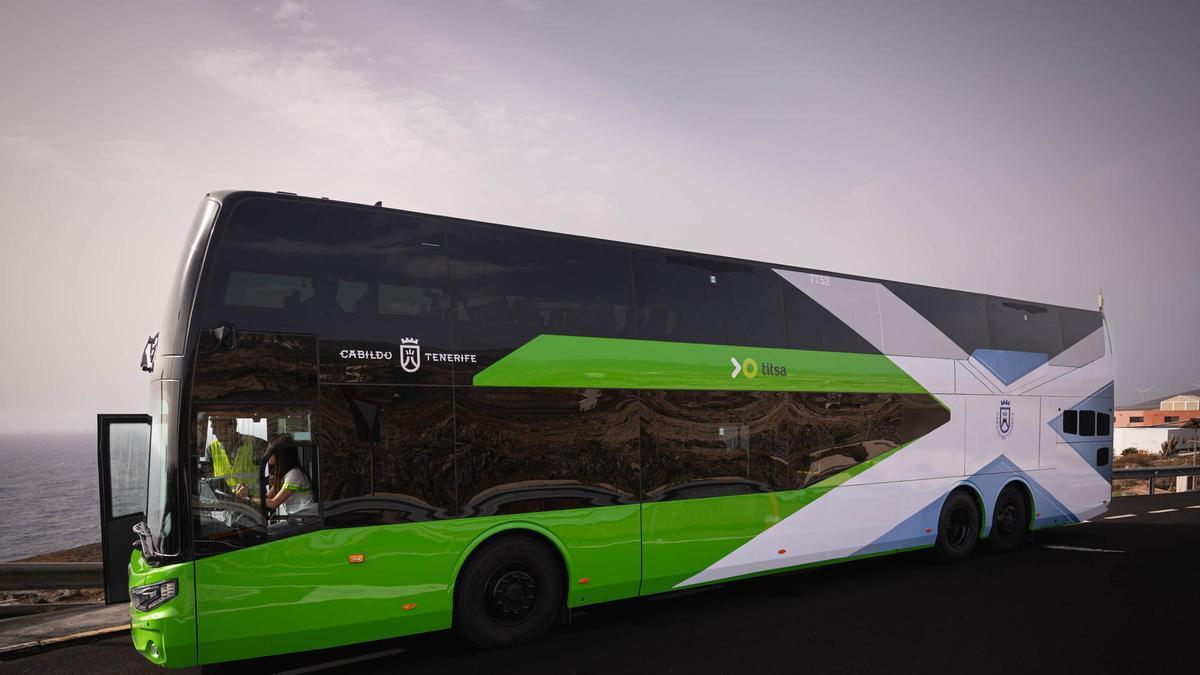
The final image was a new one: a double-decker bus cruising down the southern motorway. From the top, the road looked different. From the outside, Tenerife saw a vehicle appear that until now had not been part of its everyday landscape. Beyond the novelty, the challenge remains the same on the same roads: to see whether more capacity, technology and comfort will be enough to make more people leave their cars at home and decide to get on the bus.

Work on TF-5 third lane between Guamasa and Los Rodeos to start in November
Canary Islands international air arrivals fall 1.3% in September
Helicopter evacuates US cruise passenger near Tenerife
El Hierro airport sees 3.6% rise in September passengers
Gran Canaria approves €509k works to shore up GC-200 slope
Canary Islands gets €47.5m for free public transport in 2026
Canary Islands airports see 0.9% fall in September passengers
El Rejo road in La Gomera to close for six hours on Tuesday
Man, 65, seriously injured in GC-1 crash in Agüimes
Las Palmas traffic changes for emergency sewer works
But the story of the launch was not just about the data. There was also an unexpected protagonist: Manuel Ramos López, a resident of Las Galletas. He had gone out for a walk, but the wind made him change his route and he decided to catch a bus to Santa Cruz. Without expecting it, at the invitation of Rosa Dávila, he ended up on board for a historic journey. “I’m absolutely delighted,” he said. A regular user of public transport, although he sometimes takes the car, he summed up his philosophy with natural ease: “You’ve got to save money, mate.” When asked about the new bus, he did not hesitate: “Great, fantastic. Absolutely brilliant.”
His presence brought the most human touch to the launch. Against the figures for investment, capacity and kilometres, Manuel represented the everyday user: someone who waits at a stop, changes plan because of the weather, travels across the island and gets on the bus that comes along. This time, a different bus, taller and more modern.
A new sight on the southern motorway
The final image was a new one: a double-decker bus cruising down the southern motorway. From the top, the road looked different. From the outside, Tenerife saw a vehicle appear that until now had not been part of its everyday landscape. Beyond the novelty, the challenge remains the same on the same roads: to see whether more capacity, technology and comfort will be enough to make more people leave their cars at home and decide to get on the bus.
But the story of the launch was not just about the data. There was also an unexpected protagonist: Manuel Ramos López, a resident of Las Galletas. He had gone out for a walk, but the wind made him change his route and he decided to catch a bus to Santa Cruz. Without expecting it, at the invitation of Rosa Dávila, he ended up on board for a historic journey. “I’m absolutely delighted,” he said. A regular user of public transport, although he sometimes takes the car, he summed up his philosophy with natural ease: “You’ve got to save money, mate.” When asked about the new bus, he did not hesitate: “Great, fantastic. Absolutely brilliant.”
His presence brought the most human touch to the launch. Against the figures for investment, capacity and kilometres, Manuel represented the everyday user: someone who waits at a stop, changes plan because of the weather, travels across the island and gets on the bus that comes along. This time, a different bus, taller and more modern.
A new sight on the southern motorway
The final image was a new one: a double-decker bus cruising down the southern motorway. From the top, the road looked different. From the outside, Tenerife saw a vehicle appear that until now had not been part of its everyday landscape. Beyond the novelty, the challenge remains the same on the same roads: to see whether more capacity, technology and comfort will be enough to make more people leave their cars at home and decide to get on the bus.
A new view of the motorway
There was a sense of anticipation to see how Tenerife looked from above. Or, more precisely, how the southern motorway looked from the top deck of a bus. The scene had something of a school trip about it: journalists, officials, TITSA technicians and that childish curiosity that arises when something everyday is seen from a different height. From the Cuevas Blancas depot to junction 34 of the TF-1, heading towards Fasnia and Las Eras, it was 30 kilometres of absolute novelty. TITSA’s first double-decker bus took to the road this Tuesday as a dress rehearsal for a new chapter in the island’s public transport.
Inaugural journey
The inaugural journey was led by Rosa Dávila, alongside Eulalia García and Victoria Padilla. At the wheel was Yurena, the driver responsible for operating a vehicle that from this Wednesday 1 July begins service on routes 110, between Santa Cruz and Los Cristianos, and 112, between Santa Cruz and Playa de las Américas.
The trip brought back childhood memories of those bus excursions where you could almost smell the fried Russian steaks – cold, of course – and the Russian salad. But this time there was no smell of packed lunch; it smelled of new. The bus was brand new and ready to hit the island’s roads.
Farewell to wing mirrors
The vehicle has no conventional mirrors; instead, it is fitted with a system of high-definition digital cameras that assist the driver. Connectivity: all seats have individual seatbelts and USB ports for charging mobile devices. Full accessibility: the lower deck is adapted for people with reduced mobility, with a double access ramp (electric and manual), accessible buttons and improved visual information systems. Alcohol lock: it is a safety device that prevents the engine from starting, similar to a breathalyser.
Capacity boost on busy routes
Dávila explained that the first routes chosen are long-distance lines used mainly by workers travelling between Santa Cruz and the south at different times of day. The new units will increase capacity per journey by 44 per cent: from around 59 seats on a conventional bus to 85, with 18 seats on the lower deck and 67 on the upper deck.
Lines 110, 112 and 108 carried around four million passengers last year and the Cabildo (island council) expects to raise that capacity to six million. The investment is part of a wider strategy to improve mobility. Over three years, 351 new buses have been brought in, with an investment of €125 million, and fares have remained free for frequent travellers.
“Our obsession was to improve mobility on the island of Tenerife,” said Dávila, who asked the public to leave their cars at home more often and use the bus to get to work or school.
Built in Girona, smart and safe
The units, manufactured by Ayats in Girona, measure 14.60 metres in length, are over four metres high and weigh around 19,000 kg empty and up to 26,000 kg when fully loaded. Juan Carlos González, a TITSA instructor, summed up the challenge of driving them with a clear image: “We are driving a vehicle that, when empty, is like any loaded lorry.” Some 60 drivers have already been trained and the aim is to reach 90.
Technology was another of the points that drew the most attention. The bus does not use conventional mirrors but digital cameras that widen the driver’s field of vision and help control blind spots. The system detects people, motorbikes or bicycles on either side and warns the driver depending on speed and manoeuvre. “It’s a smart vehicle,” said González. “It only needs to talk,” someone joked.
Designed for long journeys
The interior is designed for long journeys and to improve accessibility. All seats have seatbelts and USB ports. The lower deck has two spaces for wheelchairs, a double access ramp, accessible buttons and visual information systems. In addition, the vehicles will feature an alcohol lock, which prevents the engine from starting if the driver tests positive for alcohol.
Thirteen on the way
The Cabildo has acquired 13 double-decker buses, of which five are already on Tenerife. Two are beginning service in the south, a third will soon be added to the northern corridor and one will be kept for training. The aim is for all 13 to be operational before the end of the year. Each unit must first pass through TITSA’s workshops to have cameras, ticketing systems, cashless payment, communications and passenger information installed. Route 108, between Santa Cruz, La Orotava and Icod de los Vinos via the TF-5, will be the next to be progressively added.
The intention is to reinforce the corridors with the highest demand without increasing the number of vehicles on the road by the same proportion. On an island where congestion on the TF-1 and TF-5 continues to shape daily life, every extra seat counts.
An unexpected passenger
But the story of the launch was not just about the data. There was also an unexpected protagonist: Manuel Ramos López, a resident of Las Galletas. He had gone out for a walk, but the wind made him change his route and he decided to catch a bus to Santa Cruz. Without expecting it, at the invitation of Rosa Dávila, he ended up on board for a historic journey. “I’m absolutely delighted,” he said. A regular user of public transport, although he sometimes takes the car, he summed up his philosophy with natural ease: “You’ve got to save money, mate.” When asked about the new bus, he did not hesitate: “Great, fantastic. Absolutely brilliant.”
His presence brought the most human touch to the launch. Against the figures for investment, capacity and kilometres, Manuel represented the everyday user: someone who waits at a stop, changes plan because of the weather, travels across the island and gets on the bus that comes along. This time, a different bus, taller and more modern.
A new sight on the southern motorway
The final image was a new one: a double-decker bus cruising down the southern motorway. From the top, the road looked different. From the outside, Tenerife saw a vehicle appear that until now had not been part of its everyday landscape. Beyond the novelty, the challenge remains the same on the same roads: to see whether more capacity, technology and comfort will be enough to make more people leave their cars at home and decide to get on the bus.