Luxury tourists using five times more water than locals
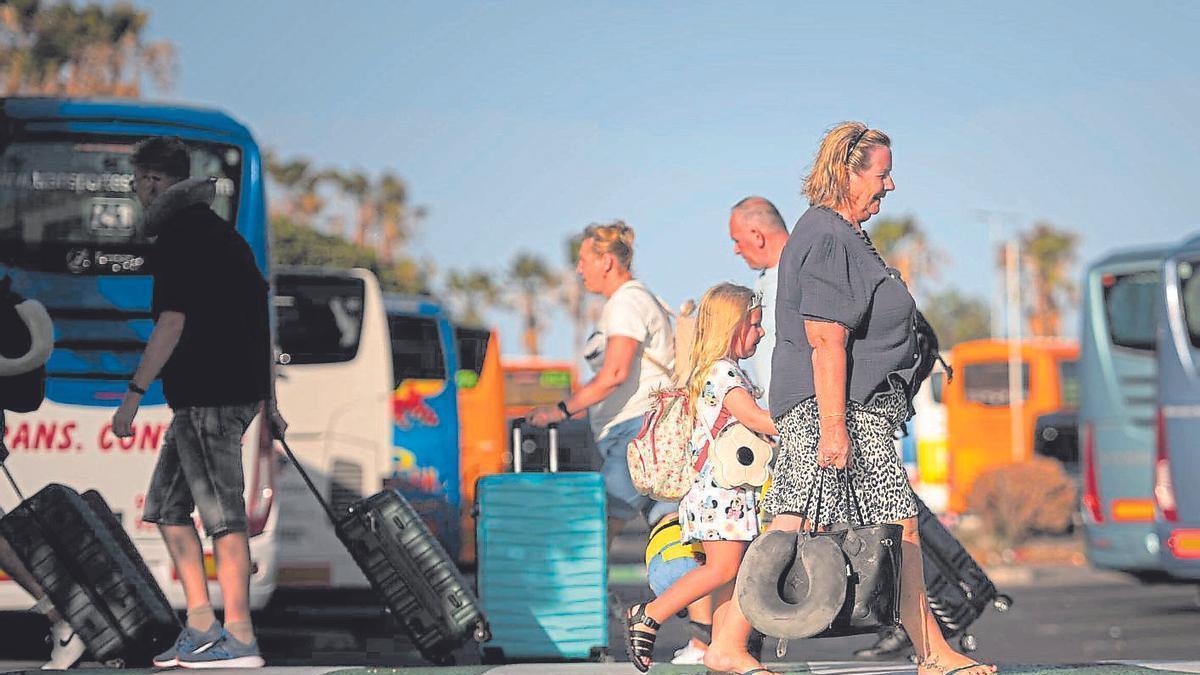
A tourist staying at one of the five-star hotels scattered across the Canary Islands consumes five times more water than a Canary Islander. Specifically, a visitor lodging in one of these ultra-luxury establishments tends to use an average of 500 litres of water per day, although peaks of between 700 and 1,000 litres per day have been recorded in some five-star hotels. This is happening while, according to the Canary Islands Statistics Institute (Istac), a resident in the islands consumes barely 115 litres per day.
Luxury facilities driving up demand
While part of this inequality is linked to the tourist’s own consumption – who, according to science, tend to relax their environmental awareness when on holiday – a large part is due to the logistics of an establishment with luxury services. “High-end hotels, which include facilities such as swimming pools, spas, or extensive landscaped gardens, can significantly multiply water demand, with garden irrigation responsible for up to 50% of the total consumption of some complexes.” This is stated by the Renovables Foundation, which has just published a report on water consumption in the Canary Islands and the Balearic Islands, warning that this phenomenon is putting pressure on both archipelagos, which have limited water resources and are clearly impacted by climate change in their rainfall patterns, temperatures, and solar radiation.
In collaboration with the Ministry for the Energy Transition and the Demographic Challenge, the Foundation insists that water consumption is directly linked to the type of establishment where the tourist stays, as there is a notable difference between spending the night in an apartment (from an average of 180 litres per person per day) and staying in a luxury hotel (500 litres).
Tourism accounts for 11% of water use
Overall, tourism accounts for around 11% of water consumption in the Canary Islands. A figure that, on islands with greater accommodation pressure, such as Tenerife, rises to 13.4%. This means that this regional average is double the global average for water consumption in the tourism sector, which stands at 5.8%. “It is intensifying pressure on ecosystems and compromising the supply to the local population,” the authors state in a press release. This diagnosis is shared by researcher Juan Carlos Santamarta from the University of La Laguna (ULL) – who did not participate directly in this report – who also believes that “the economy that sustains the islands – as it represents 37% of GDP – puts pressure on the resource that makes them habitable.”
Golf courses, water parks, and cruise ships add to pressure
But accommodation is not the only factor impacting consumption. Beyond hotels, other tourist activities that intensify pressure on water resources include golf courses, water parks, and marinas. Similarly, the cruise industry, with ports such as those in Santa Cruz de Tenerife or Las Palmas – which are among the most important in the Atlantic – generates temporary peaks in consumption in supply systems by concentrating the arrival of thousands of passengers within a few hours and the need to supply large vessels.
Agriculture a major water user, especially on La Palma
A large part of the islands’ water resources are destined for agriculture, although consumption is uneven. In the islands, except for Lanzarote and Fuerteventura, which allocate a low proportion of water to agriculture (7% and 3%, respectively), the proportion of water used for crop irrigation is significant, exceeding 40% in the central islands (Gran Canaria, El Hierro, Tenerife, and La Gomera) and 87% on the island of La Palma. The report links these differences to the predominant types of crops on each island.
Banana cultivation is the largest consumer of water in the archipelago and one of the most relevant from an economic perspective. On Tenerife, it represents 49% of total agricultural production, and the associated water consumption reaches 52% of the island’s total, with an estimated demand of 50.75 cubic hectometres per year exclusively for this crop. On Gran Canaria, the water demand of banana plantations was estimated at 21.07 cubic hectometres per year, accounting for 32% of the island’s total water consumption for agriculture.
Huge water losses from leaking pipe networks
The Foundation has also assessed water infrastructure in a complementary study that also aims to lay the foundations for improving the situation. This second report examines the cases of three islands in the archipelago: Tenerife, Lanzarote, and El Hierro. In particular, it highlights enormous water losses due to the poor condition of distribution networks. On Lanzarote, 61% of the drinking water produced does not reach the end user: more than 16.5 cubic hectometres per year. On Tenerife, the situation depends on who you ask. Officially, 28% of water is lost, but the agricultural sector puts losses at 60%. On El Hierro, around half of the water never reaches the consumer.
Urgent call to fix leaks and limit tourist demand
For these researchers, the resilience of the Canary Islands cannot be solved simply by “producing more water” at the cost of burning more fossil fuels to obtain desalinated water. The researchers believe that the roadmap urgently requires: stopping physical losses in distribution networks (where literally half of the desalinated water is wasted), expanding tertiary treatment for reuse, and setting limits on the tourist demand model in regions with the greatest water stress. Santamarta agrees, considering the most relevant angle of the report to be the opportunity for improvement. “The Canary Islands has a consolidated desalination capacity and a clear horizon: to power that production with renewables, as El Hierro already does,” insists the researcher, who believes that the issue to be addressed, in general, “is the efficiency of the system as a whole.” “It would be inconsistent to increase production while a substantial part of the water is lost in outdated networks,” he concludes.
What’s happening in the Canaries – straight to your phone
News, weather alerts and practical updates – direct from the islands, in English. We live here and know what’s going on – before the international media catch up. Everything lands on our WhatsApp channel – no middlemen, no algorithm. Curated for families, expats and travelers.

Rare deep-sea codlet confirmed in Canary waters for first time

Tenerife faces summer with just two campsites amid outdoor tourism boom

Canary Islands to get first dedicated biodiversity law

Tenerife seismic activity: 550 events recorded in 24 hours

Contigo La Palma slams ‘unethical’ banana aid compensation

Canary Islands observatories get major data network boost
Energy storage framework finally approved for Canary Islands

US military hub near Canaries: what it means for Spain
Man arrested after wildfire in Masca ravine spread near homes