Protesters take to sea and land against industrial fish farm
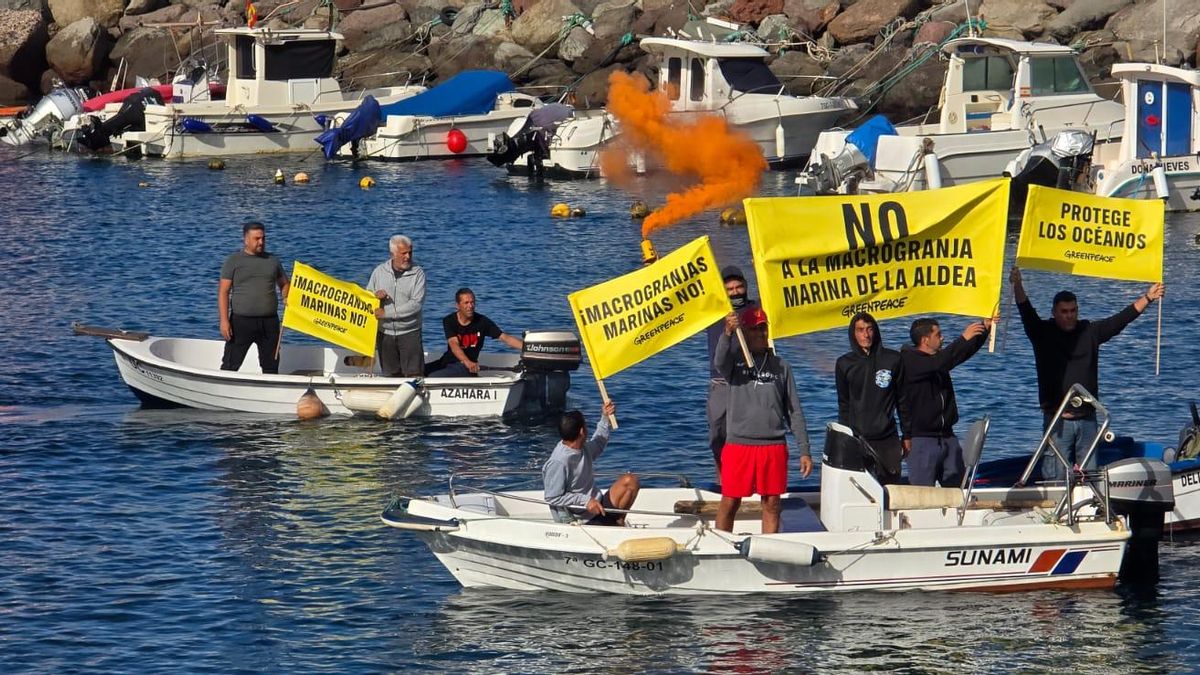
The coast of La Aldea in Gran Canaria became the scene of a powerful citizen protest on Sunday, the eve of World Oceans Day, against plans to install industrial aquaculture cages off the coast by the company Gran Canaria Bass Company SL. Organised by Greenpeace in collaboration with the Platform for a Clean Coastline, hundreds of people joined a collective action demanding the immediate halt of a megaproject they described as an ecological and socio-economic assault.
‘Our sea will not become an industrial estate’
“Today the people of La Aldea and the whole of Canarian society have made it clear that they will not allow our sea to be turned into an industrial estate. The megafarm of Gran Canaria Bass Company SL represents a direct threat to the health of the islands’ marine environment, as well as a severe blow to the local economy and the survival of the artisanal fishing sector,” said Irene Sánchez Lasso, spokesperson for Greenpeace in the Canary Islands. The mobilisation served to highlight civil society’s outright rejection of an extractivist economic model that privatises public marine space for corporate profit, jeopardising the fragile balance of Canarian waters.
700 people gather on the beach
Several vessels sailed to the breakwater of La Aldea beach, carrying a banner that read “No to the marine megafarm in La Aldea”. Around 700 people were waiting on the shore to raise their voices and make it clear, by sea and by land, that the people of the Canary Islands do not want megafarms in their waters. At the end of the event, a joint manifesto was read out warning of the serious environmental impacts of these floating installations, including water pollution from organic matter and toxic substances (such as algicides, bactericides and antibiotics), the transmission of diseases to wild species, eutrophication of the marine environment – which reduces the availability of light and oxygen – overexploitation of the oceans, and the critical risk of fish escaping from the cages.
Company backed by Emirati capital
Gran Canaria Bass Company SL, with 90 per cent of its capital coming from the United Arab Emirates, plans to install 24 marine cages off La Aldea. The facility would produce 5,400 tonnes of sea bass, almost all of which would be destined for export, as this species is barely consumed by the local population. The proposed location is very close to two protected marine areas within the Natura 2000 network – the Special Area of Conservation (SAC) Sebadales de Gando and the Special Protection Area for Birds (SPA) Mogán-La Aldea marine area – and falls within the transition zone of the Gran Canaria Biosphere Reserve. Furthermore, the presence of the angel shark (Squatina squatina), a species classified as critically endangered by the IUCN (International Union for Conservation of Nature), has been documented in several areas near the installation site.
Threat to artisanal fishing and protected species
If the project goes ahead, beyond the impact of placing cages near these ecologically valuable protected areas, it would deal a severe blow to the municipality’s artisanal fishing sector, whose community has historically been closely tied to the sea. Greenpeace has pointed out that Canarian artisanal fishing is a cornerstone of the local economy and the islands’ food sovereignty, and that the introduction of intensive industrial aquaculture would displace fishermen from their traditional fishing grounds due to the accelerated degradation of the marine environment.
Previous mass die-off raises alarm
The island has already suffered the negative impacts of marine aquaculture. In late 2025, a mass die-off of sea bass occurred in cages owned by the company Aquanaria, located just 350 metres from Melenara beach, leading to the closure of several beaches across the municipalities of Telde, Mogán, Agüimes and San Bartolomé de Tirajana. A total of 15 beaches, distributed along the island’s eastern and southern coasts, were affected by the incident. Greenpeace, together with other local groups, has been denouncing these events for years and calling for the removal of these cages, which are visible from the shore.
Environmental group calls for protection, not exploitation
The environmental organisation advocates for protecting the coastline through marine reserves and promoting sustainable fishing, not aquaculture. “This project is yet another example of an extractivist economic model that only benefits a few, leaving a trail of ecological destruction in its wake. The defence of our oceans and the future of coming generations are not negotiable, and we will continue to mobilise if the authorities insist on ignoring the public. We will not take a step back,” concluded the Greenpeace spokesperson for the Canary Islands.
What’s happening in the Canaries – straight to your phone
News, weather alerts and practical updates – direct from the islands, in English. We live here and know what’s going on – before the international media catch up. Everything lands on our WhatsApp channel – no middlemen, no algorithm. Curated for families, expats and travelers.

Earthquake felt in Tenerife and Gran Canaria

Rare deep-sea codlet confirmed in Canary waters for first time

Tenerife faces summer with just two campsites amid outdoor tourism boom

Canary Islands to get first dedicated biodiversity law

Tenerife seismic activity: 550 events recorded in 24 hours

Contigo La Palma slams ‘unethical’ banana aid compensation

Canary Islands observatories get major data network boost
Energy storage framework finally approved for Canary Islands

US military hub near Canaries: what it means for Spain