RIU unveils plans for controversial Corralejo hotel revamp
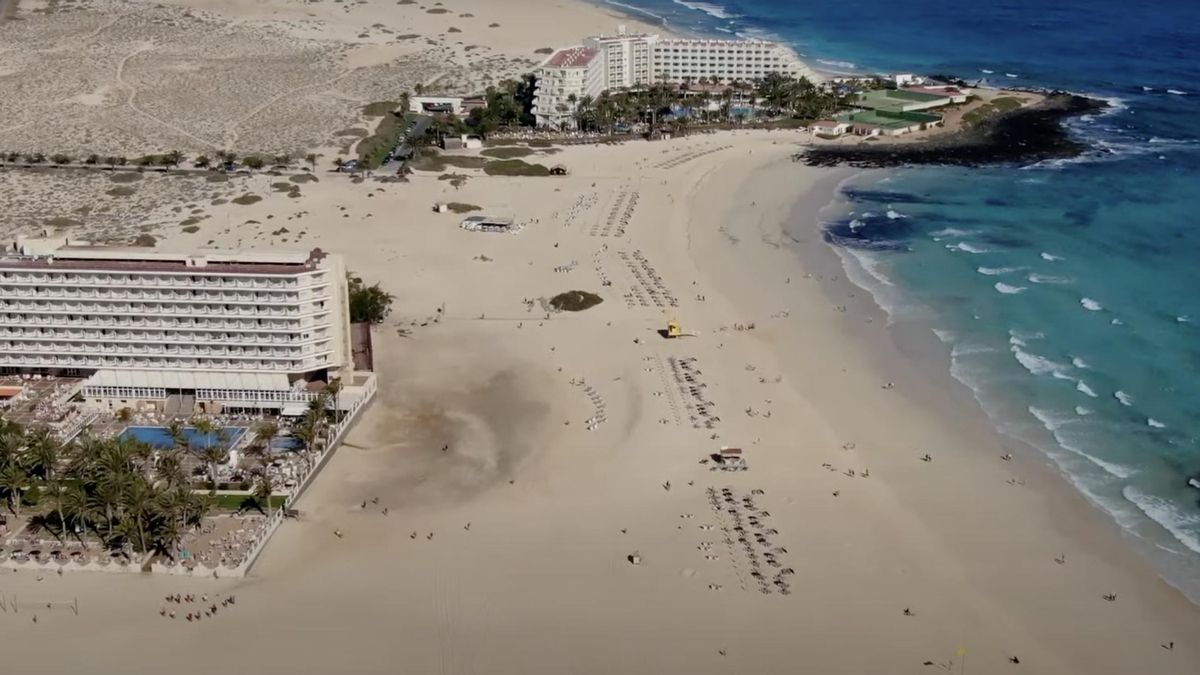
Mallorcan hotel chain RIU has submitted a project to modernise and refurbish one of its hotels in the Corralejo Dunes, the Hotel RIU Palace Tres Islas. The company has sent a document to the environmental body of the Cabildo of Fuerteventura requesting a simplified environmental impact assessment for the works, which include the creation of six new rooms. The report argues that the building is deteriorating due to its exposure to sea spray and proposes several measures to turn it into a benchmark for sustainability, despite the controversy surrounding its location within a natural park and a coastal protection zone.
Environmental groups lodge objections
The environmental groups Turcón and Ben Magec have filed objections to the modernisation project, which was put out to public consultation. They insist that the renovations are incompatible with the protection of the public maritime-terrestrial domain and the ecologically valuable natural environment in which the hotel sits. The campaigners consider that the project contradicts the principles of environmental sustainability and the public interest that should guide administrative action.
Four key pillars of the project
According to the modernisation project document consulted by Canarias Ahora, the works are structured around four main axes: upgrading the air conditioning system to improve energy efficiency; structural safety, to reverse degradation from the environment and age; functional modernisation and accessibility improvements; and sustainability and efficient use of resources, including the installation of water-saving technologies. The project includes more than 20 individual actions. Among them are creating six new rooms on the sixth floor of the building, new parking areas, replacing all lifts, replacing kitchen extractors, refurbishing the reception lobby, creating a new solarium, a new fitness area, refurbishing one of the swimming pools and a spa zone adapted for people with reduced mobility.
RIU claims works are limited to existing building footprint
In the document, RIU argues that the refurbishment will act exclusively on the existing building, focusing on interior spaces, communal areas, service zones, sports facilities and pools. The company’s environmental document analyses the impact that the modernisation works could have on the natural spaces crossed by the hotel, which form part of the Natura 2000 network. Specifically, the project is located on a 30,438-square-metre plot of land affected by the Corralejo Special Area of Conservation (SAC), the Sebadales de Corralejo SAC, the Isla de Lobos Special Protection Area (SPA) and the La Bocayna Marine Space SPA. Bird species that can be identified in the area include the Cory’s shearwater, the European storm petrel, the Bulwer’s petrel, the stone curlew, the Kentish plover and the Egyptian vulture, which is critically endangered. In terms of flora, the seagrass that forms the sebadal meadows stands out as being of interest to Canarian ecosystems and is also included in the catalogue of protected and vulnerable species.
“The main activities taking place in the area related to the hotel establishment that could cause impacts on the SAC are discharges from land to the sea,” the document details. According to the promoter, no impact on the marine SAC is anticipated from this project because no intervention is planned on hydraulic infrastructure or in the marine environment. In its conclusions, RIU insists that no significant effects on protected habitats are foreseen and argues that any potential negative effects on the environment are temporary, reversible and of low magnitude, concentrated mainly during the renovation phase.
Chain insists revamp is essential for safety and sustainability
According to RIU, the consolidation and modernisation refurbishment is imperative to guarantee the safety of the structure and environmental sustainability, but also to improve the hotel’s service offering. The chain insists that the property, located in the Grandes Playas natural area within the public maritime-terrestrial domain, is suffering from “critical technical and energy obsolescence”, compounded by material degradation from exposure to sea spray. Of all the alternatives proposed by RIU, the chain has opted for option number three, which includes a total cessation of accommodation activity during the works period. “The temporary closure allows the modernisation to be quick, safe and thorough, transforming an obsolete complex into a benchmark for environmental sustainability in the protected space,” the text states.
Ecologists demand demolition and end to concessions
The environmental groups Turcón and Ben Magec have filed objections to the project and urge the administration to act firmly, in accordance with current legislation and in defence of the common good. Both have called for the effective completion of the demolition of the Oliva Beach hotel, guaranteeing the restoration of the occupied natural space, as well as the continuation of the procedure to revoke the concession for the Tres Islas hotel. In the documentation sent by the campaigners to La Oliva Town Council, to which this newspaper has had access, Turcón stresses that these hotels “have been a poor example of how to carry out a sustainable policy for tourism activity”, by occupying “the environmental asset that serves as the attraction”. Furthermore, they claim that the right of citizens to use the public domain and the environmental assets to be preserved has been put at risk.
For Turcón and Ben Magec, the revocation of the concession and the demolition of the hotels “will benefit the Corralejo Dunes, Fuerteventura and Canarian society in general”. In this vein, they call for support from public administrations to demonstrate whether they are committed to defending the territory and the public interest. “It is about moving towards a truly sustainable tourism model, one that is not predatory and is based on the general interest, rather than on the privileges and benefits of a few […]”, they stress.
Black flag award and a history of legal disputes
Both this hotel and the Oliva Beach, also in the Corralejo Dunes, received a black flag from Ecologists in Action for poor environmental management, as the organisation described them as “two very serious cases of occupation of the Public Maritime-Terrestrial Space”. RIU also submitted three renovation projects for the Oliva Beach in 2017, two of which were rejected for breaching the Coastal Law. In April, the National High Court validated the company’s withdrawal of all three proposals.
In July 2023, the General Directorate of Coasts initiated a new file to declare the revocation of the concession granted to the Tres Islas hotel to occupy the public domain. It was in 2007 that a ministerial order granted Sonco Canarias (absorbed by RIU) the concession until 2037, on the condition that neither the height nor the surface area of the hotel, located on a protected natural space, would be modified. Just over a year later, Coastguard inspection staff verified that expansion works had been carried out and imposed a fine of 10,885 euros along with an order to return the property to its previous state. The requirements were not met, so in 2021 a file to revoke the concession was opened.
Coasts, which falls under the Ministry for Ecological Transition, reported in 2023 that the 2021 procedure had exceeded the maximum processing period. Having confirmed that the works breaching regulations and the conditions of the concession were still in place, the process was restarted in 2023, but according to environmentalists, it was allowed to lapse without a firm resolution. In 2025, the illegal suites on the roof of the Hotel Tres Islas were demolished to comply with the requirement from Ecological Transition, but Turcón-Ecologists in Action described the action as a “cosmetic patch”. For the group, this demolition “cannot be understood as a repair of the damage caused to the public maritime-terrestrial domain, but rather as a greenwashing exercise”.
Who is responsible for the coastal site?
Although the Government of the Canary Islands has held powers over coastal matters since 2023, when asked about the current administrative situation of the Tres Islas, the regional executive responded that the matter is the responsibility of the State. This newspaper has also put the question to the Ministry, which has so far not replied. In the environmental document, the promoter maintains that the project is located within the Public Maritime-Terrestrial Domain and that the structural unit of the existing buildings has been granted an administrative concession for occupation. It therefore appeals to Law 2/2013 of 29 May on the protection and sustainable use of the coastline, which establishes that while the concession is in force, its holders may carry out repair, improvement, consolidation and modernisation works provided that they do not involve an increase in the volume, height or surface area of the existing constructions.
What’s happening in the Canaries – straight to your phone
News, weather alerts and practical updates – direct from the islands, in English. We live here and know what’s going on – before the international media catch up. Everything lands on our WhatsApp channel – no middlemen, no algorithm. Curated for families, expats and travelers.

Earthquake felt in Tenerife and Gran Canaria

Rare deep-sea codlet confirmed in Canary waters for first time

Tenerife faces summer with just two campsites amid outdoor tourism boom

Canary Islands to get first dedicated biodiversity law

Tenerife seismic activity: 550 events recorded in 24 hours

Contigo La Palma slams ‘unethical’ banana aid compensation

Canary Islands observatories get major data network boost
Energy storage framework finally approved for Canary Islands

US military hub near Canaries: what it means for Spain