
The Invisible Economy of Holy Week
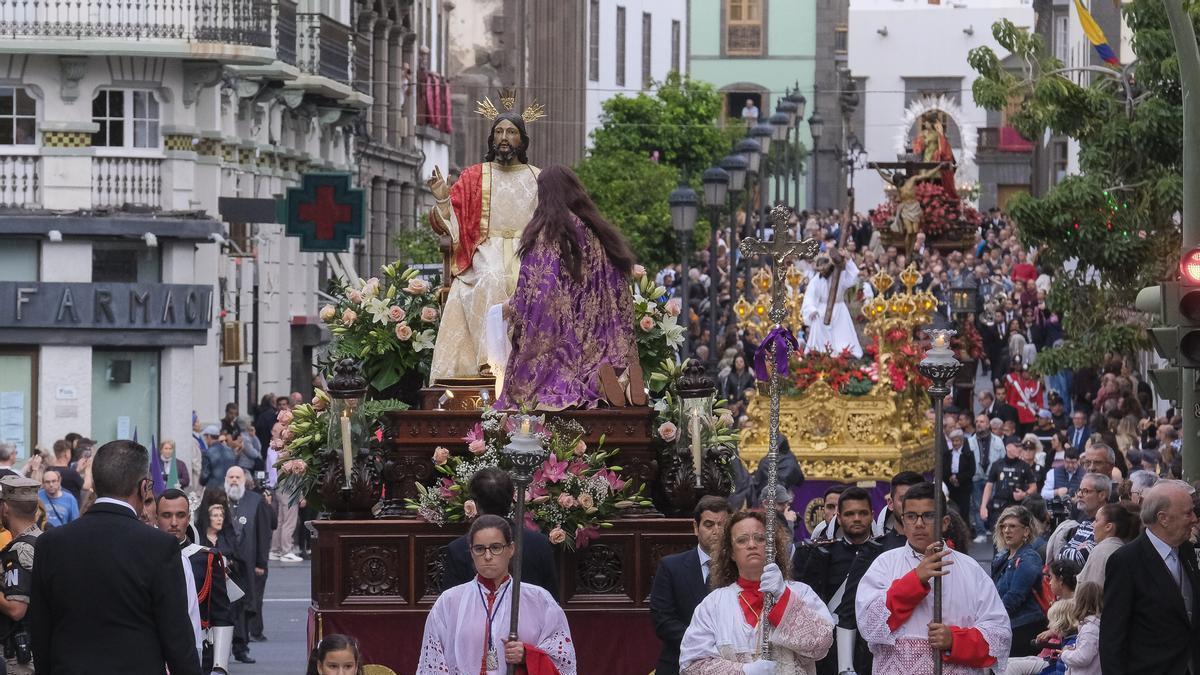
With the arrival of Holy Week, the accounts of the religious brotherhoods begin to tremble. The red numbers appear. As the processions start, taking the sacred floats (pasos) out onto the streets is far from cheap. Flowers, bands, robes, candles—the list is long, and while the final sum depends on many factors, the average cost in the Canary Islands is around €10,000 per procession. Some, however, reach €15,000 for each outing. Behind the most important week of the religious calendar lies a whole invisible economy, months in the making, and one that is broadly shouldered by the brotherhoods themselves.
“This is undoubtedly the time of year when we spend the most. When Holy Week ends, we are practically back in the red,” explains Lino León, President of the Council of Brotherhoods, Fraternities and Patronages. An opinion shared by the Sister Superior of the Brotherhood of La Macarena in Tenerife, María del Carmen Llarena Suárez. “The rest of the year we only have occasional expenses for changing robes or small bouquets, but nothing compared to the investment we make for these days,” she admits.
Where Does All the Money Go?
The cost is the sum of many ingredients. A large portion is invested in flowers; smaller brotherhoods spend about €2,000, while the largest disburse up to €5,000 for the main days. Demand is so high that importing is essential, which drives up the bill. “Our tendency is always to support local produce, but it’s true that flower wholesalers face problems because they cannot find, for example, enough red carnations,” states León. Floral arrangements are also the product most subject to inflation caused by international changes and tensions. Rising oil prices, as a consequence of wars, make the brotherhoods’ accounts more expensive.
“Flower prices have been rising at a very high rate for three years, and since January they have shot up again,” laments León. “Just for the kissing of the hand ceremony, we spent €260 on flowers, and on the other two floats about €1,400. It’s a fortune,” acknowledges Llarena.
Imported Wax and Scarce Musicians
The wax for the candles also comes from abroad, with many brotherhoods buying it in Seville. “We have spent €800 on candles alone,” explains the Sister Superior of the Brotherhood of La Macarena. There also aren’t many wax manufacturers in Spain, and the orders placed by the brotherhoods are very specific, further increasing the cost.
Another major expense comes from the musical note. Music bands charge between €2,000 and €3,000 per afternoon, though the cost can reach €6,000. “There isn’t much supply either, and the prices are what they are,” says León.
The Mounting List of Smaller Costs
To these large outlays are added many other expenses which, though more discreet, end up inflating the final bill. Maintaining the heritage requires buying specific products like silver polish, often also brought from outside, and undertaking constant small renovations. A sash can cost around €15, a pair of slippers another €14, and to that is added the cleaning of tunics and vestments, which is around a hundred euros, plus laundry, repairs, or replacements.
During the main days, logistics also count, and you have to add food for the float-bearers and musicians—sandwiches, water, or basic materials to ensure the procession runs smoothly. “There are many things you add up little by little,” summarises Llarena. All this without considering larger investments like renewing robes or acquiring new statues.
The Art of the Imaginer: A Craft in Short Supply
In that realm moves the art of the imaginer (religious image maker), an almost artisanal trade with scarce presence in the Canaries. Only a handful of professionals dedicate themselves to it, and demand is high, with waiting lists that can stretch several years. “Some people are willing to wait, and others are not,” explains the imaginer Ibrahim Hernández, who works from Tenerife for brotherhoods and private clients. He highlights that this type of commission requires time, specialisation, and very specific materials.
They are not usual expenses, but when they arrive, they represent a significant effort for the brotherhoods. Behind each new image or restoration lies an artisanal process that takes time. The Tenerife-based imaginer reveals the complexity of a task that requires patience and select materials. “For a quality commission, like a wood carving, you can take two months of intensive work, dedicating many, many hours to it,” he explains.
Hernández, one of the few remaining professionals in the Canaries dedicated to author religious imagery, underlines the logistical difficulty his work entails. “I have to import all the material; the wood, the gold leaf, the pigments… you can’t get any of that here in the Canaries,” he states. It is an extraordinary expense that the brotherhoods assume—very occasionally—knowing it is a work “for a lifetime,” and one often financed thanks to private donations from devotees who decide to pay for a specific piece.
How Is Everything Else Paid For?
With their own resources. The brotherhoods are financed mainly through their members’ fees, which are usually around €30 per year, plus an additional payment for those who participate in the procession. Public aid is scarce and, in many cases, symbolic. “The subsidy may only represent 1% or 2% of the total expenditure,” points out León, who calls for greater institutional commitment. “We often limit ourselves because we don’t have money for more,” he adds.
Even so, the network of brotherhoods also relies on altruistic contributions, such as one-off donations or collaborations that allow specific projects to go ahead, like the renewal of vestments in the case of La Macarena. “This year, the Virgin and the Lord have new robes thanks to a donation from one person,” acknowledges Llarena.
Planning Ahead Amid Soaring Inflation
The economic organisation is not improvised. The brotherhoods plan months in advance and, in many cases, at the start of the year they already have much of Holy Week locked in. Orders to suppliers, especially those outside the Canaries, require foresight and coordination in a high-demand market.
The brotherhoods have not been able to escape inflation. In the last decade, costs have increased notably. “At a minimum, the cost of a Holy Week has gone up by 30% in the last ten years,” calculates León. A rise that, added to the lack of structural income, keeps many brotherhoods in a delicate economic balance every time their big days approach.

Hotel facade fire in Las Palmas causes material damage

Tenerife comic salon returns with 40 exhibitions and 80 artists

Buenavista del Norte and Villa de Mazo compete for Christmas lights glory

Tourism overcrowding and its impact on Canary Islands healthcare

WOMEX 2026 closes in Gran Canaria as Tenerife named 2027 host

Five French sailors injured as yacht hits rocks off Lanzarote

Amaia Montero’s emotional tribute at Gran Canaria concert

Netflix begins filming new thriller in Tenerife

Loquillo and Amaia headline Tenerife Peñón Fest 2026
