
Teide’s hidden frozen air lake
In a rarely visited spot on the lower slopes of Mount Teide, the volcano guards one of the best-kept secrets of this untamed corner of the planet. Trapped between towering walls of basalt rock, forged long ago by the relentless lava of the great volcano, lies a structure as invisible as it is enigmatic: a frozen air lake. Here, temperatures are so extreme that the living organisms that call this place home endure what scientists describe as ‘summers and winters’ in less than 24 hours.
Ignacio Plazaola, a researcher at the University of the Basque Country (UPV-EHU), has been visiting the national park regularly for several years. As he explains: “It’s one of the most interesting places to study.” His enthusiasm is understandable to anyone who has walked the trails of malpaís, lapilli and basalt, because this peculiar feature of the Teide landscape has presented science with a fascinating puzzle: plants that can survive and grow each day under a gradient of extreme temperatures.
How the frozen air lake forms
“We’re very interested in understanding how they manage to adapt to this environment,” says Plazaola. This week, he has brought his team and collaborators from the University of La Laguna (ULL) to the area as part of the Rebeca research project – a three-year study funded by the National Parks Authority and the UPV-EHU – to collect real-time data on humidity and temperature, and to assess the photosynthesis cycle of the plants found in this unique zone.
“Here, on calm nights when there isn’t much wind, the thermal current flows down the slopes and becomes trapped in the basin, causing that temperature difference,” explains Plazaola. Frozen air lakes are a common phenomenon that Teide shares with other national parks, such as the Picos de Europa. However, the case of this Tenerife summit is extraordinary, as few places on Earth experience such an abrupt daily temperature shift as this basin.
A landscape of extremes
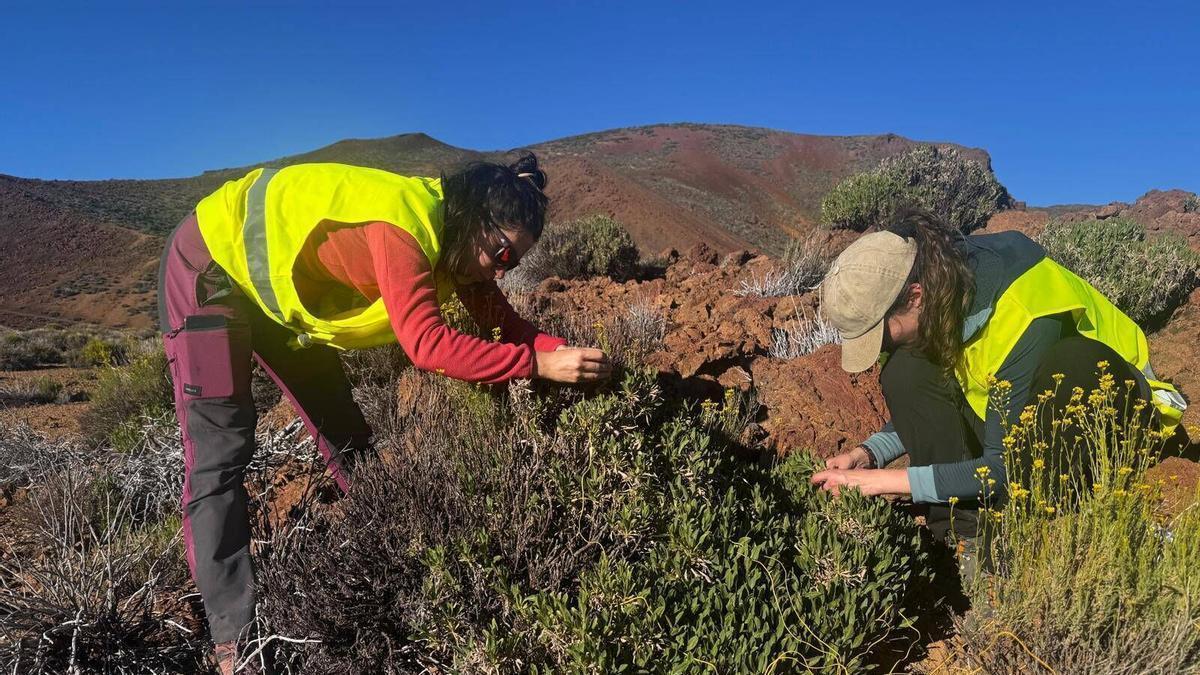
On a scorching hot day, two scientists, Beatriz Fernández and Enara Alday, are taking samples in the basin that turns into a frozen lake at night. On this flat area, which stands out against the rugged, lunar landscape of the National Park, two shrub species have caught the scientists’ attention: the pajonera grass (Descurainia bourgaeana) and the rosalito or rosalillo de cumbre (Pterocephalus lasiospermus).
“These two species grow both in the Portillo area and in this frozen lake, which allows us to compare their characteristics,” explains the researcher. Both locations are separated by barely 20 metres in length and 50 metres in elevation, but an even greater gap divides them: a temperature difference of several degrees. “Last night we detected a difference of 7 degrees between the two sites,” reveals the researcher, though it can be even more. “In this area, the lowest minimum temperature recorded was -14.5°C last Tuesday.”
But if it becomes a frozen air lake at night, in the morning – especially after midday – the opposite can also occur: the frying pan effect. “If there’s no air movement, that area becomes suffocatingly hot,” he reveals.
Plants that never stop growing
“For a plant, these are very harsh conditions, especially for one that is actively growing,” says the researcher, who insists that on Teide, both the pajonera grass and the rosalito de cumbre are usually in a constant state of growth. In other parts of the world, vegetation stops growing and slows its metabolism when faced with harsh conditions, but on Teide this is not the case. “Here it freezes every month of the year, so the plants can’t afford to wait for it to stop.”
“Our job is to check whether the plants down below have developed special adaptation mechanisms to withstand these tough conditions,” explains Plazaola. During the last week, the research group has visited the area to take measurements over seven days and four nights. “Right now we’re measuring photosynthesis in real time,” he emphasises.
Early results reveal ‘Ferrari’ plants
They are doing this using instruments capable of measuring carbon dioxide uptake in the plant’s leaves. “Photosynthesis involves taking CO2 from the air and, using the sun’s energy, producing sugar,” the researcher explains. The scientists insert the plant’s leaves into a capsule where temperature and humidity are controlled. “The only thing we change is the concentration of carbon dioxide, which is like giving the plant a lot or a little food to work with,” argues Fernández. In this way, through the results obtained and using mathematics, they can estimate “how it works on the inside”.
The first results, although very preliminary, have shown that the pajonera grass functions like “a Ferrari”. “They are incredibly fast at doing photosynthesis; this has really caught our attention because it means they are constantly growing,” argues Plazaola. Meanwhile, a difference has also been detected between the microorganisms found in the soil of the frozen lake and those found closer to the Portillo.
This is, however, just a first glimpse of what may be happening in this area of Las Cañadas. “We plan to carry out more experiments to find out how the microorganisms relate to the flora and whether this might explain the adaptive differences,” the researcher concludes.
What’s happening in the Canaries – straight to your phone
News, weather alerts and practical updates – direct from the islands, in English. We live here and know what’s going on – before the international media catch up. Everything lands on our WhatsApp channel – no middlemen, no algorithm. Curated for families, expats and travelers.

Canary Islands sea hits second-hottest year on record

Legal bid to halt tree felling in Santa Cruz’s La Salud

Fiesta del Charco: A journey through La Aldea’s past

Corralejo dunes power line set for removal

ULPGC launches 14 research projects at Las Canteras

TMT will never be built, says Canary Islands astrophysics chief

Pedro Duque: Canarias is the “ultimate dream” for rockets

Court blow to Tenerife motor circuit project
La Palma faces new volcanic risk planning deadline
