New fish farm project in protected waters
A new project to install marine fish cages is taking shape in a protected area off Tenerife. The Canary Islands Government has awarded the company Socat Canarias S.L. the right to operate fish farms in the Aquaculture Zone of Interest (ZIA) TF-5, along the coastline of Adeje, specifically between Playa del Veril and Playa de Troya. This ZIA overlaps with the Teno-Rasca Special Area of Conservation (SAC), which is protected under European law.
Precious marine life at risk
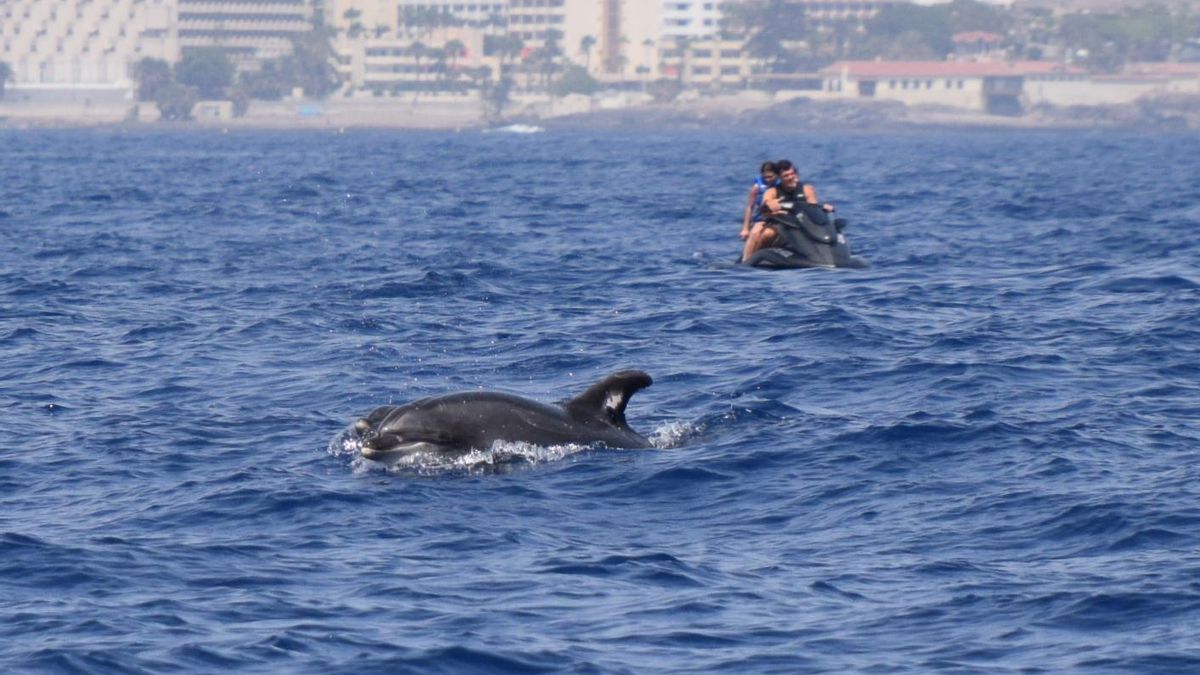
The natural assets that earned this site its protected status include the bottlenose dolphin (Tursiops truncatus), the loggerhead sea turtle (Caretta caretta), and sandy seabed habitats. Moreover, this stretch of sea is home to Europe’s only Whale Heritage Site, largely due to its significant resident population of tropical pilot whales.
The scale of the proposal
Socat’s project envisages 28 production cages covering an area of 22,500 square metres for the cultivation of sea bass, sea bream, and amberjack. In addition, eight auxiliary cages, each 12 metres in diameter, will be installed for operational tasks such as stocking and transferring fish, rather than for fattening. The combined annual production across the three species is estimated at 3,000 tonnes.
The Directorate General for Fisheries has stressed that the project is not yet authorised and must pass all mandatory assessments required by regional, national, and European regulations before a final decision can be made. “The resolution of February 2026 was limited to selecting the winning project from the public tender,” they added.
No attempt to hide protected status, say authorities
Regarding the potential impact on the SAC, officials from the department maintain that “this circumstance has not been hidden or ignored at any time.” They argue that the existence of this protected area is explicitly referenced in the aquaculture plan approved in 2018, as well as in the rules governing the public tender, which “establish the obligation to obtain the necessary favourable reports before resolving the procedure.”
Existing operations and new players
According to data from Grafcan, as of December 2025 Socat Canarias S.L. was already operating marine cages off the coast of Arona, producing 162.5 tonnes of sea bream and sea bass. Meanwhile, within the ZIA TF-5, the concession was held by the company Cabo Pez S.L., which ran fish farms in Adeje producing 175 tonnes of sea bream and sea bass.
Government accused of failing to inform state bodies
In June, the Ministry for Ecological Transition issued a letter criticising the regional Fisheries Department for learning about this project through information forwarded by Adeje Town Council rather than from the regional government itself. In the document, the Deputy Directorate General for Terrestrial and Marine Biodiversity states that “there is no record of any request for an impact assessment report” on the project submitted by the Canary Islands Government.
The Deputy Director General for Terrestrial and Marine Biodiversity, Fernando Magdaleno, reminded the regional government of its obligation to subject any plans, programmes, or projects that could affect the Teno-Rasca SAC to a proper impact assessment. He also stressed that his department is the body responsible for issuing the impact report, as it manages the affected area. Consequently, he has requested all information regarding the project’s characteristics, environmental documentation—including preventive, corrective, and compensatory measures—as well as the environmental monitoring plan proposed by the promoter.
Fisheries department rejects accusations of secrecy
The Directorate General for Fisheries has rejected any suggestion that it hid information, stating in a statement that it did formally send the Ministry a detailed report on the administrative status of the file. Along the same lines, they claim that “the simplified environmental impact assessment procedure has not yet been formally initiated,” and that it will begin once the analysis of the objections submitted has been completed. “It will be then,” they said, “that the legally required environmental and sectoral reports will be requested and issued, including those relating to the Natura 2000 network.”
Environmentalists: “Conservation zone is not for corporate profit”
ATAN (the Tenerife Association of Friends of Nature), which obtained the Ministry’s letter through a freedom of information request, has criticised the Canary Islands Government for “processing the concession of a massive marine fish farm off the coast of Adeje without informing the competent state body at any time.” ATAN has also submitted objections to the project, which was opened to public consultation on 17 March 2026.
In the objection document, seen by Canarias Ahora, ATAN warns that interaction with aquaculture “puts the conservation of the Teno-Rasca SAC at risk.” The group cites the 2004 study Study of interactions between bottlenose dolphins (Tursiops truncatus) and human activities in aquaculture zones in SW Tenerife, which details how aquaculture cages alter the natural behaviour of this species, turning them into zones of human interaction.
Researchers observed bottlenose dolphins approaching these installations, particularly attracted by fish that had escaped from the nets, such as sea bream and sea bass. On other occasions, workers themselves threw dead fish to them during harvesting operations. This causes the animals to spend a significant portion of their time begging for food from humans instead of hunting or socialising. “In the case of females, the situation is even more serious, because they need much more time to hunt and eat everything they need before giving birth,” the study notes. “Dolphins that have been fed by humans in the wild display feeding behaviours similar to those in captivity.”
ATAN also highlights the impact of aquaculture on protected habitats such as seagrass meadows, as well as organic and chemical pollution, visual impact, fish escapes and the introduction of species, and the effect of attracting and concentrating pelagic and benthic species around fish farms. The environmental group has called for the definitive suspension of the procedure, arguing that “the SAC is for conservation, not for the extractive profit of a company.”
Local council also opposes the mega-farm
Adeje Town Council has also submitted objections and is opposed to the project.
A protected area already under pressure
The Teno-Rasca SAC contains some of the most important natural assets in the Canary Islands. Up to 28 different cetacean species have been identified there, including resident, migratory, and seasonal populations. Among them, the resident population of tropical pilot whales stands out, with at least 300 individuals. However, the integrity of this area has been compromised by various human factors, including noise pollution, the risk of collisions with high-speed vessels, saturation of cetacean-watching activities by illegal operators, and wastewater discharges.
This area has been subjected to the effects of human pressure for years. Various urban development projects have been designed around it. The latest was Underwater Gardens, which the Tenerife Cabildo denied island-interest status, partly due to its impact on this enclave, described by the island’s president, Rosa Dávila, as “one of the most important marine spaces in Tenerife, the Canary Islands, and the planet.”
For its part, Greenpeace has also warned of the potential impact on the SAC from the Cuna del Alma mega-tourism project, which is building 420 luxury villas in Puertito de Adeje, stating that “anthropogenic pressure is unsustainable.”
What’s happening in the Canaries – straight to your phone
News, weather alerts and practical updates – direct from the islands, in English. We live here and know what’s going on – before the international media catch up. Everything lands on our WhatsApp channel – no middlemen, no algorithm. Curated for families, expats and travelers.

Tenerife faces huge tourism expansion despite moratorium calls
El Bejeque in Las Canteras adds sea to its fire

Siam Park Gran Canaria must build its own desalination plant
Fuerteventura’s biggest resort to open on 1 November
Gran Canaria to teach tourism history in schools
Canary Islands see 0.3% rise in foreign tourists in August

Row over 368-bed hotel project in La Gomera
Spanish astronaut trains in Lanzarote for Moon mission

Tivoli La Caleta hosts first red tuna Kaitai in Canarias