
Government activates major operation for hantavirus cruise ship
The Spanish government has maintained an extensive health and logistical operation designed to receive the MV Hondius in Tenerife, the cruise ship affected by a hantavirus outbreak which is continuing its voyage towards the Canary Islands. Authorities insisted yesterday that all passengers remain asymptomatic and defended that the risk to the general public remains “very low.” Furthermore, given the ship’s progress, its arrival at the port of Granadilla could potentially be brought forward.
This was communicated by the Secretary of State for Health, Javier Padilla, and the Secretary-General for Civil Protection and Emergencies, Virginia Barcones, following another coordination meeting to prepare for the vessel’s arrival in the Canary Islands this Sunday. Padilla explained that no new clinical cases have been detected on board and confirmed that the Minister for Health, Mónica García, also held a video call yesterday with the 14 Spanish passengers, who will subsequently be transferred to the Gómez Ulla Hospital in Madrid to undergo quarantine.
Passengers “no risk to the general public”
According to details provided, all are well, continuing to wear preventative face masks and maintaining the respiratory hygiene measures advised by health authorities. The Secretary of State also wanted to issue a message of reassurance following the reactions that have emerged regarding the arrival of the cruise ship in the Canary Islands. “They have asked us, as an institution, to communicate that they are not a risk to the general public,” stated Padilla, who further insisted that the entire planned procedure for disembarkation and the subsequent transfer to Madrid “poses no risk to the general public.”
Staggered disembarkation with Zodiac boats
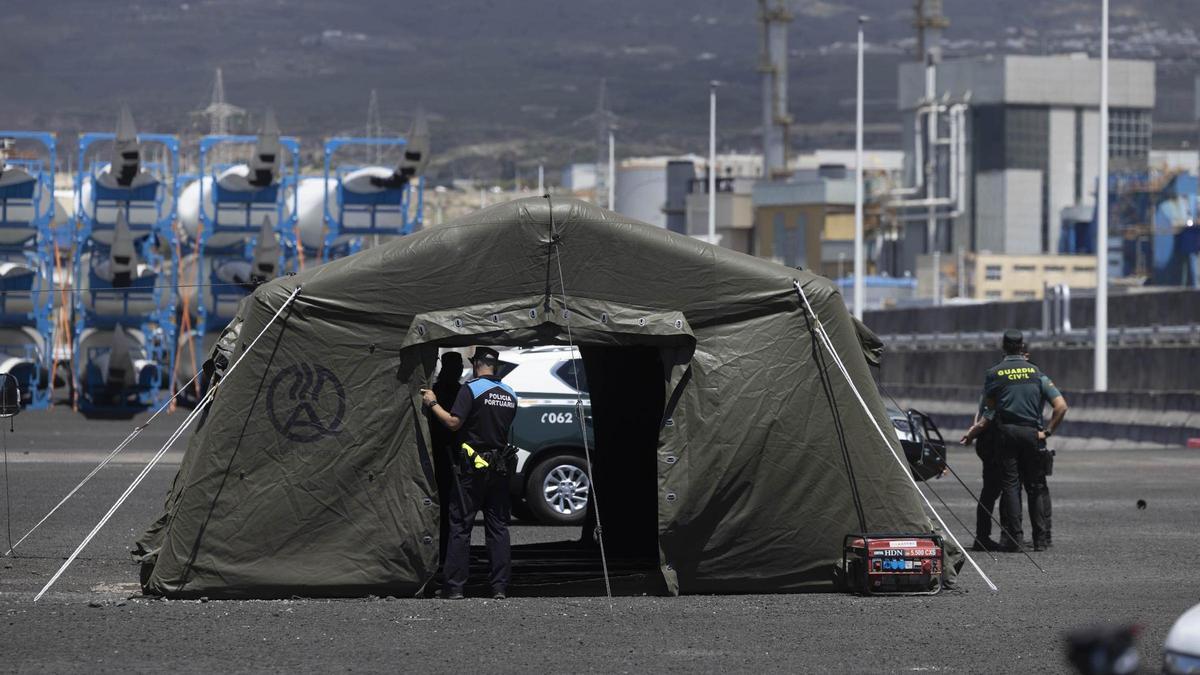
The planned operation envisages the cruise ship anchoring inside the port of Granadilla, in the area considered “safest” by the Port Authority and the Maritime Captaincy for carrying out the operation. From there, a staggered disembarkation will begin using small Zodiac-type boats. Virginia Barcones explained that passengers will only leave the ship when the aircraft assigned to each nationality is ready for take-off from Tenerife South Airport. Once on land, passengers will be transported directly by coach to the airport runway to board their respective flights to their home countries.
The Secretary-General for Civil Protection insisted on several occasions that there will be no contact whatsoever with the civilian population. “All the areas through which they will transit will be isolated,” she stated, while emphasising that only authorised personnel equipped with “the highest standards of protection” will participate in the operation to guarantee safety.
International repatriation effort for 23 nationalities
The government is also working with different international scenarios to organise the repatriation of passengers from 23 nationalities. Germany, France, Greece, the Netherlands and Turkey have already indicated their willingness to provide air transport, while Belgium, Ireland and Sweden would use the European civil protection mechanism. Meanwhile, the United States, the United Kingdom and Canada are also preparing their own flights to evacuate their citizens. Spanish authorities have additionally requested medicalised aircraft and medical protection equipment to respond to any possible contingency during the operation.
Barcones also assured that Spain is working “with every possible scenario,” including potential weather changes, and confirmed that the State Meteorological Agency (Aemet) is preparing specific bulletins to monitor the situation at the port and airport in advance.
Precautionary hospitalisation in Alicante
The main health development of the day occurred in Alicante, where a 32-year-old woman was admitted as a precaution after having been on the same flight as one of the cruise passengers who later died in South Africa. The patient has mild respiratory symptoms and remains isolated in a negative pressure room while awaiting the results of a PCR test sent to the National Centre for Microbiology. Padilla stressed, however, that this is considered a “quite unlikely” case, as the woman was travelling two rows behind the infected passenger and the contact was brief, reducing the chances of transmission.
In addition, health authorities are trying to locate another South African individual who was also on that flight and subsequently spent several days in Barcelona before returning to their home country. The authorities are maintaining contact tracing and monitoring protocols.
Official protocol approved for passenger management
The Ministry of Health also approved yesterday, together with the autonomous communities, the official protocol for managing passengers arriving from the MV Hondius. The document stipulates that Spanish passengers will be transferred to the Gómez Ulla Hospital in Madrid, where they will undergo a PCR test at the start of quarantine and again seven days later. The protocol also includes temperature checks twice daily, active symptom surveillance, and specific mental health monitoring and emotional support for those in isolation. Should any passenger develop symptoms compatible with hantavirus, they will be immediately transferred to a negative pressure isolation room and the high-level isolation network will be activated.
What’s happening in the Canaries – straight to your phone
News, weather alerts and practical updates – direct from the islands, in English. We live here and know what’s going on – before the international media catch up. Everything lands on our WhatsApp channel – no middlemen, no algorithm. Curated for families, expats and travelers.

Rain alert declared for El Hierro as La Palma stays on pre-alert

Wednesday: showers and unstable air across the Islands

Tuesday: heavy showers and storms in El Hierro

El Hierro issued yellow warning for heavy rain

Monday: autumn showers and a cooler feel

Sunday: scattered clouds and showers on the islands

Saturday: cooler air and clearing Saharan dust

Canary Islands weather: rain and storms on the way

Friday: summer heat before an autumnal weekend
