Compiled with the help of artificial intelligence, based on Spanish-language information. Source below the article.
Thousands take to the streets of Las Palmas against evictions and mass tourism
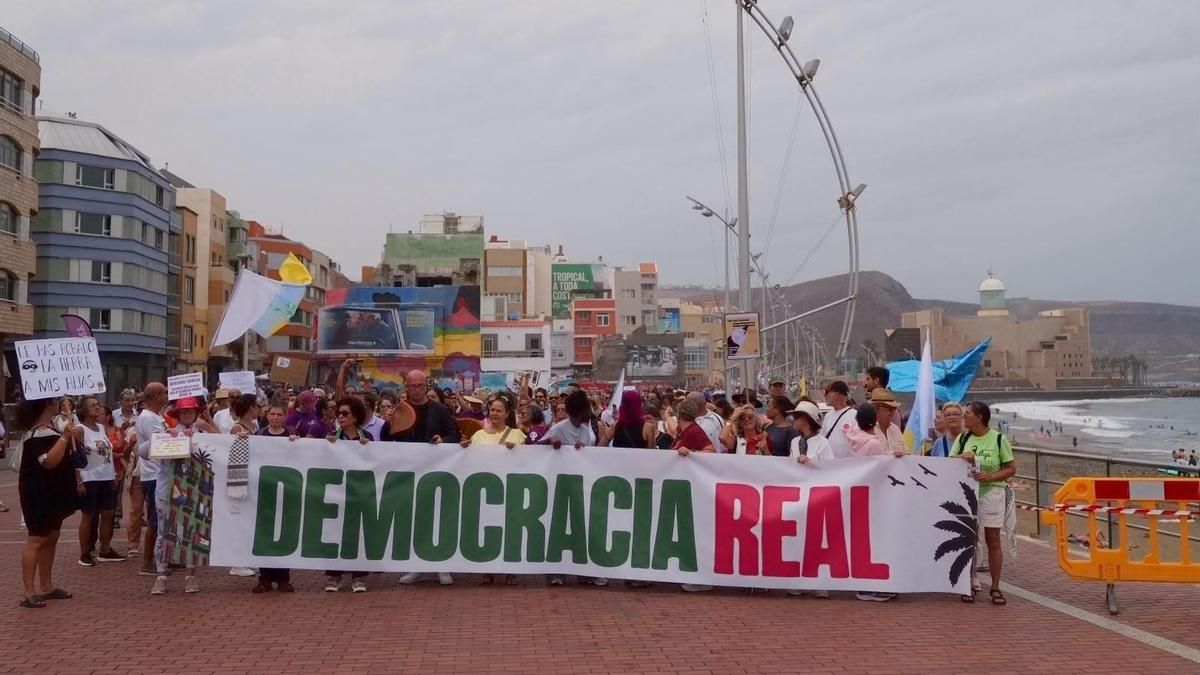
The citizens’ protest for a real democracy and against evictions in Las Palmas de Gran Canaria began on time. From the Auditorio Alfredo Kraus, and despite the fierce heat trapped under the “donkey’s belly” cloud over Las Canteras, more than 10,000 people — according to the organisers, 2,500 according to the National Police — marched along the avenue, telling one another that all is not lost. The demonstration, backed by more than 12,000 citizens’ signatures, brought together individuals and groups from a range of social, trade union and civic backgrounds, united in defence of a society in which people’s lives and needs come before economic interests.
Palestine, Western Sahara and a new symbol: keys against speculation
It was a struggle of all struggles: flags for Palestine and Western Sahara, banners against mass tourism and, above all, a new symbol — keys waved against urban speculation and evictions, accompanied by many affectionate words for Maricarmen, the 87-year-old woman evicted this week in Madrid.
Tita is a forest firefighter and told this newspaper that what drove her to take to the streets this Saturday was “everything that is happening”. She is concerned about the genocide in Palestine and the structural problem of housing: “Evictions have been happening for a long time and we have a problem with rental prices in relation to how poor our wages are. Then, when you can’t pay, they evict you,” she explains.
For Manuel, who wears braces in the colours of the republican flag, the struggle is not a question of age. He came out today to defend hard-won rights and democracy, and did so alongside his friend Armando. “We were both tortured under Franco in Soria prison,” he confesses, putting his arm around his comrade. “We risk returning to dark times.”
Madai, 30, is not suffocated by paying rent because she shares a flat. “I know people who pay exorbitant prices,” she tells Canarias Ahora. “I hope that with this demonstration we really see a change and that evictions really stop.”
Chants, a minute’s silence and echoes of the 15M movement
The march proceeded amid chants such as “Ayuso’s flat for Maricarmen”, “they bail out bankers and evict workers” and “no human being is illegal”. It genuinely felt as though the odd one out was anyone not at the protest, even if they were on holiday. Tourists and passers-by stepped aside as the demonstrators passed, and many people leaned out from their privileged front-row view of Las Canteras.
With echoes of the 15M movement and even more anger in the air, in a protest that united all causes, the crowd was greeted by “Bella Ciao” in Parque de Santa Catalina, where various manifestos were to be read out. A minute’s silence was also observed for those who have taken their own lives after being evicted, for women who are victims of gender-based violence and for the migrant lives lost at sea.
The journalist Herminia Fajardo opened the round of speeches, paying tribute at the outset to the struggle of women and recalling the words of Simone de Beauvoir: “Never forget that a political, economic or religious crisis will be enough for women’s rights to be called into question once again. These rights are never definitively won; you must remain vigilant all your lives.”
Demands for public services, migrants’ rights and an end to discrimination
The demonstrations also condemned racism, xenophobia and discrimination against LGTBIQ+ people, while calling for strong public services, fair working conditions and a society without exclusion. The manifestos read out set out the demands of the participating groups, which agreed on the need to strengthen protection of the common good in the face of inequality, the erosion of rights and the growing precariousness of living conditions.
The activist Koldobi Velasco called for “radical tenderness in the face of violence”. Sofía, from Derecho al Techo (Right to a Roof), recalled that precariousness kills and that “we need to reclaim our neighbourhoods and demand that the ‘desocupa’ groups, the property squatters, be made illegal”. Among other representatives of the groups, Leonora Angono, of Regularización Ya, also took the floor, asserting history as an element of struggle. “History explains why we migrants are here. Europeans did not arrive in Africa asking for visas and respecting our sovereignty. They came to our territory, seized our resources and subjected millions of people to slavery, torture and violence.”
Finally, a voice was heard in the square: “We’re finishing for today, but the street is ours.” Minutes later, the sound equipment was being packed away and people were returning to their routines with the feeling of having seen a seed begin to flower.
What’s happening in the Canaries – straight to your phone
News, weather alerts and practical updates – direct from the islands, in English. We live here and know what’s going on – before the international media catch up. Everything lands on our WhatsApp channel – no middlemen, no algorithm. Curated for families, expats and travelers.
Canary Islands banana prices finally rise after summer crisis

Police exam scandal reaches Canary Islands Parliament
Gran Canaria woman, 87, finally owns El Lasso home
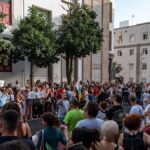
Tenerife eviction halted after mass protest in Santa Cruz

Canary Islands defy national slump as property sales rise 2.1%

Family demands probe into Fuerteventura demolition operation
Canary Islands: Tourists Now Outnumber Residents

NC-BC proposes seizing empty homes for affordable rent
El Médano residents revolt against council failures