Compiled with the help of artificial intelligence, based on Spanish-language information. Source below the article.
Spanish astronaut says it is too early for a Spaniard on the Moon
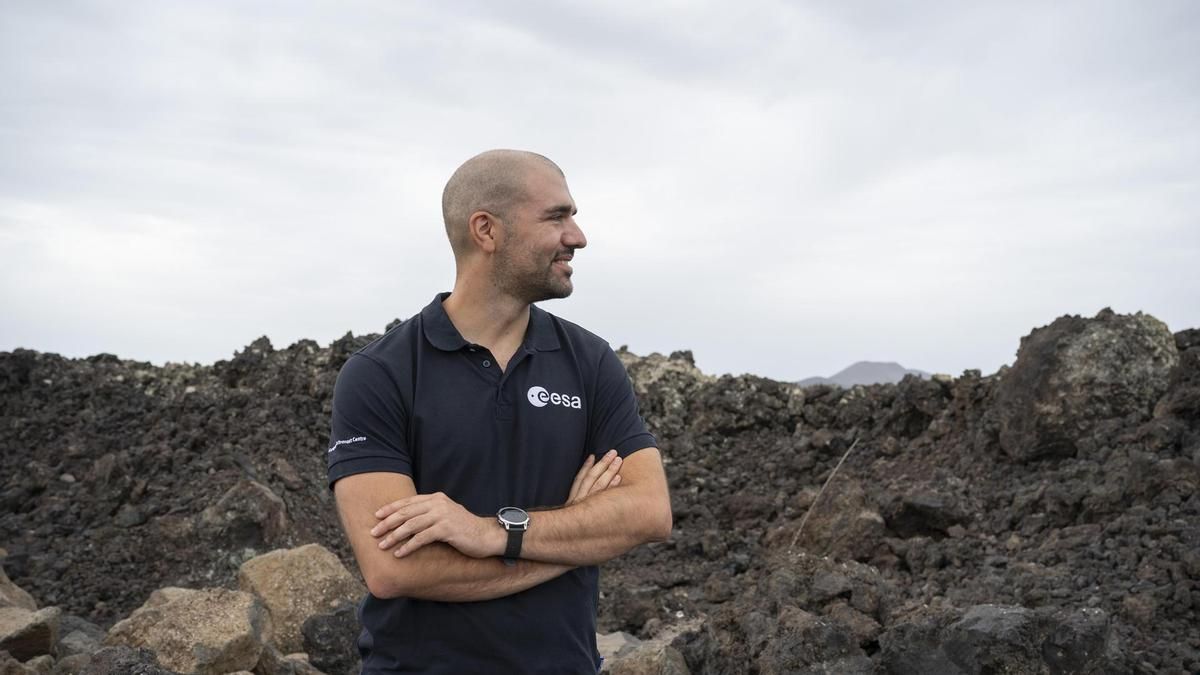
Pablo Álvarez, the Spanish astronaut from the European Space Agency (ESA) who is completing three weeks of training in Lanzarote, believes it is still too early to see a Spaniard set foot on the Moon, as there is still a great deal of work to be done before that becomes possible. He made the comments on Saturday.
Álvarez appeared before the media at the Parque Natural de los Volcanes alongside Loredana Bessone, the project lead; Oswaldo Betancort, president of the Cabildo of Lanzarote and La Graciosa; and Samuel Martín, the island councillor for Geopark, Biosphere Reserve and Environment.
Hopes of reaching the International Space Station before 2030
The astronaut hopes to make his first trip beyond the planet, to the International Space Station, before 2030, the date from which a return mission to the Moon is being considered. However, he has no expectations of featuring in that mission. “They are not going to let a rookie astronaut go to the Moon first,” he said, while refusing to give up on the dream of going one day.
“I am going to keep preparing and giving everything I have to train and be as ready as possible so that, perhaps, I might have that opportunity in the future,” said Álvarez, who has been an astronaut for four years, although this is the first time he has undertaken this type of training.
Learning to read Lanzarote’s volcanic landscape
In Lanzarote, in a volcanic setting, astronauts learn to interpret lava units and the different volcanic events. “Training like this changes the way you see your surroundings. Where I used to see a mountain, I now see a volcano with different events that have occurred over time,” he stressed.
Speaking about the island, he highlighted the good conservation of some “immaculate” spaces, with a landscape that was frozen after the eruptions, something that can only be achieved in a place as special as Lanzarote, “very arid and without the influence of other erosive environments,” he said. “Lanzarote is the best place in the world to learn what the future mission to the Moon will be like,” he added.
Speaking the same language as scientists
The main aim of this geological training is to learn to understand the volcanic environment and the language used by geologists and scientists. “As astronauts, we have to learn many things — biology, mechanics, engineering — but it is important to speak the same language as the scientists, because we are their hands and their eyes in space,” said Álvarez.
The astronauts have carried out several journeys in different areas of the island, in which they had to identify features of the terrain, such as rocks, materials, eruptions and different volcanic formations.
Keeping his feet on the ground
Asked how he imagines his first spaceflight, he said it is very easy to live thinking about the future, but that he always tries to keep his feet on the ground and remember that life happens today, enjoying every training session and every small step. “We have so many simulations and so many rehearsals that I almost imagine it as just another day in the office,” he added.
He also noted that the goal is for all the astronauts of his generation to fly before 2030, and that the Artemis III mission will prepare the equipment and operations needed so that Artemis IV can return to the Moon, which no human has walked on since 1972. “Space exploration remains tremendously complicated. The further we go into the solar system, the more complex it will be, and we really do not know when we are going to achieve it. Step by step, all the bricks make a wall, but there is a lot of wall still to build,” said the Spanish astronaut.
Ten years of Pangaea training in Lanzarote
For her part, Loredana Bessone, head of the Pangaea project, which has also been developed in Italy and Germany, highlighted that this training has now been taking place in Lanzarote for ten years, with the astronaut and former minister Pedro Duque taking part in the first edition. “We have been coming to Lanzarote for 10 years and 30 astronauts have passed through here. I am sure that one of them, before too long, will be on the Moon and will directly apply the knowledge we have acquired here in Lanzarote to lunar exploration,” she concluded.
What’s happening in the Canaries – straight to your phone
News, weather alerts and practical updates – direct from the islands, in English. We live here and know what’s going on – before the international media catch up. Everything lands on our WhatsApp channel – no middlemen, no algorithm. Curated for families, expats and travelers.

Tivoli La Caleta hosts first red tuna Kaitai in Canarias
La Laja natural pools reopen in Las Palmas
Canary Islands hotel prices rise 6.08% in August
Canary Islands hotel prices almost double since 2008
La Oliva bans quad and buggy firms from eight rural paths

CC Tenerife calls for population cap but avoids tourism moratorium
Canary Islands cruise tourism set for 18% growth

Guachinche David: Traditional Canarian food in Santa Úrsula
Tenerife named best European island for 2026 travel