Compiled with the help of artificial intelligence, based on Spanish-language information. Source below the article.
Canary Islands banana prices begin recovery after summer of losses
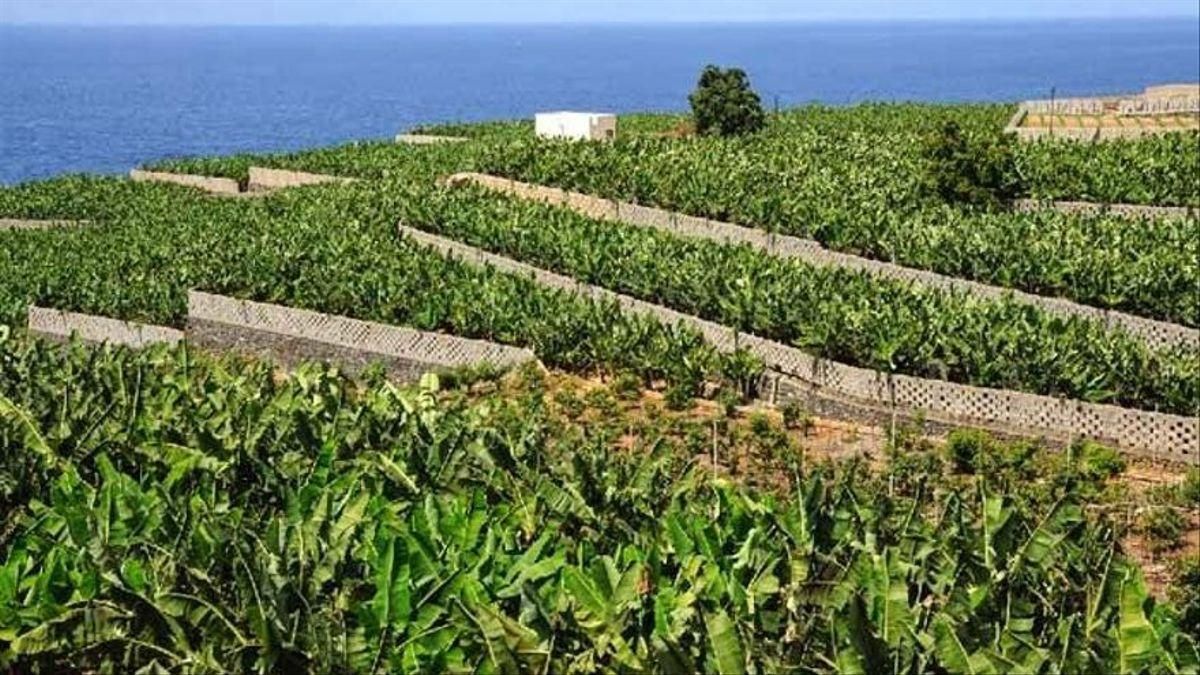
The recovery in the farm-gate price – what Canary Islands growers receive for selling their bananas on the Spanish mainland – is not yet complete, but the gains recorded in markets across the rest of Spain in week 38, from 14 to 20 September, clearly point to an exit from the deepest part of the crisis that has hit wholesale and green prices for the archipelago’s principal export fruit. The situation of ruinous average prices received by island growers for more than two and a half months – the so-called sale at a loss (well below average on-farm production costs of between 0.80 and 0.90 euros per kilo, pending further updates) – began abruptly in early July and is still ongoing. However, that trend now appears to be receding, with the upward movement clearly evident in week 38, leading to expectations that the farm-gate price will reach more satisfactory levels in the coming weeks.
The usual summer crisis now finally seems to be becoming recent history, although it is still too early to celebrate. In week 38, which provides the most recent data available through Spain’s Ministry of Agriculture, Fisheries and Food (MAPA), the farm-gate price of Canary Islands bananas – the money that ends up in the local producer’s pocket before covering agricultural costs and without counting the Posei subsidy (0.32 euros per kilo paid according to a historical production reference for the holdings) – stood at 0.52 euros per kilo. That represents a rise of 62% compared with week 37, which recorded the worst value of the year at 0.3214 euros, and an absolute increase in the variable under analysis of no less than 0.20 euros.
Payments to growers during the summer crisis
To gain a more precise idea of the payments made by some cooperatives to their farmers during this ruinous summer for bananas – another one with no solutions in sight – we can look at what happened with the La Palma entity Cupalma, now integrated into the OPP Unión Platanera Canaria, a public limited company, and previously part of the OPP Cupalma, a cooperative. That La Palma marketing entity, in week 31 (the last week of July and the most recent month with sales settlements), paid growers just 0.38 euros per kilo for their highest-quality fruit, known as Boutique. From there downwards, it paid 0.10 and 0.05 euros for its second-best categories, extra and first quality. It is worth recalling that on-farm production costs stand at between 0.80 and 0.90 euros per kilo (pending upward revision), with direct aid per kilo, the Posei subsidy, of 0.32 euros. Add up the income and subtract the costs, and the substantial losses during the summer weeks become clear.
Clearing old stock and the arrival of new fruit
Following that surge in mid-September, which is linked to the clearing of old fruit up to week 37 (a boom in cut-price offers on supermarket shelves) in the mainland market and the full reactivation of demand after the disastrous summer months – the aforementioned return to normality – the hope now is simply that the increase is sustained over time so that remunerative market values can gradually be reached for island banana growers, with average farm-gate prices above 0.80-0.90 euros per kilo. In week 37, the Canary Islands shipped 6.6 million kilos to the mainland, while the forecast for the period from 14 to 20 September, week 38, was set at almost seven million, exactly 6.89 million. In the coming weeks, the volume shipped to the islands’ almost sole market – the rest of Spain – will remain at around seven million kilos.
Change of trend and comparison with previous years
The positive change in trend in average wholesale and green prices in week 38, which are first-transaction values for higher qualities, brings a clear upward shift in the curve recording that variable by week. The task now is for that evolution to consolidate so that the Canary Islands can soon leave behind the agricultural losses – borne solely by local producers – caused by the dramatic fall in fruit prices over the past two and a half months, a situation worse than in 2025 and somewhat better, especially for August, than in 2024. The start of this summer crisis in farm-gate prices – what returns to the local farmer – occurred this year in week 27, the first week of July. More than two and a half months have passed and there is still some way to go before reaching the optimum level already mentioned, with returns to growers that cover their on-farm costs and even allow profitability in the crop before access to the European Posei subsidy.
What’s happening in the Canaries – straight to your phone
News, weather alerts and practical updates – direct from the islands, in English. We live here and know what’s going on – before the international media catch up. Everything lands on our WhatsApp channel – no middlemen, no algorithm. Curated for families, expats and travelers.

Mass protest in Las Palmas against evictions and overtourism

Police exam scandal reaches Canary Islands Parliament

Gran Canaria woman, 87, finally owns El Lasso home

Tenerife eviction halted after mass protest in Santa Cruz

Canary Islands defy national slump as property sales rise 2.1%

Family demands probe into Fuerteventura demolition operation

Canary Islands: Tourists Now Outnumber Residents

NC-BC proposes seizing empty homes for affordable rent
El Médano residents revolt against council failures