
Project Aims to Solve Historic Bottleneck
The Ministry of Public Works, Infrastructure, Architecture and Housing of the Cabildo of Gran Canaria, led by Augusto Hidalgo, has completed the so-called ‘Bridge Widening and Miraflor Crossing Improvement Project’ on the GC-21. This plan, agreed with Teror Town Council, aims to eliminate the bottleneck caused by the century-old bridge carrying the Teror road and to resolve safety issues for both traffic and pedestrians at this crossing. Yesterday, Augusto Hidalgo and the Mayor of Teror, José Agustín Arencibia, presented the details of a project that was also shown to residents of this neighbourhood in the ‘Villa Mariana’. The event was also attended by Teror’s Deputy Mayor, Sergio Nuez, and the Councillor for Roads and Works, Laura Quintana.
Respecting Heritage While Improving Functionality
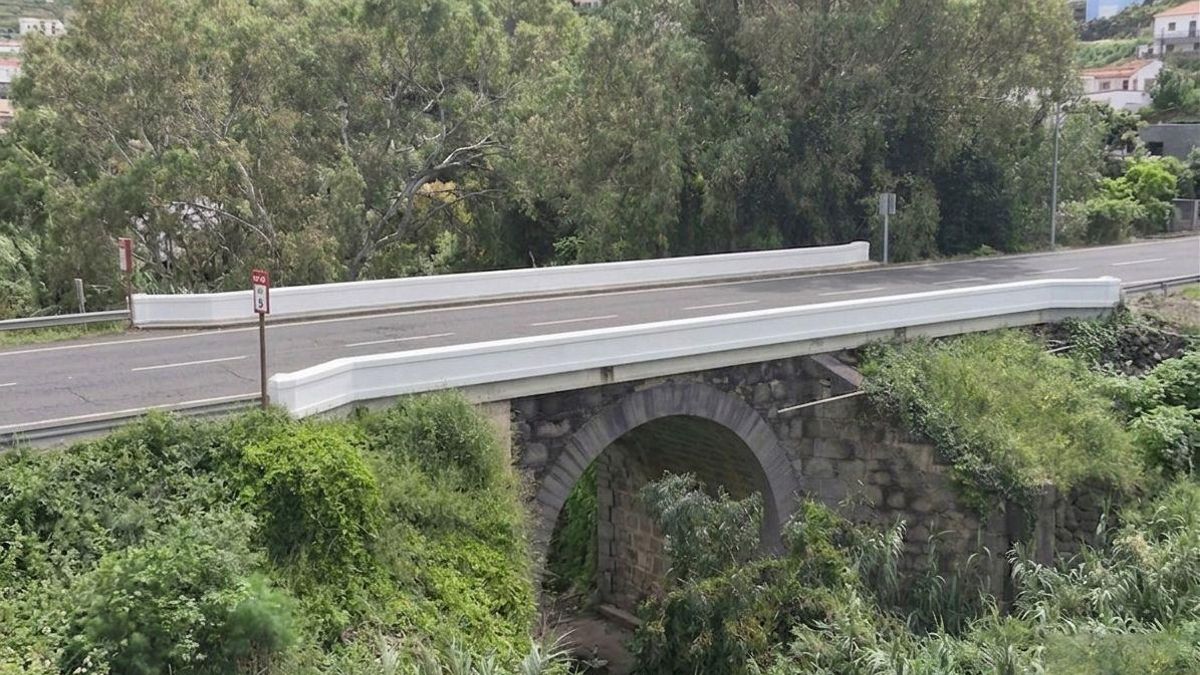
The Cabildo’s Public Works service has proposed a new alternative that provides better functionality for the GC-21 crossing while respecting historical heritage by leaving the century-old Miraflor bridge intact. The Cabildo highlights that this is a section which generates some conflict due to the narrowness and age of the bridge, and for which Teror Town Council had long been requesting improvements. The project focuses on the stretch between kilometres 7.4 and 8 of the GC-21 road, where it passes through the Miraflor neighbourhood. This approximately 600-metre section has serious problems due to its narrowness, as the ravine is crossed by a very old bridge that has become too small for a road of this importance, which also fails to meet current accessibility and safety needs.
Structural Rehabilitation and Traffic Calming
Located here is the historic Miraflor Bridge, a stone structure about five metres wide, insufficient for safe traffic flow and vulnerable due to its age and traditional construction methods. This project seeks to achieve several objectives. The first is the structural rehabilitation of the bridge, which will also involve an improvement to the road’s cross-section. Furthermore, the road margins will be urbanised and access to adjacent plots and houses will be adapted. Finally, the plan is to implement traffic calming measures, improve pedestrian accessibility and public transport, and condition the drainage of the ravine.
How the Bridge Will Be Safely Widened
For the structural rehabilitation of the bridge, the plan is to widen the carriageway over 55 metres to nine metres in width, four more than at present. The widening will be executed entirely via an independent structure to protect the historic masonry work. The resulting platform will be nine metres wide, composed of six metres of carriageway—allowing two cars to pass without problem—and a 1.5-metre hard shoulder to provide continuity for the pedestrian route, protected from traffic by bollards. Additionally, the new structure over the bridge will be finished with special stone-clad railings, harmonising with the current aesthetics of the historic bridge.
To achieve this widening of a historic bridge of great heritage value like Miraflor’s without affecting or damaging its structure, the plan is to construct two abutments using micropiles at both ends of the road before crossing it. The new concrete structure will be placed on these, bearing all the weight and wear from passing vehicles without those loads being transmitted to the century-old construction.
Completing the Upgrade of a Key Pilgrimage Route
Along the rest of the crossing, in addition to widening the carriageway and creating a pedestrian route, seven new pedestrian crossings will be installed, existing bus stops will be improved, and a parking area will be set up near the junction with the road leading to Hornillo, Lo Blanco and San José del Álamo. As Augusto Hidalgo stated, this project addresses the only section of the Teror Road that had not been widened or improved during the 2021 works. “In this way, we complete the upgrade of a route used daily by nearly 8,000 vehicles and of special importance also for pilgrims walking up to the Basilica of the Virgin of the Pine. With the project presented today, we gain space for both cars and pedestrians, guaranteeing the continuity of the pedestrian route already set up in 2021 but which does not exist in this Miraflor section,” assured the Cabildo Vice President.
For his part, Mayor Arencibia valued the solutions this project offers to residents’ long-standing demands. “This is a project we have been working on for years together with the Cabildo of Gran Canaria’s Ministry of Public Works, which I publicly thank for the commitment they have shown over these years to address, without a doubt, a historic demand from residents to recover safety on that very important stretch of Miraflor, not only for vehicles but also for all the pilgrims who come to Teror every weekend and during our ‘Fiestas del Pino’,” highlighted the mayor.
Timeline and Linked Road Works
The Cabildo Vice President, Augusto Hidalgo, also reported that the Public Works Service, having finished drafting the project, is already processing the expropriation of some 40 plots (not buildings) necessary to carry out the carriageway widening. The goal is to finalise this task by the end of the year, after which works valued at €3,171,424 will be put out to tender. These could begin in just over a year and a half, with an execution period of 20 months.
The minister added that Public Works is also about to tender a project to modernise and improve the San José del Álamo road (GC-211), which could begin at the end of this year and will involve an investment of another €3.5 million. This route will play an important role when work begins on the GC-21 in Miraflor. “With the bridge works, it will be necessary to close the Teror road to traffic for four or five months, and the natural alternative will be to divert traffic via the GC-211. Therefore, we will start the improvement works on that San José del Álamo road earlier and finish them just when work begins on the GC-21, to provide a safe and appropriate passage for vehicles going to or coming from Teror,” concluded Hidalgo.

Vueling plane lands with landing gear fault at Los Rodeos

Ferry contract to Canary Islands declared void

Bomb threat on Vueling flight triggers Gran Canaria airport security operation

Cruise to Canaries cancelled after collision in port

Tenerife tram delays worsen amid staff shortages

Titsa adjusts night bus times for clock change on Tenerife

Night roadworks to disrupt TF-1 traffic from Sunday

Public service obligation for Canary inter-island flights announced

Iberia accused of ejecting passengers from paid seats
